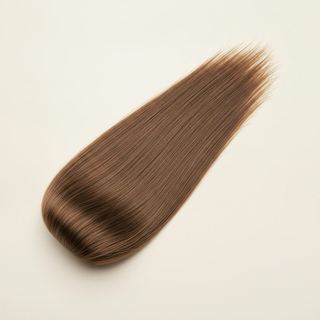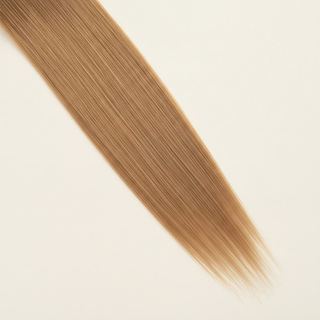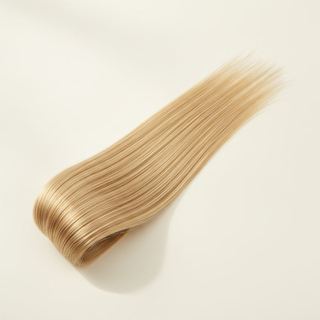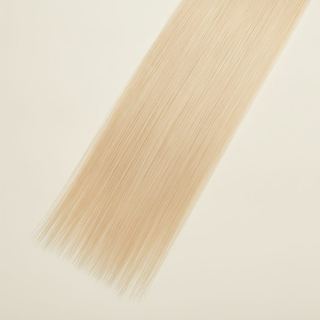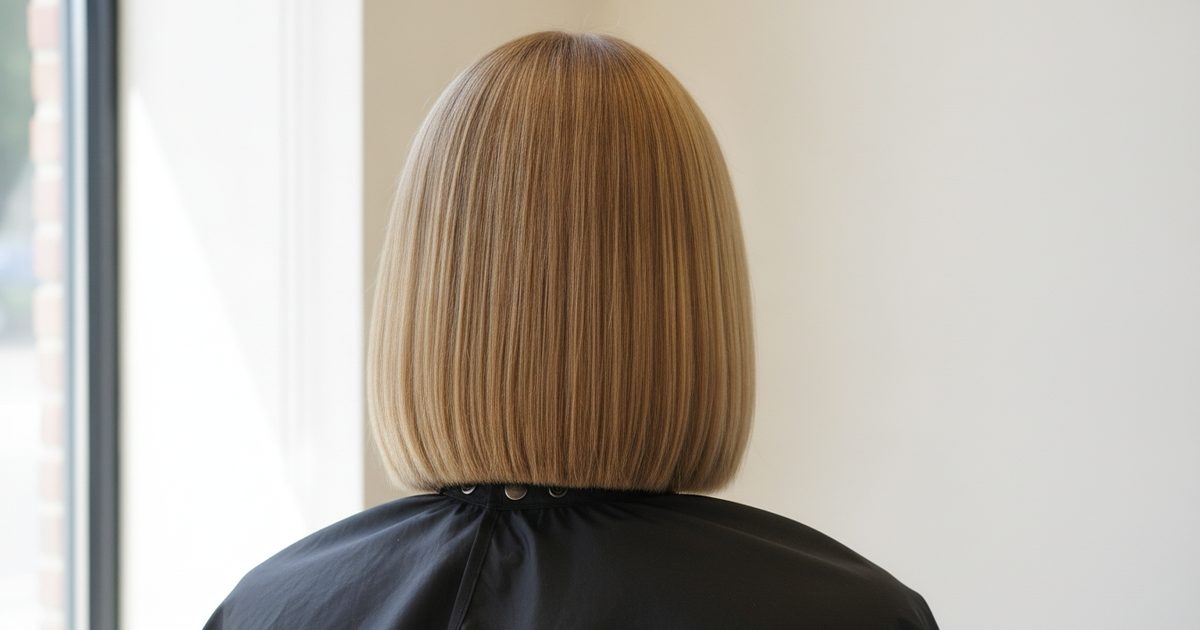
Seven is where a lifted brunette stops. A level 4 on 30 volume climbs three levels and lands here, a 5 on 20 volume lands here, and the yellow-orange the hair shows at the rinse is the strongest warmth in the whole sequence, which is why the word people use for a fresh 7 is brassy. As a natural color it is medium blonde, warm sand, one step above dark blonde and one below light blonde, and the level chart puts it beside the other nine. Read it at the root, dry, in daylight, and read the lifted lengths as a second number, because a head can be a natural 5 at the scalp and a lifted 7 below it and the two want different bowls.
Getting to 7
Sessions assume healthy, uncolored hair and a test strand from the back.
| Starting level | Distance | What does it | Sessions | On the way |
|---|---|---|---|---|
| 3, dark brown | 4 levels of lift | High-lift, 40 vol, virgin hair only; otherwise bleach | 1 high-lift; bleach in one visit, a second round if it stalls | Red, red-orange, orange, then yellow-orange |
| 4, medium brown | 3 levels of lift | 30 vol permanent, or high-lift with 40 vol on virgin hair | 1 | Red-orange, orange by 25 minutes, then yellow-orange |
| 5, light brown | 2 levels of lift | 20 vol permanent (30 vol on coarse, resistant hair) | 1 | Orange-red, orange, then yellow-orange |
| 6, dark blonde | 1 level of lift | 20 vol permanent | 1 | Orange briefly, then yellow-orange |
| 9, very light blonde | 2 levels darker | 10 vol demi or 20 vol permanent, in a warm shade (7N or 7.3) | 1 | Pale yellow takes color fast, ends first |
| 10, lightest blonde | 3 levels darker | Fill with a warm shade, then deposit the 7 on 10 vol | 1, two steps | The fill goes apricot; the 7 over it reads sand |
The lift rows assume natural pigment. Color does not lift color: a level 4 that came out of a box will not move under 30 or 40 vol, so the regrowth climbs to 7 and the lengths stay a 4, and that head needs a color remover or bleach from the start. Hair lightened to 9 or 10 has the reverse problem. It has lost the yellow-orange a natural 7 carries, and a 7.1 laid straight onto it goes flat and gray-green at the ends, so from 9 the warmth in a 7N or 7.3 is usually enough and from 10 the hair wants an orange-gold filler first.
Why 7 stalls, and why it stalls orange
By level 6 most of the brown pigment is gone and the hair shows clean orange. At 7 the orange has begun to thin toward yellow, and the mix reads as a saturated yellow-orange, gold in kind light and brass in the rest. Permanent color has done its lifting by this point: after three levels the peroxide is spent, so a 4 on 30 volume arrives at 7 around the thirty-minute mark and sits there whatever the timer says, and the extra quarter hour warms the scalp and moves nothing. Orange at this stage is normal. It is the middle of the lift, and every brown head does it.
Lifting through 7 is bleach work. The orange keeps thinning, and by level 8 the hair shows plain yellow, the first stage a blonde toner handles cleanly. Bleach on the scalp stays at 20 vol, a bond builder goes in the bowl, and the hair gets a cap or a bag to hold its own warmth with no dryer over it. A second box of permanent color changes nothing at 7, since it cannot lift its own deposit.
7.1, 7.12 and 7N on lifted hair
The neutralizer for yellow-orange is blue-violet, blue for the orange half and violet for the yellow half, straight across the wheel. The shades at 7, with the US letters beside the decimals:
- 7N, natural. On lifted hair it softens the warmth without canceling it, a warm sandy blonde. In some demi lines the N carries a soft violet-blue and does more than the name suggests.
- 7.1 (7A), ash, blue-based. Cancels the orange, leaves a trace of yellow, and reads as a cool dark ash blonde, what most clients mean by mousy.
- 7.12 (7VB), ash-violet or ash-iridescent. Blue and violet together, the closest match to the pigment, and the best a 7 looks without more lift.
- 7.3 (7G), gold. Adds yellow to the yellow-orange and reads as honey.
- 7.4, copper. Adds orange, reads as soft copper blonde, and hides uneven lift better than anything cool.
Cool reads darker. Ash absorbs light where gold reflects it, so a 7A on an orange 7 can dry looking like a 6 or a 5, and colorists split on what to do about that. Some go a level lighter with the ash, an 8A, because it settles back at 7 once it has done its canceling, and some go a level darker when the orange is heavy, because a light ash does nothing to it. None of them tones lighter than the hair and expects lift, since a toner deposits. Over-neutralizing is easy here too: a 7.12 on hair that has drifted toward 8 carries more blue-violet than there is orange to cancel, and the surplus shows as khaki at the root and gray-green at the ends. Any of these goes on 10 vol, or on the 5 to 9 vol toning developer most lines now sell as processing solution or activator, for 10 to 20 minutes on towel-dried hair, and the toner selector narrows the family from the warmth in front of you. Purple shampoo afterward maintains what the toner did. On its own it will not touch orange.
What a natural 7 looks like at the chair
A natural 7 is mostly a childhood color. The adults who still call themselves blonde are usually a 5 or 6 at the root with ends the sun has lifted back to 7, and the root is the number that goes on the ticket. Gray on a 7 hardly contrasts, so a head can be 30 percent white and read across a room as a slightly ashier blonde, and the complaint arrives as “it has gone flat” before anyone says the word gray.
Covering gray at 7
A 7 covers on 20 vol, natural share by the percentage of white: a quarter of 7N up to 25 percent, half to 50, three quarters to 75, 7N or 7NN alone from 80 up. Something natural has to be in the bowl, because coverage is built from warmth, and a 7.1 on heavy white has nothing to cancel and comes out flat, sometimes faintly green. On white hair 7N reads as a soft sandy blonde, sheerer than a 5N and far more solid than an 8, where coverage begins to turn translucent. Start where the white is, usually the hairline and the top, so that section gets the longest time, and give resistant white 45 minutes. Before the rinse, push the cream back on the grayest section with the tail of the comb. If the hair under it still looks translucent, it gets ten more minutes, and the gray coverage calculator turns the percentage into grams for the next visit.