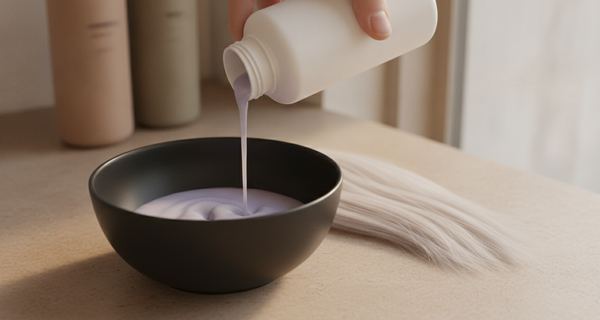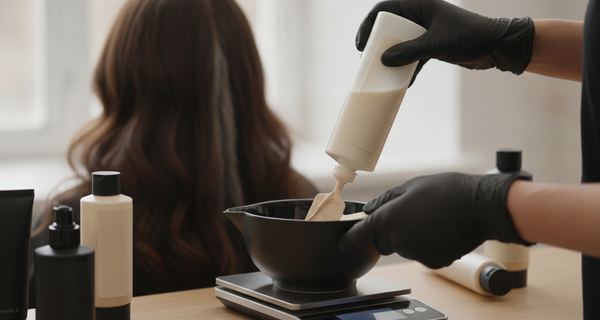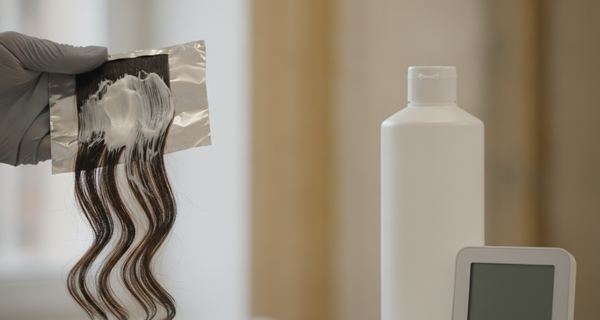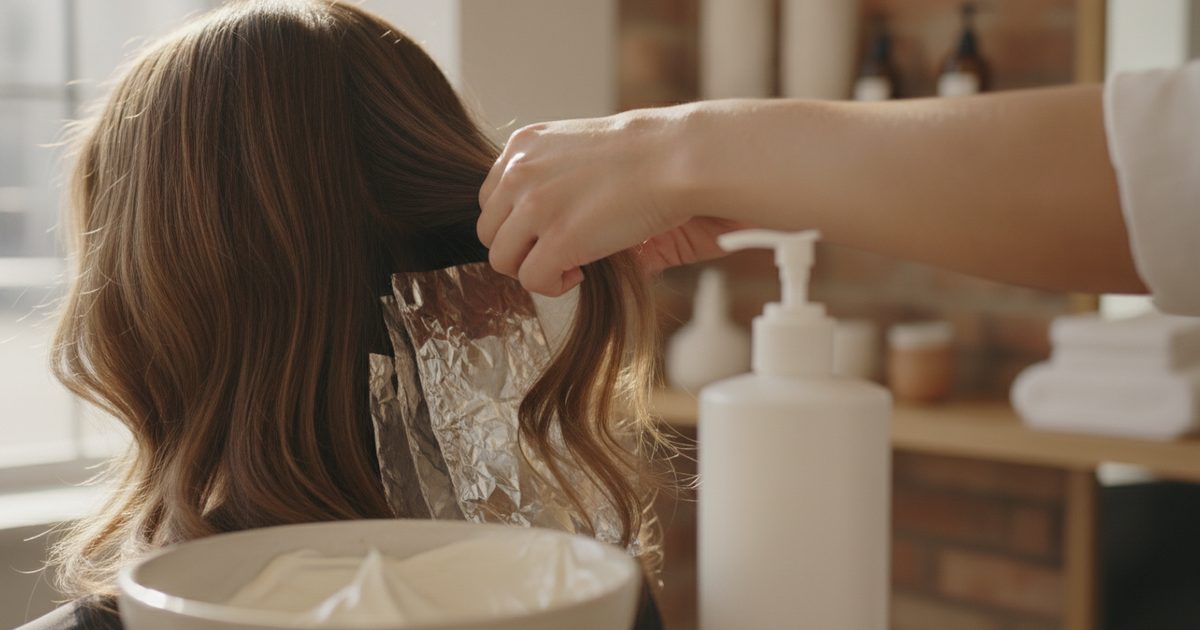
Wet a strand at the nape and pull it between two fingers. Hair that wants 30 volume feels glassy and slick, takes an age to wet through and dries fast at the ends because the water never got in. That is coarse, resistant hair, the cuticle thick and lying flat, and it is the head that takes one level on 20 vol in the brand’s time and then sits there. Thirty is 9 percent hydrogen peroxide. It lifts two to three levels with permanent color on healthy, uncolored hair, runs the same 30 to 45 minutes as 20 vol, and puts out more heat on the skin, which is why most colorists keep it for foils and for the heads that need it.
Off the scalp, mostly
Most of the trade keeps anything over 20 off the scalp with lightener, and a good number keep 30 off the scalp with color too, because body heat speeds it up and the skin takes the peroxide along with the hair. A whole head of 30 on the scalp tends to itch by minute 20 and a few scalps blister. One very well-known colorist calls 30 his standard on everybody, scalp included, and says he has never had a problem, so this is a place where colorists disagree and you will hear both. What I do is put 30 on the bands that need it, a coarse regrowth or a stalled patch, mix 20 for the rest of the head, and apply the 30 as cream, roots last, with gloves on. No dryer over any of it. Body heat is already doing more than people think.
The day 20 stalls
Thirty-five minutes in, a natural 4 with a 6.3 mixed on 20 has moved the roots to a 5 and stopped, and the lengths are red-orange under the cream and going nowhere. More time does nothing here. The peroxide in that bowl has done its work, and the color at 45 minutes is the color at 60 with more damage. A fresh bowl of the same shade on 30, on the bands that stalled and nowhere else, for the brand’s time, moves them the rest of the way. Then a line on the record card so that next time the 30 goes on from minute zero, because the choice belonged there. A stall is nearly always a band at the back, where the hair is coarsest and the head runs coolest, and the client finds it in a hand mirror before you do.
Three levels with color
Three levels is the top of what permanent color on 30 does on healthy, uncolored hair. A 4 to a 7 or a 5 to an 8 arrives warm, because three levels of lift exposes the pigment under the level you started at, and the level chart shows that pigment at each rung. The level 4 page says it plainly: 20 vol reaches a 6, a 7 needs 30. Plan the toner before the color is mixed. A 4 lifted three levels sits at a 7 with yellow-orange under it, and the ash gloss on 10 vol afterward goes on the ticket at booking. Four levels is past 30 with a regular tube. That is a high-lift series or lightener.
Foils on 30
Lightener in foils is the other job. The foil keeps the mix off the skin and holds heat in, so 30 vol lightener lifts cleanly inside it in the brand’s time, and the processing time calculator treats a foil and the scalp as two different jobs for that reason. Mix at 1:2 unless the tub says otherwise, an ounce of powder to two of developer or one scoop to two, the same scoop for both parts, in a plastic bowl, and the developer mix calculator scales that to however many foils you are doing. Saturate the strand inside the foil, because thin lightener lifts in spots. Check every ten minutes and rinse the first foil that goes pale yellow. With lightener the developer sets the speed and the powder sets the lift, so 30 in a foil gets to the same pale yellow 20 would, sooner. A bond builder in the bleach bowl is normal now and does not change the developer choice.
When 30 is the wrong bottle
Gray coverage. 30 lifts the pigmented hair while the white hair, which has nothing to lift, takes the deposit thinly, and the result looks tinted rather than covered. 20 is the coverage standard for that reason.
Fine hair. Less cuticle to get through, so it lifts fast on 20, and on 30 it goes past the target and into damage in the same 35 minutes. Fine virgin hair that needs three levels is the one case worth a strand test on 30 before ruling it out.
Toners and demis. A toner deposits. On 30 it lifts the base under it and turns a 10.2 into a warmer, thinner version of itself. Toner takes the lowest bottle you have, 10 or the 5 volume toning developer some lines sell.
| Situation | Use 30? | Why |
|---|---|---|
| Natural 4, coarse, going to a 6 | Yes | Two levels on resistant hair, 20 stalls at a 5 |
| Natural 5 to an 8 with permanent color | Yes, plan a toner | Three levels is the top of 30’s range, and it arrives orange-yellow |
| High-lift on a healthy virgin 5 or 6 | Yes, if the tube allows 30 | Three levels with less heat than 40, the full four want 40 |
| 40% gray, 6N, same level | No, use 20 | 30 lifts the pigmented hair and leaves the white sheer |
| Toner on a lifted 9 | No, use 10 | Toners deposit, 30 lifts the base and warms the result |
| Lightener in foils | Yes | Clean lift in the foil without scalp heat |
| Lightener on the scalp | Most say no, use 20 | Body heat plus 30 vol lightener stings and can burn |
High-lift and reds
High-lift color runs on 30 or 40 depending on the tube, always at 1:2, one part color to two parts developer. On 30 the series gets three levels with less heat, and 40 vol is what the full four levels need, on virgin hair, strand tested. Some colorists also bump a red shade from 10 or 20 up to 30 to bring the vibrancy out, and they will tell you it is a habit rather than a rule.