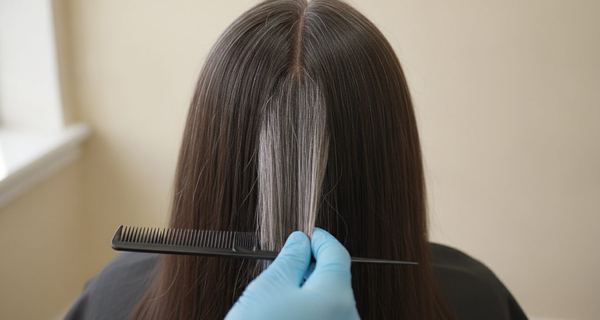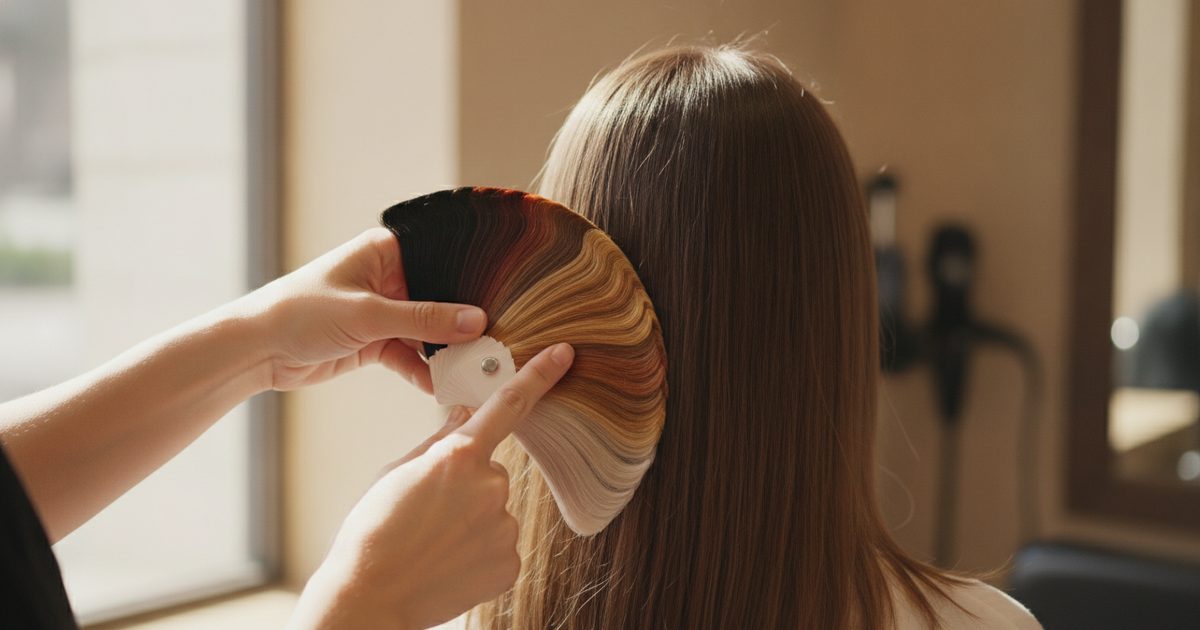
Read the root. The first inch at the scalp is the only hair on the head that is reliably natural, so that is where the level is read: dry, in daylight, against a swatch, for lightness only. Warmth fools the eye, so judge the section as if the photo were black and white, and if two swatches both look possible, take the darker one. The number you get is the hair color level, 1 to 10. Level 1 is black and level 10 is the palest blonde hair can reach without being white. Tone, warm or cool, golden or ash, is written separately as the letter or decimal after the number, so two heads at level 7, one coppery and one mousy, share a row in the table below.
Levels are a scale of lightness agreed by eye, and two people reading the same dry section at the same window can still put it a level apart.
The ten levels
The table gives what it takes to reach each level, from one level below and from two. One brand's dark blonde is another's light brown, so the number is the part worth writing down. The pigment under every level and the toner that cancels it are on the hair color levels chart, with a picture of each.
| Level | Name | From one level below | From two levels below |
|---|---|---|---|
| 1 | Black | Deposit only (10 vol demi) | Not applicable |
| 2 | Darkest brown | 20 vol, permanent color | Not applicable |
| 3 | Dark brown | 20 vol, permanent color | 20 vol, permanent color |
| 4 | Medium brown | 20 vol, permanent color | 20 vol, permanent color |
| 5 | Light brown | 20 vol, permanent color | 20 vol, permanent color |
| 6 | Dark blonde | 20 vol, permanent color | 20 vol, permanent color |
| 7 | Medium blonde | 20 vol, permanent color | 20 vol, permanent color |
| 8 | Light blonde | 20 vol, permanent color | 20 vol, permanent color |
| 9 | Very light blonde | 20 vol, permanent color | 40 vol high-lift series (virgin hair only), or lightener |
| 10 | Lightest blonde | 20 vol, permanent color | 40 vol high-lift series (virgin hair only), or lightener |
Level versus tone
Level is depth. Tone is the direction of the color at that depth: gold, copper, red, ash, violet, neutral. A shade written 7.1 or 7A is level 7 with an ash tone, and 7.3 or 7G is level 7 with gold. 7N or 7NN is level 7 in the natural series, with no dominant tone and, in the double-letter version, extra pigment for gray coverage. A request for "lighter but not so warm" is two requests, a level change and a tone change: developer volume moves the level, and the tone of the shade, and later the toner, deals with the warmth. That decoder holds for most permanent lines. Demi lines have their own language, in one of them N is a cool ash and NB the true natural, so the brand's chart belongs next to the bowl.
Underlying pigment
Lightening takes the dark pigment out first and fastest, so the hair passes through a fixed run of warm stages on the way up. Colorists teach it as red, yellow and blue in the hair, with the blue leaving first, then the red, and yellow the last to go. At levels 1 to 3 the warmth is a red so dark it reads as black or mahogany. Levels 4 and 5 expose red-orange and orange-red. Level 6 is clean orange, level 7 yellow-orange, level 8 yellow, and levels 9 and 10 pale to almost invisible yellow. Green cancels red, blue cancels orange and violet cancels yellow, straight across the wheel. Charts differ by about a level between brands, some putting orange at 7 and yellow-orange at 8, and on a head that was dark this morning the orange hangs on longer than any chart says, so the scraped strand outranks the chart. Every lightening formula either lifts past the stage it will stop at or neutralizes that stage with its opposite.
Levels of lift versus developer volume
Lift is the number of levels the hair moves lighter in one application. Developer volume is the peroxide concentration that drives it: 10 volume is 3 percent peroxide, 20 is 6, 30 is 9 and 40 is 12. More peroxide means more lift, with more heat and stress on the cuticle. Permanent color reaches a ceiling because the same alkaline mixture that lifts also has to deposit, and the two jobs work against each other after about three levels. A high-lift series used with 40 volume stretches to four on virgin hair. Past four, only lightener, which lifts without depositing anything, at 20 volume on the scalp however far it has to go.
| Developer | Lift | Where it belongs |
|---|---|---|
| 10 vol (3%) | 0, deposit only | Demi-permanent, toners and glosses (most lines also sell a 5 to 9 vol toning developer for these), going darker |
| 20 vol (6%) | 1 to 2 levels | Everyday permanent color and gray coverage |
| 30 vol (9%) | 2 to 3 levels | Lightening with permanent color on healthy hair |
| 40 vol (12%) | 3 to 4 levels | High-lift series on virgin hair from a base of 4 or lighter; off-scalp lightener |
| Lightener | 5 levels and more, and any 9 or 10 that is two levels away | 20 vol at most on the scalp, 30 off the scalp in foils |
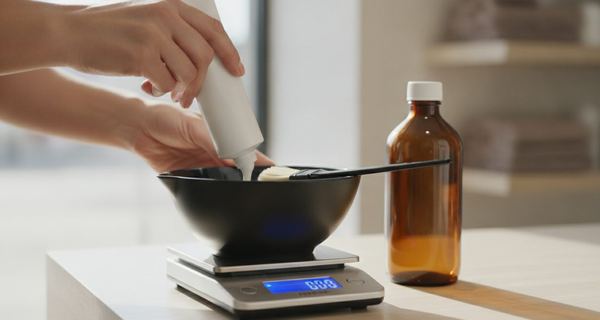
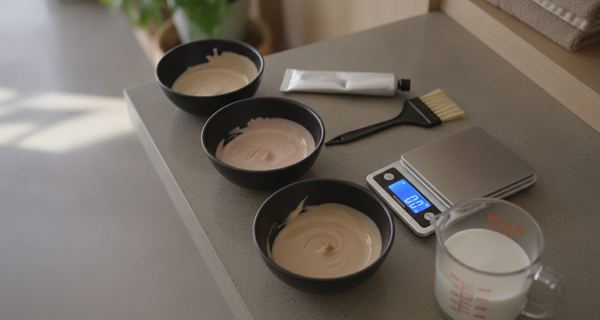
Volume decides how far; time decides how completely. A 20 volume taken off early under-lifts. But a 30 volume left on too long does not turn into a 40, because lift stops once the peroxide is spent, roughly 35 to 45 minutes in. The mix calculator covers quantities and the processing time calculator covers the clock.
None of this applies to hair that has been colored darker: permanent color lifts natural pigment only, so the regrowth lifts and the lengths stay where they are. That is a remover first, or lightener. Going three or more levels darker, hair that has been lightened, or that starts at a 9 or a 10, has little warm pigment left to sit under the new color, so it takes a warm fill shade first or the result turns muddy or green. And a lift of five or more to a 9 or a 10, or six or more to any level, is more than one session for most hair: lift in rounds, check the ends' strength between them, and tone at the end.
Reading your own level
Read the root, the first inch, dry and in daylight, and match for lightness only. If that number is not obvious, what level is my hair walks through it with a picture of every level. Bring back two numbers: where the hair is now and where it is going. Read the lengths as a second number if they have been lifted or colored, since a natural 5 at the root over lifted 8s is two heads in one, and previously lightened hair is a separate case, where the porosity test says how it will take color. The target level is the third number, and what lives underneath it, on the level chart, decides the toner before the bowl is mixed.
Why level 7 goes orange
Most box-dye disappointment happens at level 7. A level 4 or 5 base lifted with a 30 volume permanent lands at 7, and the underlying pigment at 7 is yellow-orange, the most saturated warmth in the sequence. The ash in a "light ash blonde" box is built to cool a level 7 or 8 starting point, with far too little blue to cancel the full orange a brunette reveals on the way up. More permanent color on top does nothing for it, because color cannot lift its own deposit. The fix is to stop at 7 and tone with a blue-based demi at that level, or to keep lifting with lightener to level 9, where the yellow is pale enough for a violet toner. A toner cannot lift, so a level 10 toner on a stalled 7 does nothing. A formula planned from a 6 that is really a 5 stops a level short and lands on orange the same way, and the afternoon goes to a toner nobody planned for.