Read the back first
The back of the tube says what the ratio is, and that is where to start, because every line is a little different. Most US permanent creams are 1:1, a few lines ask for 1:1.5, high-lift blondes are 1:2, and lightener runs from 1:1 to 1:2 or looser depending on the tub and the job. The ratio is written color first, developer second, so 1:1.5 is one part color to one and a half parts developer. The part can be a gram, an ounce or the same scoop for both sides, and equal parts is the ordinary case: an ounce of color and an ounce of developer, or 60 g and 60 g, is the same 1:1 either way.
Which ratio for which product
The line sets it and prints it. The presets above are the ratios that come up most often, and the tube outranks them.
| Product | Typical ratio | Why |
|---|---|---|
| Permanent cream (most US professional lines) | 1:1 | Equal parts. A thick cream that wants an equal weight of developer to activate and spread. |
| Permanent cream (some lines, several European) | 1:1.5 | The line is formulated for the looser mix, so use 1:1.5 only when the tube says so, and never carry it over to a 1:1 line. |
| High-lift blonde series | 1:2 | Double developer with 30 or 40 vol, as printed. Mix it the way the line says. |
| Demi-permanent and liquid toner | 1:1 or 1:2 | Shades EQ type and most US demi glosses are equal parts, mixed with the line's own processing solution. Liquid toners of the T18 type are 1:2 on the 20 vol the bottle names, and the odd demi is 1:3. The bottle says which. |
| Lightener | 1:1 to 1:2 (some tubs to 1:2.5) | 1:1 is the strongest mix. 1:1.5 is thicker, for hand painting and balayage, so it holds its edge without bleeding. 1:2 is looser, for foils and global applications, so it spreads and saturates. More developer means less lift and less swell. |
Consistency is the check once it is mixed. Lightener at the right ratio looks like royal icing or a thick Greek yogurt, permanent cream like frosting, and either should sit on the brush. Some colorists loosen a stiff bowl with a splash more developer and go. The ones who swatch-test their ratios say mix to the printed number every time, because a bowl that looks right can still be a weaker bowl, and a head done from three bowls of three consistencies lifts unevenly.
Grams, ounces and the cup
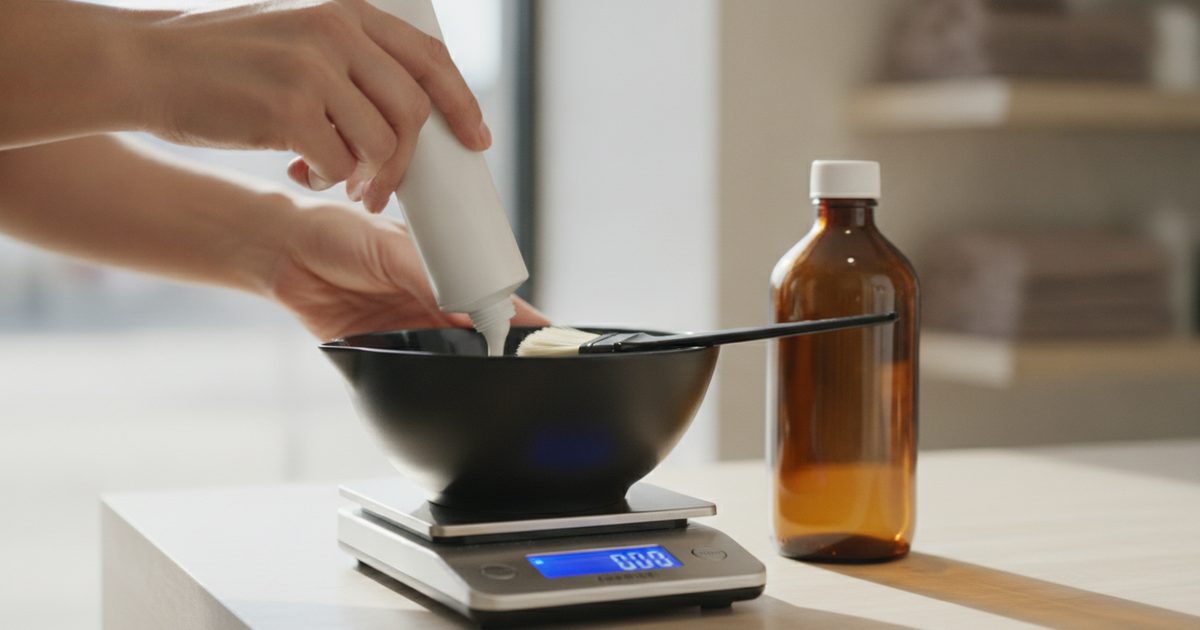
Salon practice is a scale. A digital kitchen scale that reads to 1 g costs less than a tube of color. Gloves on, a plastic or glass bowl on the scale, never metal, zero it, squeeze color to the first number, zero it again, developer to the second number. Zeroing twice, even for a 10 g dab, means no subtraction while a client watches you in the mirror. Developer is close enough to water that a marked cup works for it, and the cream or powder can be weighed with the developer poured to the line. The scale matters most for what is thick: cream traps air when you squeeze it and a third of what you measured stays smeared inside a cup, and a scoop of powder from a fresh tub and one from a tub that has sat with the lid off do not weigh the same. A scoop is fine when the scoop goes onto the scale.
US colorists also talk in ounces, and every number on this page converts. Most tubes hold 60 ml, a little over 2 oz, though some lines use 50 ml and others 90 ml, so check yours. Half an ounce of color takes half an ounce of developer at 1:1, and 2 oz of powder at 1:2 takes 4 oz. Whichever unit, mix with the brush or a whisk until nothing is sitting at the bottom of the bowl, because lumps go on as lumps and show up later as spots that did not lift.
Starting from the total
Sometimes you know how much you want in the bowl, say 150 g for a full head of long hair, and want the split. At 1:1.5 that is 60 g of color and 90 g of developer, because 150 divided by 2.5 parts is 60 per part. The dye amount calculator estimates the total from the hair itself if you are not sure where to start.
Quick reference: developer for common amounts
Grams of developer for each amount of color at the three common ratios. Add the two together for the bowl total.
| Color | 1:1 | 1:1.5 | 1:2 |
|---|---|---|---|
| 10 g | 10 g | 15 g | 20 g |
| 30 g (about 1 oz) | 30 g | 45 g | 60 g |
| 45 g | 45 g | 68 g | 90 g |
| 60 g (one 60 ml tube) | 60 g | 90 g | 120 g |
| 90 g | 90 g | 135 g | 180 g |
| 120 g (two tubes) | 120 g | 180 g | 240 g |
Ratio and volume are two different choices
Volume is the strength of the peroxide in the bottle: 10, 20, 30 and 40, or 3, 6, 9 and 12 percent on a bottle sold outside the US. It decides how much lift a permanent color gives and how hard the cuticle is opened. Cream and clear developer are the same strength and differ only in consistency, cream for a bowl and brush, clear for a bottle application. If you are unsure, 20 vol cream is the bottle, and nothing over 20 goes on the scalp under lightener. Demi glosses run on 10 vol or the line's own processing solution, and liquid toners of the T18 type on the 20 vol the bottle names.
With permanent color, the brand fixes the ratio for the line and you pick the volume for the level change, as the hair level finder lays out. With lightener the ratio is a strength setting of its own. Powder is the thing doing the lifting and developer activates it, so the less developer in the bowl, the more powerful the mix: 1:1 for maximum lift, 1:2 for the usual, 1:3 or 1:4 on hair that is already compromised. The volume then sets the speed. Think of it this way: ratio for power, volume for speed. It holds well enough to remember.
Mistakes that look like product problems
- Eyeballing half a tube. A 60 g tube squeezed to the middle is rarely 30 g, and the tube gives no feedback either way.
- Loosening a stiff bowl. A 1:1 permanent is supposed to feel stiff. Extra developer dilutes the pigment and weakens gray coverage.
- Carrying a ratio across lines. Switching from a 1:1 brand to a 1:1.5 brand and mixing 1:1 gives a thick, over-pigmented mix that processes unevenly.
- A metal bowl. Metal reacts with the mix. Spotty results, and sometimes a green cast.
- Lumps. Powder sitting at the bottom of the bowl never meets developer, so it goes on dry and that spot does not lift. Keep mixing, scrape the sides, and look at the bottom before you call it done.
- Additives counted wrong. Bond builders and mixing oils add weight and liquid. Follow the additive's own dosing. Some colorists count the booster inside the color weight and add developer on the sum.
Developer to color ratio: questions
What is the developer to hair dye ratio?
It is how much developer to add for each part of color, and it is printed on the back of the tube. Most permanent creams are 1:1, so 60 g of color takes 60 g of developer. High-lift shades usually want 1:2, lightener is commonly 1:2, and demi lines run 1:1 or 1:2 depending on the brand. Read that line before you weigh anything, because the ratio belongs to the product and not to the job.
What does a 1:2 ratio mean?
One part color to two parts developer, so twice as much developer as color. Weigh 40 g of lightener and 2 parts developer is 80 g, which is 120 g in the bowl. It makes a looser mix that spreads easily and swells less, which is why it is the default printed on most lightener tubs.
Is it 1 part color to 2 parts developer, or the other way round?
Color first, developer second. Written 1:2, the 1 is the color and the 2 is the developer, and the back of the tube spells it out in words next to the numbers. Getting it backwards ruins the bowl: two parts color to one part developer on a permanent leaves a stiff mix that under-processes and fades within weeks.
What is the standard hair color mixing ratio?
There is no single standard, which is the honest answer, but 1:1 covers most permanent creams and is the safest assumption if the box has been thrown away. From there it is 1:1.5 on several European permanent lines, 1:2 on high-lift shades and most lighteners, and 1:2 on liquid toners of the T18 class. The ratio belongs to the line, so check it per product rather than carrying one brand habit to another.
Can I measure in ml instead of grams?
For developer, yes. It is close enough to water that 1 ml weighs about 1 g, and the cream or powder can be weighed in the bowl with the developer poured to the line on a marked cup. Cream color is thicker and clings to the cup, so it belongs on the scale, and bleach powder settles in the tub, so a scoop is fine only when the scoop goes onto the scale. US colorists also work in ounces: an ounce of color to an ounce of developer is the same 1:1, and most tubes hold 60 ml, a little over 2 oz, which is where the 60 g figure comes from. Some lines use 50 ml or 90 ml tubes, and the tube count in the calculator assumes 60.
What happens if I add too much developer?
With permanent color the mix goes thin, the pigment is diluted and the result comes out lighter, sheerer and shorter-lived, especially on gray. A little extra on a 1:1 is forgiving, doubling it is a different result, and if you overshoot, add color until the ratio is back where it should be before any of it touches the hair. With lightener the extra developer makes a gentler, looser mix that swells less and lifts less, which is sometimes the point, as with a 1:3 on fragile ends.
What happens with too little developer?
The bowl is stiff and hard to spread evenly, and the color under-processes and fades fast, because the oxidation needs enough peroxide to open the cuticle and develop the dye, which is why the line prints its ratio. Lightener runs the other way: 1:1 is the strongest mix there is, thick as royal icing, and it is the mix for maximum lift off the scalp.
How much do I mix for a root touch-up?
About 30 g of color, which is an ounce or half a standard tube, with its developer at the ratio on the back: 30 g at 1:1 or 45 g at 1:1.5. That does half an inch of regrowth on an average head. Thick, long or very dense hair needs more, and the hair dye amount calculator works from length and density. If the last section runs short, mix a small fresh bowl.
Does the ratio change with developer volume?
They are two separate choices. With permanent color the brand fixes the ratio for the line and you pick the volume for the lift you need. With lightener the ratio itself changes the strength of what is in the bowl: powder mixed 1:1 is the most powerful mix, 1:2 is the common default, and every extra part of developer makes the mix gentler and looser with less swell. So a 1:1 on 20 vol and a 1:3 on 20 vol are two different lighteners even though the bottle is the same.
Small batches, and using it now
The ratio does not care how small the batch is. A 10 g dab for a hairline is 10 g of color and 15 g of developer at 1:1.5, and the scale reads it fine. What changes is the clock. Mixed permanent color keeps working for about 30 to 45 minutes and then loses its strength, so leftovers are waste. Lightener is stricter. It starts oxidizing the minute air hits it, swells in the bowl and on the head, and is processing whether it is on hair or not, so a bleach bowl gets mixed and used, and on a long application a fresh bowl every ten minutes beats one big one mixed at the start.