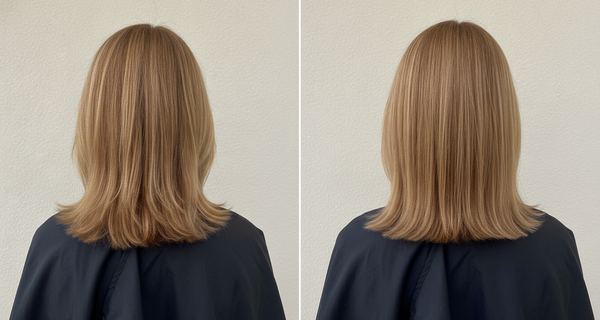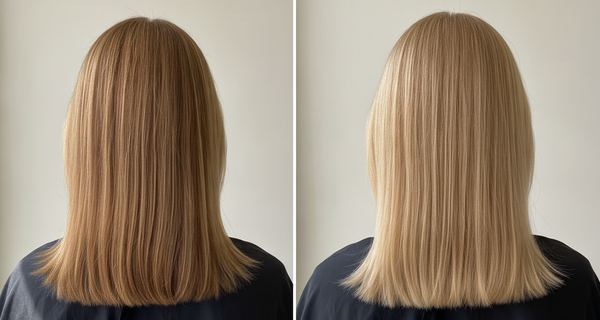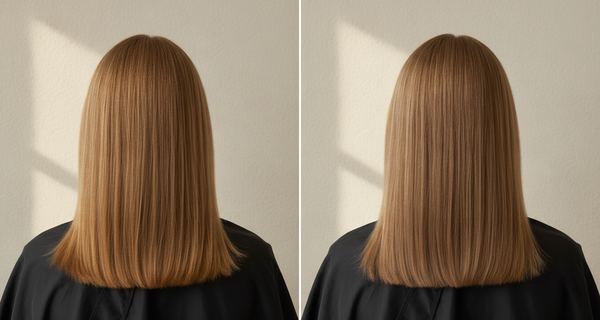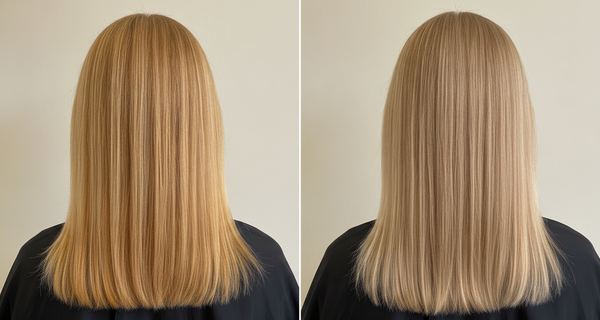
Every 7 that comes to my basin arrives the same way: lightened from a 5 or a 6, rinsed, and yellow-orange in the towel. The level 7 page covers how the hair got here; this page is the twenty minutes after.
Minute 0: damp hair, lilac-gray bowl
Towel-dried until it stops dripping and no further; dry hair grabs the cream where the brush lands first, and dripping hair waters the developer down. In the bowl, 40 g of 7.12 and 80 g of 10 vol, or the demi ratio on the tube; the developer mix calculator does the sum for odd ratios.
Blue cancels orange and violet cancels yellow, and a 7 has both, so the shade needs both. 7.12 carries them in one tube. 7.1 alone has only the blue: it handles the orange half, leaves the yellow, and the ends drift green by the second wash. I have never liked a 7.1 on lifted hair; in my chair it is 7.12, and I know colorists who disagree.
Ten volume, because a toner deposits and the level stays where the lightener left it.
Minute 5: it looks like a mistake
The cream goes a dirty khaki within a couple of minutes, the yellow-orange showing through a translucent lilac. Nothing is wrong. On normal hair there is nothing to check at 5; I use the time to wipe down the cart. On hair lightened twice, wipe one end at 5, and if it already reads flat and cool, rinse the ends and leave the rest.
Minute 10: wipe a strand and take it to the window
A damp towel, one strand. Under the window (the basin lamp is warm and lies in the client’s favor) the yellow-orange should have gone dull, a wet sand. Clear orange at the root means a 6 the 7.12 will not catch; note it for a 6.1 pass next visit. I once misread a root under the basin lamp, called the whole head a 7, and sent a woman home with cool lengths and a warm halo an inch wide. The fix, three days later, took 30 minutes and 20 g of 6.1 I did not charge for.
Minute 15: gray in the bowl, and why that is fine
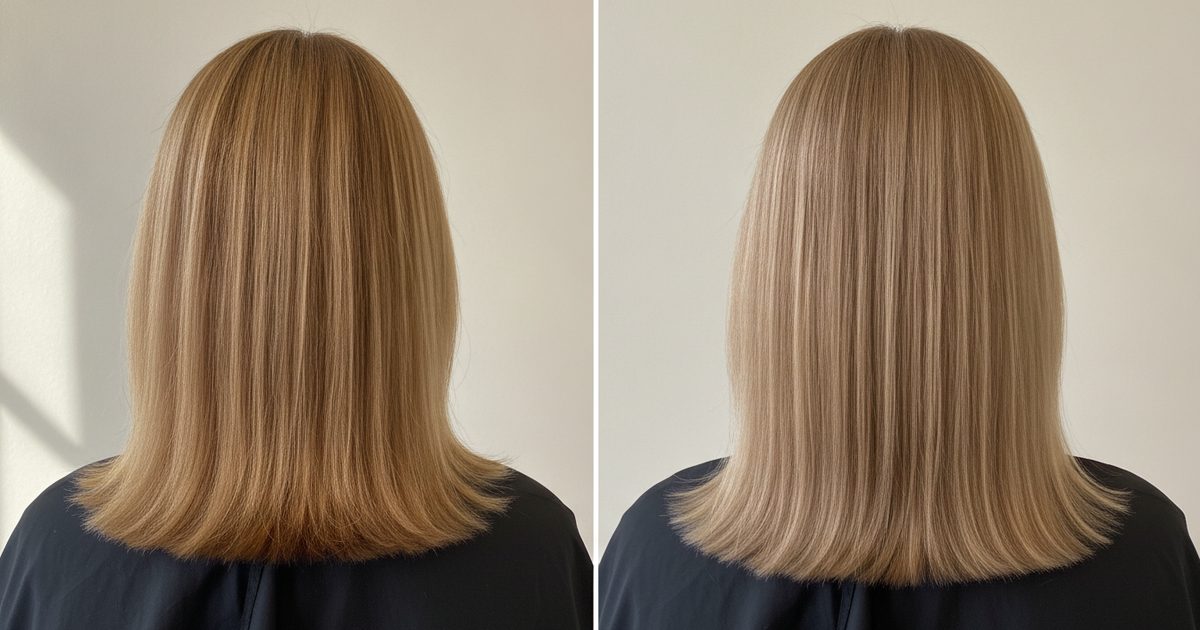
Wet 7.12 on a lifted 7 reads gray. Properly gray, and the leftover cream in the bowl has gone the same. Wet hair reads a level darker, and the violet and blue over yellow-orange read a step cooler with it. Rinse cool and condition, then dry a section fully before either of you says a word, because dry, the same section is a cool medium blonde with the brass gone, a shade deeper than the wet gold at minute 0. But clients see the gray in the bowl and worry, and I have found it easier to warn them at minute 0 than to explain it at 15. Some still worry.
| Minute | On the hair | In the bowl | What you do |
|---|---|---|---|
| 0 | Damp, yellow-orange | Pale lilac-gray cream | Apply, ends last |
| 5 | Khaki sludge | Same | Nothing; wipe a porous end |
| 10 | Dull sand, gold gone | Darkening | Wipe a strand, judge at window |
| 15 | Wet gray | Gray | Rinse on normal hair |
| 20 | Wet gray, no change | Gray | Rinse; past this the ends go steel |
Minute 20 and past it
Coarse hair gets the last 5 minutes. After 20 the violet keeps depositing on the most porous ends, which go a steel gray that looks fine wet and awful dry; two or three clarifying washes take most of it back. What I cannot give you is the exact minute for a head with three years of different porosities in it; on those I go by the wiped strand, and the processing time calculator gives a starting point.
The week after
Four to six weeks. The violet fades ahead of the blue, so yellow shows at the ends by week three and warmth at the root by week five. Cool water stretches it; a pool shortens it. At week five the same 7.12 for 5 to 10 minutes puts it back, and the toner selector may hand you a 7.2 for that gloss if the fade is pure yellow. If she wants lighter after all, lift to 8 and use the level 8 to 8 formula.