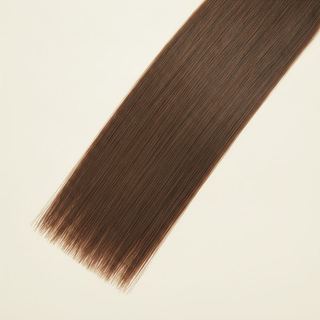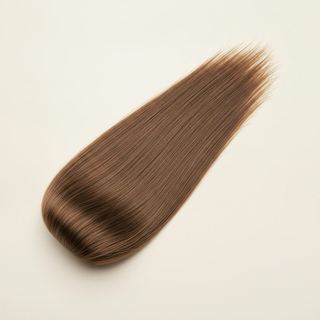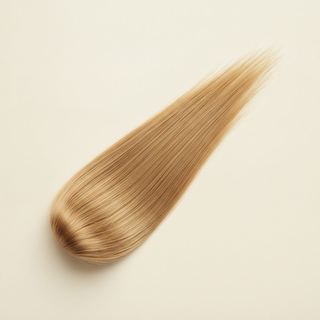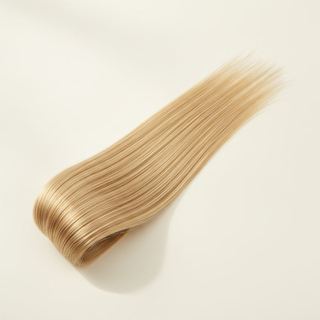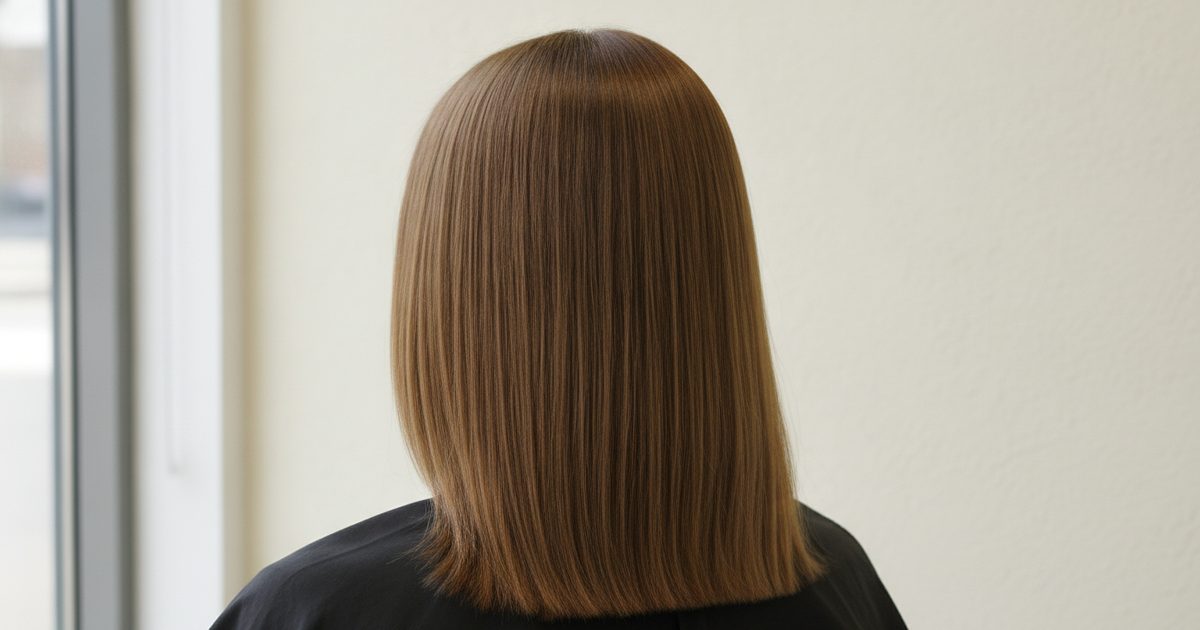
Level 6 is the number that gets argued over most at a consultation. The client says dark blonde, her sister says light brown, and both are describing the same head. The scale settles it, not the name: 6 is the first blonde level, one above level 5, light brown, and it is read at the root, on dry hair, in daylight, against a swatch, for lightness only. Warmth is a separate question. A natural 6 nearly always carries a 5 at the nape and sun gold through the ends, which is why a colored 6 looks more plainly blonde than a natural one.
From a natural 4 on 20 volume
The most common way to arrive at 6 is two levels up from a 4. On healthy, uncolored hair that is a 20 vol job: 60 g of 6.1 and 60 g of 20 volume, 6 percent, weighed one to one, and the developer mix calculator does the 1:1.5 and 1:2 lines. The cream turns mauve in the bowl, which is the blue in an ash shade showing early.
Mids and ends go on first, a finger’s width off the scalp, and the root inch at about ten minutes, because the scalp is warm and the root would otherwise finish a level ahead of the lengths. Thin sections, saturated. A 4 that stops at a warm 5 has usually been starved of product.
Then the checks. At 15 minutes a strand scraped clean at the crown has moved to about a 5 and looks copper-red, the orange-red of level 5 surfacing as the brown breaks down. At 25 it reads a warm 5 going on 6 and the color under the cream is plain orange, and this is the minute a nervous hand reaches for the water. Leave it. Lift is still running, and the ash in the tube only reads once the cuticle closes at the rinse. At 35 the peroxide is spent. Wiped, the strand is a level 6, cooler than it looked under the cream, and after the shampoo, at a window, it is a cool dark blonde with a little more warmth at the nape. Coarse or resistant hair gets 45 minutes and past that the clock buys nothing. The processing time calculator shifts the numbers for texture.
Orange is the pigment at 6
Every level has warm pigment under it, and lifting shows it in order: red at 3, red-orange at 4, orange-red at 5, orange at 6, yellow-orange at 7, yellow at 8. Six is plain orange. Anyone lifting brown hair passes through it, so orange at 25 minutes is the middle of the lift and not a fault in the mix. The level chart lays the sequence out. Across the wheel from orange sits blue, which is why the 6.1 went in the bowl and why the cool 6s in most lines are blue-based.
If the wiped strand at 35 is a true 6 and still reads coppery, the tube did not carry enough blue for that head, and a blue-based demi at level 6 finishes it: 10 vol, or the line’s own toning developer at 5 to 9 vol, 15 to 20 minutes on towel-dried hair. The toner selector narrows the shade from the warmth in front of you. Cool reads darker, because ash absorbs light where gold reflects it, so a 6A on an orange 6 can dry looking like a 5, and some colorists go a level lighter with the ash for that reason while others go a level darker when the orange is heavy. And a toner cannot lift. It is chosen at the level the hair reached, or close to it, and a 9 or 10 toner on a 6 does nothing at all.
If the strand reads a 5 with a copper cast, the hair stopped a level short, and blue built for level 6 orange has met level 5 orange-red. A 3 that was read as a 4, thin application, coarse hair that wanted 30 vol, or old tint in the lengths, which permanent color cannot move, are the usual reasons. Too much blue is the other failure: a 6.1 on hair with little orange left, or on hair that reached 7, dries smoky green-gray.
Reading the codes
6N is the natural series, no dominant tone. 6.1 or 6A is ash, blue-based, a cool mushroom blonde. 6.3 is gold, honey. 6.4 is copper, a light ginger. 6.13 is beige, ash and gold in one tube, sold as bronde. The tone codes shift by brand, so the line’s own chart is the one to trust.
Gray at level 6
6N goes into more bowls than any other shade between 30 and 70 percent white: light enough to soften the regrowth line, dark enough to cover. Coverage needs 20 vol, since 10 vol blends and does not cover, and it needs something natural in the bowl, because coverage is built from warmth and a fashion or ash shade alone leaves white hair with a khaki shine and no cover. Start the application where the white is, usually the front and the hairline, so that section gets the longest time, and check it before the rinse: 35 minutes for most heads, 45 where the white is coarse and glassy. The gray coverage calculator sets the share of N, half at 50 percent and all of it at 70. A solid permanent 6 means a regrowth line at about three weeks. A 6N demi as a shadow root over lighter lengths grows out softer, which is a choice to make before the bowl is mixed.
6.3 or 6.1 on white hair
White hair has no orange in it. A 6.1 is built to cancel orange, so on a 70 percent white head the blue meets nothing and reads as itself, a slightly green ash that pulls the face gray. A 6.3 lays gold onto the white and reads honey, and 6N with a quarter of either is the middle road.
Six as the stop on the way to 8
From a 4, an 8 is four levels: a high-lift blonde on 40 vol on virgin hair, or bleach. The gentler road is two visits: 4 to 6 on 20 vol now, six to eight weeks living at the 6, then 6 to 8 on 20 vol, two levels again. The table gives the common starts on healthy, uncolored hair, and all of them assume the start was read right. From a 2 it is high-lift on virgin hair or bleach, from a 1 bleach only.
| Start | Lift | Developer | Time | Result |
|---|---|---|---|---|
| 3, dark brown | 3 up | 30 vol permanent, or high-lift with 40 vol on virgin hair | 45 min | Warm 6; tone with blue |
| 4, medium brown | 2 up | 20 vol permanent, 30 on resistant hair | 35 min, 45 resistant | This page |
| 5, light brown | 1 up | 20 vol permanent | 35 min | Orange unless the shade carries ash |
| 8, light blonde | 2 down | 10 vol demi, or 20 vol permanent for gray | 20 min demi, 35 permanent | Deposit only, 6.3 or 6N; from a 9 or 10 fill first |
On the second visit the ends are no longer virgin. Lifted hair is porous and moves faster, so the regrowth goes on first, the lengths get the last part of the time, and nothing fresh is overlapped onto hair that was lifted the first time. Before that visit, pull a wet strand from the back: if it stretches and springs back the lengths can take the second round, and if it stays long they want a cut before they want a bowl.