A toner does not lighten hair. Every colorist who teaches this says it twice, and it is still the thing people most want a toner to do. Toner deposits. It cancels the yellow or orange the bleach left behind, and because cool pigment reflects less light than warm, the hair reads a touch darker for it, and if you wanted lighter, that is another bleach.
What level is it, really?
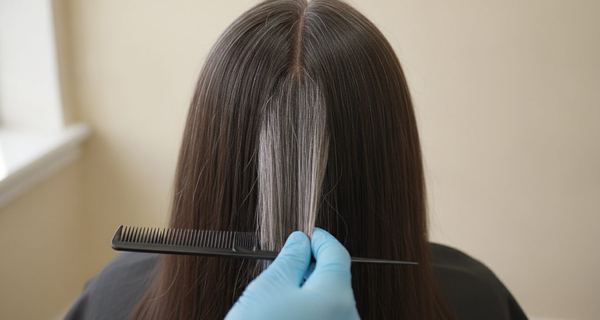
Level before tone: how light the hair is, with the color ignored. Bleach on the hair looks whiter than the rinse: the foils come out nearly white, and the rinse is yellow, or orange. Wet hair reads a level darker on top of that. So rinse, towel it, dry a piece, and read it against the chart of the ten levels in daylight. A 10 toner on an 8 does nothing at all, so the number you would rather not write down is usually the right one.
The tool stops at 5, where a toner does very little on its own. Below that the pigment is red, red wants green, and that is brunette color work.
What color is fighting you?
Every level has a pigment underneath that the bleach exposes, and everybody lifts warm. The chart says 6 is orange, 7 yellow-orange, 8 yellow, 9 pale yellow and 10 the palest yellow, close to cream. It is a brand chart, and hair has not read it. A stalled 8 very often still shows orange at the root, which is why some colorists put orange a level higher than this. So read the strand you scraped with the towel, set what you see, and the tool works from that over the slider.
Which toner cancels it?
Opposites on the wheel. Blue sits across from orange, violet across from yellow, and the in-between tones want an in-between mix. The digits do the work: .1 is blue-based ash, .2 is violet, .1 with .2 is the blend for yellow-orange, .21 is pearl, which is violet over ash, .13 is beige, which is ash over gold, and .26 is rose, violet over red. Ash in one line is not ash in another, so the chart for the line in your hand beats this table.
| Level | Underlying pigment | Neutralizer | Example toner |
|---|---|---|---|
| 5 | Orange-red | Blue | 5.1 (a cool brown at this level) |
| 6 | Orange | Blue | 6.1 (a cool brown at this level) |
| 7 | Yellow-orange | Blue-violet | 7.1 with a touch of 7.2 |
| 8 | Yellow | Violet | 8.2 and 8.1 in equal parts; 8.13 for beige, 8.3 for honey |
| 9 | Pale yellow | Violet | 9.2 with a little 9.1; 9.21 for pearl, 9.13 for beige |
| 10 | Palest yellow | Violet | 10.2 with a little 10.1; 10.21 with a touch of 10.1 for silver |
Straight blue on pale yellow drifts green, and straight violet on orange does almost nothing.
How light can the result be?
Never lighter than the hair you are toning. Silver, pearl and platinum need a 9 or a 10 underneath. Beige wants 8 or 9. Cool ash starts working at 7 and looks its best at 8 or 9. At 5 and 6 the same ash reads as a cool brown, which is a result in itself. The cooler you go, the darker it looks, because blue and violet pigment do not reflect light the way gold does, so most colorists leave a little warmth in the bowl, an ash with a beige or a gold beside it.
Rose gold is a blonde result too: 8 and 9 are its window, diluted with clear. Gold builds on the warmth rather than canceling it, so honey works from 7 up and reads as caramel below that. If the level cannot carry the result, lift again after 4 to 6 weeks of rest, or pick one it can. Toning anyway is how a 7 comes out dingy and greenish. The toner goes at the level you reached or darker. Inside that, colorists spread out: some go a level or two lighter with an ash on orange because ash reads darker, others go a level darker when the orange is heavy and a 9 ash did nothing. On a clean-yellow 8 or 9, the level you are at is the safe pick.
A head that is two levels at once, a 9 through the lengths and a 7 at the scalp, is not one bowl of toner. Either the warm roots get their own ash pass, or you make it a root shadow: a darker demi, a 6N or 7N, an inch down from the scalp and melted into a 9.2 with clear through the ends.
Developer and timing
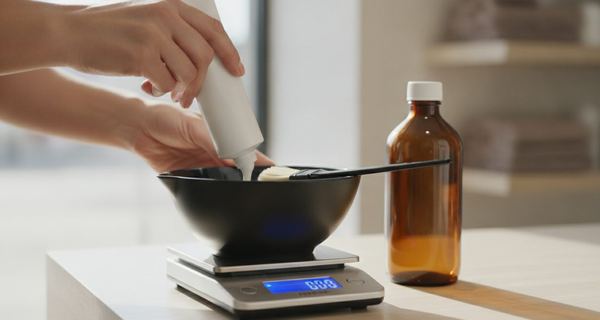
Ten volume, almost every time, or the low developer that belongs to the line, 5 to 10 vol. A liquid toner goes 1:2 in a bottle, a demi cream at the ratio on the tube, and every line is different, so read the directions. Some liquid toners are written for 20 vol. Twenty buys a little lift and a longer-lasting result, and it can burn a scalp that had bleach on it an hour ago, so on a fresh bleach-out 10 is the safer choice. The developer mix calculator has the ratios in grams.
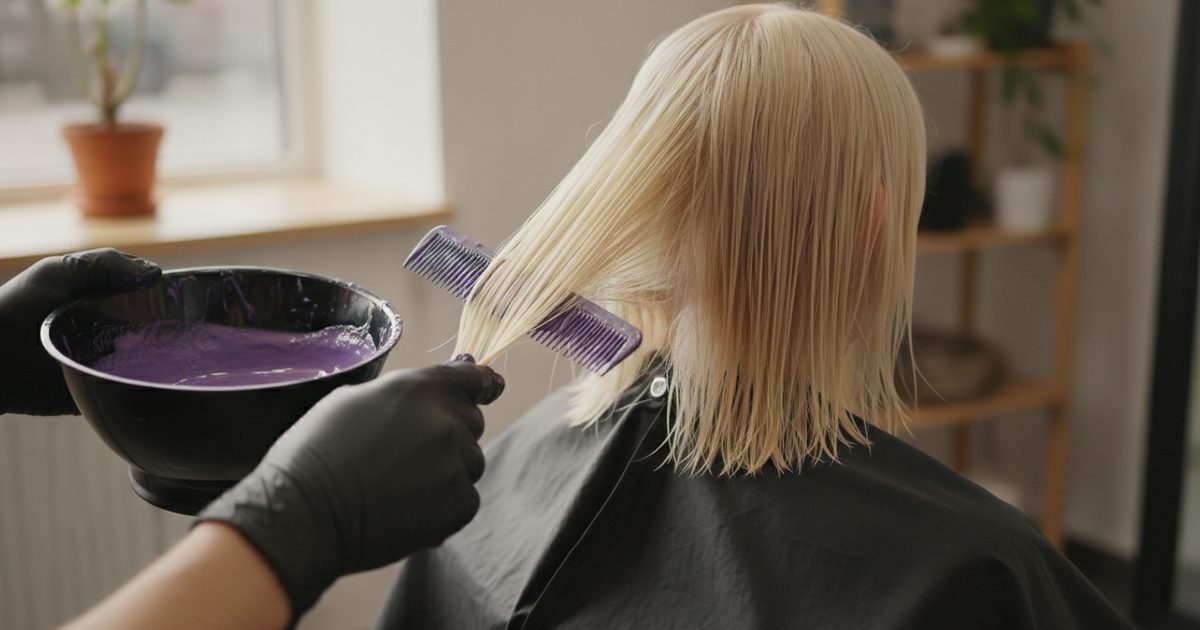
Apply it to towel-dried hair, squeezed out until it stops dripping, because the water evens out the porosity. Then get it on fast, the whole head at once. Roots first, because they are the healthiest hair and take the longest. Ends last, because the ends grab. On hair bleached more than once, put clear in the portion for the ends, or the last three inches take the violet before the roots have moved.
Liquid toners want 15 to 20 minutes, demi creams 10 to 20, and a demi on a level 10 comes off sooner, 5 to 15, because a 10 grabs. Take a first look at 5 to 10, or at 5 on porous hair. Wipe a strand, look at what is under the purple, and pull it when it looks right, whatever the box says. For unusually fine or coarse hair, see the processing time calculator first.
When toner is the wrong tool
A toner cancels unwanted tone, and it does nothing else. It is the wrong tool when:
- The hair is not light enough for the result. That is more lift, and a T18 or any other pale-yellow toner will not stand in for it.
- The lift is patchy. A toner cancels what is under each piece, so light bands go gray and dark bands go violet-brown. Even the lift first, or tone only the pieces that are already blonde.
- You want the hair darker. That is a demi or permanent color at the target level.
- The warmth is old dye. A toner cannot cancel artificial pigment, so a remover comes first.
Permanent color is the borderline case. On a 9 or 10 with 10 vol it tones with a whisper of lift and it stays. On an 8 or below it lifts the natural regrowth toward orange while it deposits on the rest, it tends to go dull, and on 20 vol it hurts.
A toner is sheer and sits near the surface. Expect four to eight weeks from it, twelve to twenty shampoos, and then a fresh toner brings it back without another bleach. Purple shampoo once a week holds a pale blonde between visits, blue shampoo does the same for a brunette, and neither rescues a head that was never light enough to tone. Too cool, and a clarifying wash or two pulls some of it back. Too warm, and another round a week later, a step darker or with more blue in it, brings it in.