What level is my hair?
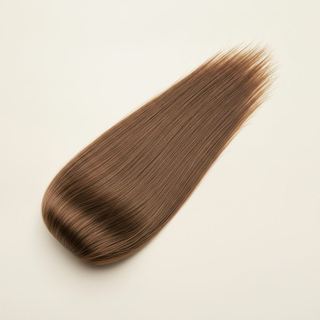
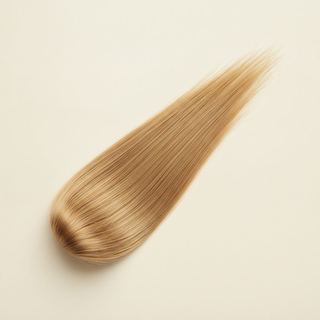
It is the number from 1 to 10 that a dry, fanned-out piece from your crown matches on the ten pictures below, and it measures lightness only. Colorists call it depth. The hair level scale runs 1 black to 10 palest blonde on every chart, and the 11 or 12 some lines print for a high-lift series does not widen it. The first correction to make: a lifted piece looks yellow, and yellow is the tone. The level is how light that yellow is.
The read, in the order colorists do it:
- Dry hair. Every read on this page is on dry hair against a picture or a swatch.
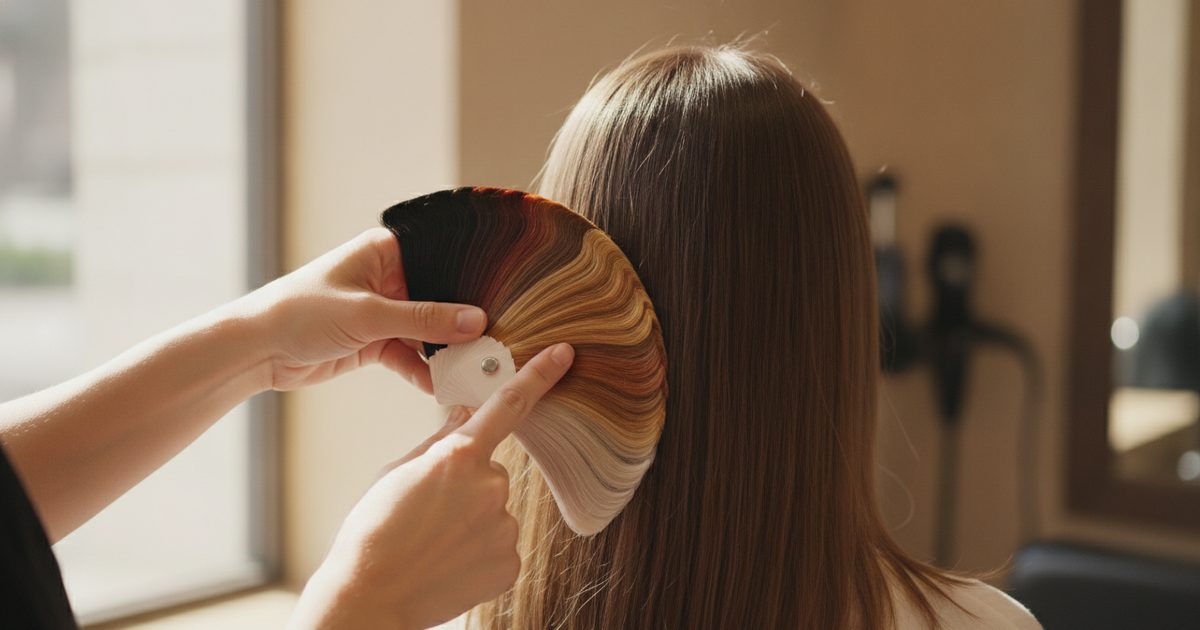
- The crown, or the back underneath. Pull a piece from the apex, the highest point of the head, or part the hair low at the back. The first inch at the scalp is the hair you were born with. Colorists do not read the ends.
- Fan it out. Hair packed together tricks the eye and looks darker.
- Lightness only. If the warmth distracts you, photograph the piece and switch the picture to black and white.
- The one that disappears. The picture the piece vanishes into is your number. You do not need a swatch book for this. A picture of the chart does the job, and that is what the strip below is.
Two minutes, and you have a number.
The hub with every level with its picture and pigment turns that number into what sits under it and what cancels that.
How to tell what level your hair is: match a root piece to the ten pictures
Two taps, three if the hair is colored or bleached. Say what kind of hair you are holding, tap the picture the root piece disappears into, and on colored or bleached hair tap the color of the lightest lengths as well. Every picture also opens its level page, so the strip works even if you skip the quiz.
Answer step 1 and tap a picture. Your level and the page to open next appear here.
How do I know what level my hair is if it is colored or bleached?
Two numbers: the root, read as above, and the lightest piece of the lengths, and you need both before you pick a box or a toner. Roots one color, lengths another, and they need different bowls, so work out both. A blonde reading her own head might call it a 10 at the ends over a 6 underneath, and a spread that wide is normal.
Write the root down first, then fan out the lightest piece of the lengths and the darkest and match each to the pictures. Boxed lengths keep whatever level that color left them at, because color does not lift color. Untoned bleached lengths read by the color the lightener left behind, because lifting exposes the warm pigment under every level in a fixed order. What each stage of bleach looks like puts a number on each of those colors.
| Lengths look | Level on this chart | What sits there |
|---|---|---|
| Red | 3 | The pigment under dark brown |
| Red-orange | 4 | Brown on its way to orange |
| Orange-red | 5 | Where a lifted 5 likes to stop |
| Orange | 6 (a 7 on some brand charts) | Where a lift from a 4 lands |
| Yellow-orange | 7 (an 8 on those charts) | The brassiest stage of the lot |
| Yellow to the scalp | 8 | The first level where blonde toners really work |
| Pale yellow | 9 | Still warm against white paper |
| Palest yellow, almost cream | 10 | The last of the yellow, no orange left |
Charts disagree here: on one the orange stage is a 6, on another a 7, and the brands’ own charts show it. So orange lengths are a 6 or a 7, and the pictures settle it. Hold the wiped strand against them and forget the color word. Yellow with orange still in it is a 7 on this chart, the stage people call a brassy 8, and it is the 7 where lifted brown stalls. Clean yellow from the scalp down is the 8, and yellow all the way to the scalp is the test to pass before any toner goes on.
The lengths number chooses the toner, since a toner works at the level you reached or darker and never lifts, and the root number chooses the regrowth formula. Once the strand is rinsed and dry, pick the toner for the stage you are at.
What level is dark brown hair, light brown, dirty blonde or copper?
Most color names are tones or marketing, and the level is the depth under them. Dark brown and light blonde are level names, ash and golden are tones, and caramel, mushroom and bronde name a level and a tone together.
| People say | Level | On the chart |
|---|---|---|
| Black, jet black, blue-black | 1 | Level 1, black |
| Darkest brown, black indoors | 2 | Black to most people until the sun hits it |
| Dark brown | 3 | Brown in daylight, red the moment lightener touches it |
| Medium brown, chestnut | 4 | Chestnut without much red: the medium brown most people call light |
| Light brown | 5 | Light brown on the chart, medium brown in everyday use |
| Dark blonde, dirty blonde, bronde | 6 | See what a natural 6 looks like |
| Medium blonde | 7 | The stage most lifted brunettes hit first |
| Light blonde | 8 | Yellow underneath, and the first level a blonde toner can do its job |
| Very light blonde | 9 | Pale yellow underneath |
| Lightest blonde, platinum, white blonde | 10 | The lightest blonde before it stops being hair. An 11 or 12 is a translucent series over hair that is still a 10 |
| Ash brown, ash blonde | Tone, read the depth | Ash is the .1 or A code at any level from 2 up |
| Golden, honey, caramel, chocolate, mushroom brown | Tone or trend name, read the depth | Gold is the .3 code from 4 to 10 |
| Copper, ginger, auburn, red | 3 to 8, read the depth | Copper is .4, mahogany .5 and red .6, most often from level 4 to 8. A natural redhead is read by depth too |
| Gray, white | No level | A percentage. The level belongs to the pigmented hair between the grays |
What level is dirty blonde hair
Dirty blonde is the everyday name for a natural level 6, dark blonde, the sandy blonde that looks brown indoors and blonde in the sun. The name stretches across more than one level in practice, so hold the root against the level 6 picture and its neighbors before you trust it. A bronde is usually a natural 6 with lighter pieces through the lengths, a two-number head.
Is a level 5 medium brown or light brown
The chart calls level 5 light brown and level 4 medium brown. Many people in the trade call a 5 medium brown, the middle of the scale, and others call it dark brown, so the name is the least reliable thing about it. Write down the number: a 5 lifts into orange-red, and 20 vol permanent color takes it to a 7, whatever anyone calls it. Hold your root against the level 5 picture and the level 4 picture and let the depth settle it.
Level and tone are two different numbers
The level is the first number on the tube, and the tone is the letter or second number after it. So your level and tone together are a depth, 1 to 10, plus a direction. On the tube, 7.1 or 7A is a 7 leaning ash, 7.3 or 7G a 7 leaning gold, and 7N a 7 with no dominant tone. A lifted 7 straight out of the bleach is a 7 leaning orange, because that is the pigment the lift uncovered, and it sits at the same depth as all of them.
| On the tube | Level | Tone |
|---|---|---|
| 7N | 7 | Natural series, no dominant tone |
| 7.1 or 7A | 7 | Ash, blue-based |
| 7.3 or 7G | 7 | Gold |
| 7.4 | 7 | Copper |
| 7.12 or 7VB | 7 | Ash-violet, built for a lifted 7 |
Letters and second digits differ by line; the first number is the level everywhere.
The letters and second numbers change from brand to brand, and that catches people out: an 8 is pearl in one line and mocha in another, ash is blue here and green there, and in one demi line N is a cool ash while NB is the true natural. The first number’s direction never changes.
When someone hates the tone and wants to be lighter, the complaint is usually about the level, and a toner will never fix it, because a toner works at the level you have or darker. Lighter is a lift. Less brassy is the toner.
Why the darker of two readings is the safer one
Torn between two pictures, fan the piece out again and, if it is still close, take the darker one. It is a habit more than a law, and the arithmetic is on its side. Build a formula from a level too light and it stops a level short, on the orange stage, with a lightener you had not planned for. Build it from a level too dark and the worst case is a result a level lighter than planned, which a toner at that level takes care of. One mistake costs an afternoon, the other a tube.
After a lift the same habit becomes a rule: be honest about what you are actually looking at. The stage misnamed most is yellow-orange, called yellow, or an 8, while it still has orange in it: a 7 on this chart, an 8 on the charts that run a level higher, and blue in the toner either way. Choose the toner by the pigment you see rather than the number you hoped for.
What fools the eye: the ends, the hairline, packed hair and the light
The ends first, because they are the piece everyone looks at, and the one to leave out of the reading. Lengths have been through sun, heat and old color, so read the root inch and let the ends be the second number.
Colorists skip the hairline too. It is the most porous hair on the head, so it takes color and light differently, and the read comes from the apex or the back underneath.
Packed hair reads darker than any one piece of it, which is why the read is always on a thin, spread piece.
Light shifts the tone you see, and only the tone. A warm bulb or afternoon sun puts gold on everything, which is how a fresh lift gets called red, and it does not move the depth.
And read it dry. Colorists read dry hair against a swatch or a chart, and a towel-dried head at the bowl is the wrong moment to decide anything.
What level is my natural hair if it is going gray?
Gray is a percentage rather than a level, so read the pigmented hair between the grays for the number and then estimate how much of the head is white. A formula for gray needs both, because the natural series shade goes into the bowl in step with the gray, at the level of the pigmented hair around it: a quarter of the bowl as N up to 25 percent white, half from 26 to 50, three quarters from 51 to 75, and all of it from 76 up. A head that is 25 percent gray still has most of its pigment waiting to expose warmth when lifted, so the level still decides the lift and the toner.
Levels 4, 5 and 6 are the workhorse coverage levels, a 7 covers but reads a little sheer on white hair, and from 8 up a shade on its own covers poorly. How much natural series your gray needs works out that proportion for you.
What do I do once I know my level?
Open your level page, then the finder for the lift to your target, and choose the toner only after the lightener is rinsed and the strand is dry.
| You read a | Open next |
|---|---|
| 1 to 3 | 20 vol permanent takes a 3 to a 5, and 30 vol a 6. Past a 6 it is a lightener job. Start with the dark brown of level 3 and how far each developer volume lifts |
| 4 to 5 | 20 vol permanent takes a 4 to a 6 and a 5 to a 7, and 30 vol one level further; past that it is high-lift on virgin hair, or lightener. See taking a natural 5 to a 7 with 20 vol, then the finder that turns two levels into a lift and a developer for any other pair |
| 6 to 7 | Where a lifted brunette lands first. Tone where you are, cooling a brassy 7 without lifting it, or take a 6 to an 8 on 20 vol if lighter is the goal |
| 8 to 10 | Toner territory. One level up from here is still a permanent on 20 vol; two levels is high-lift on virgin hair, or lightener. Violet diluted with clear is the formula at the top. Open pale yellow, level 9 for the stage before last |