Gray coverage formula

Gray blending formula: level 7 with a demi, no hard line

The demi bowl that tints white into a medium blonde without covering it, why each shade and the low developer are in it, and the three other soft routes when she would rather never see a line.

Published 2026-10-22. Written by the Easy Hair Edit team and checked against the rules the rest of the site follows.

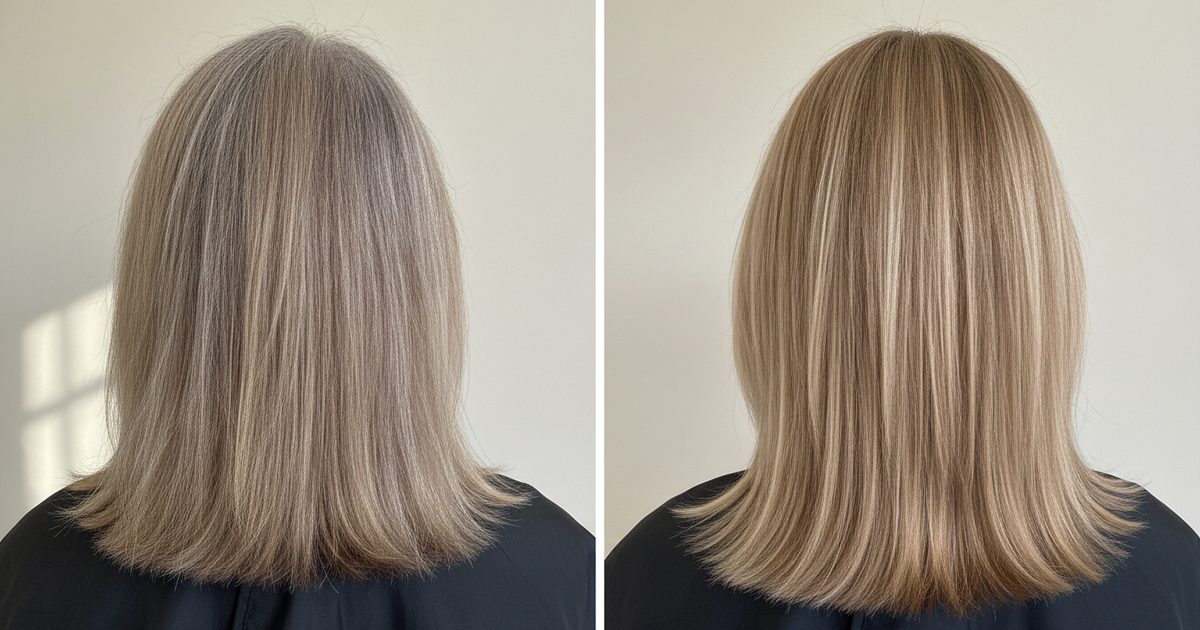
Before and after: about 40 percent white regrowth in medium blonde hair, then the white covered, one even level 7
Left: about 40 percent white regrowth in medium blonde hair, before. Right: a medium blonde at level 7 with the white tinted sheer beige and reading as lighter pieces through it, softer, still there in daylight, after demi-permanent 7NB (natural beige on 10 vol, 20 minutes on one timer from the last section. Illustration, not a photograph.
The formula
In the chair: 35 to 45 min Easy Lasts Fades soft over 6 to 10 weeks, no line; rebook when the white reads bright again
Product
Demi-permanent 7NB (natural beige, 7.13 on decimal lines) with a little 7G (7.3 gold); mostly NB, and the whiter the head the more of it
Developer
10 vol (3%), or the demi line's own developer at 5 to 9 vol
Ratio
1:1, or the ratio the demi line prints
Amount
45 g 7NB + 15 g 7.3 + 60 g of 10 vol for a first whole-head application on shoulder-length hair, about two ounces of color and two of developer
Processing
20 minutes on one timer from the last section, a look at the front at 10, room temperature under a cap, no dryer
Result
A medium blonde at level 7 with the white tinted sheer beige and reading as lighter pieces through it, softer, still there in daylight

Steps

  1. Part clean dry hair at the front, the part line and the crown and estimate the white by eye. About 40 percent white at the front and less behind is this head. Ask whether she wants it gone or quieter, and say plainly that a blend leaves white showing in daylight, because a permanent on 20 vol is a different visit and a different grow-out.
  2. Patch test 48 hours ahead, a dab behind the ear or in the crease of the elbow, every time the product changes. Weigh 45 g of 7NB and 15 g of 7.3 into 60 g of 10 vol, or at the ratio the demi line prints, in a plastic bowl, whisked smooth. Lid back on the developer.
  3. Dry, unwashed hair in four sections. The brush goes to the front and the part first, in thin sections, down the whole length of the white strands on this first visit, then back to the nape. Comb the blend through with a wide-tooth comb so it lands diffused.
  4. Start the timer when the last section is on. A plastic cap over it for the warmth of the head, and nothing hotter, since outside heat drives a demi deeper and it stops fading the way a blend should. Look at the front at 10.
  5. Rinse at 20, or at the number the demi line prints, with water until it runs clear, then shampoo and condition. Dry a piece before either of you judges it, because wet hair reads a level darker.
  6. Rebook at 6 to 10 weeks, when the white reads bright again. It is the same bowl on dry hair, whole head, since a demi fades out rather than building up.
From the chair
  • A liquid demi reads more translucent than a cream one. Many colorists reach for the cream demi on damp hair, on the line's gentlest developer, when the white is heavier than this and wants more density.
  • Cooler is possible, with a limit. A small share of 7A rides beside the 7NB and the NB still carries the blend; ash on its own over white has nothing to cancel and reads dull and greenish.
  • A blend is not thinned or pulled early to look natural. The sheerness comes from the product and the developer, and a full 20 minutes is what keeps it even from the front to the nape.
What the demi is doing here

A natural level 7 that is about 40 percent white blends with a demi 7NB (7.13 on decimal lines) and a little 7G (7.3), equal parts with 10 vol (3%) or the demi line's own low developer, on dry hair from the front back, 20 minutes at room temperature under a cap. The white takes a sheer beige tint and reads as lighter pieces through the medium blonde. It does not disappear, and that is the point: the demi fades over the washes, so there is no line at the roots and the next visit is 6 to 10 weeks away.

Forty-five grams of demi 7NB, 15 g of 7G, 60 g of 10 vol, and nothing in the bowl is there to cover. The NB carries the blend, the gold settles it, and the 3% developer opens a white hair only enough for color to sit near the surface and fade with no line. The head is a natural medium blonde about 40 percent white who wants it quieter and no monthly root.

Why 7NB carries the bowl

NB shades are formulated with more pigment than a plain natural, so a white hair takes enough beige to belong to the hair around it, and the whiter the head, the more NB goes in. A white strand has no pigment of its own, so a shade with nothing warm in it reads dull with a green edge. On a medium blonde with white through it the tinted white lands close to the hair beside it, so this level blends kindly.

Letter lineDecimal lineOn white at level 7
7NB7.13Natural beige, richer in pigment, the base of the blend
7N7.0Plain natural, less pigment than the NB
7NN7.00Double natural, a covering tube for stubborn white on 20 vol
7G7.3Gold, a small share added to settle the tint
7A7.1Ash, dingy alone on white, so only beside the NB

Does demi permanent color cover gray hair?

No. It blends the white and leaves some of it showing. A demi on three percent, the bottle that blends puts color near the surface of a white hair, so it looks tinted and wears off over the washes. Twenty vol with a permanent natural lodges pigment inside the hair, the heavy-coverage end of this subject, and brings the line at two to three weeks with it. Better that she knows which one she is buying.

Some white stays, by design A blend is judged by whether the white reads soft in daylight, never by whether it is gone. More minutes on a demi will not make it cover.

Dry hair, front first, twenty minutes

Dry, unwashed hair in four sections. The front and the part go on first. Thin sections, the whole length of the white strands this first time. Timer when the last section is on. A plastic cap for the warmth of the head and nothing hotter, since heat drives a demi deeper and it then fades less. Look at the front at 10. Rinse at 20 and dry a piece before judging it, because wet hair reads a level darker.

How long does gray blending last?

Six to ten weeks, with no line in between. The demi wears off gradually, so the white comes back across the whole head rather than as a stripe at the scalp. A solid permanent shows its line at two to three weeks, which is the whole argument for the blend.

It is not always an even fade.

A very white strand can hold a faint stain after the rest fades. Nothing put on white hair disappears completely.

Can I switch from a blend to full coverage later?

Yes, at any visit. A demi fades out rather than building up, so a permanent 7N on 20 vol goes on when she wants the white gone, mixed by the natural share for what she has, 45 minutes with the front on first. The line at two to three weeks and the monthly root come back with it.

Foils, lowlights, or half the head covered

A demi is one of three soft routes. Fine foils at the hairline copy the white coming in, and a medium blonde lifted to 9 in foils with natural pieces left out grows out on the same clock. Keep lowlights off the scalp at the face, where a permanent lowlight leaves a warm spot. Third, a deliberate partial cover: on a mostly white head, covering only half on purpose, so what washes out becomes the highlight. The white gone is a permanent 7N on 20 vol at the natural share that would cover it.
Questions about the soft route

Will a demi make my gray hair disappear?

No. A demi on 10 vol tints the white translucent, so it reads as lighter, softer pieces through the medium blonde and you can still find it in daylight. That is the trade for the grow-out: the color sits nearer the surface and wears off over the washes, so there is no line at the roots and the next visit is at 6 to 10 weeks. No color that goes on white hair disappears completely, and a very white strand can hold a faint stain after the rest has faded.

Should the demi go on dry hair or damp hair?

The line's directions decide, and the colorists split by product. The liquid acidic demi goes on dry hair for 20 minutes at room temperature, which is the blend this page uses. A cream demi on the line's gentlest developer goes on damp hair for the same 20 minutes when the white is heavier, because it is denser and more pigmented. Either way there is no dryer over it: heat pushes a demi deeper into the hair and it fades less, which defeats the blend.

Does gray blending work on medium blonde hair?

Yes, and a level 7 is where it works best. Permanent coverage at 7 already reads a little sheer on white, and above level 8 colorists say coverage gets difficult, so the lighter the natural hair, the smaller the gap between covered and blended. On a 7 the tinted white lands close to the hair beside it and reads as dimension, the way fine highlights would. The same demi on a level 4 leaves white that still reads as white.

Why does my gray blend look warm?

Because the shades that blend carry warmth on purpose. A white hair has no pigment, so anything that ties it to a medium blonde has to bring the beige and gold with it, and the NB series is built richer in pigment for exactly that. Ash on its own over white has nothing to cancel and reads dingy and greenish. If she wants it cooler, a small share of 7A goes beside the 7NB and the NB still does the blending.