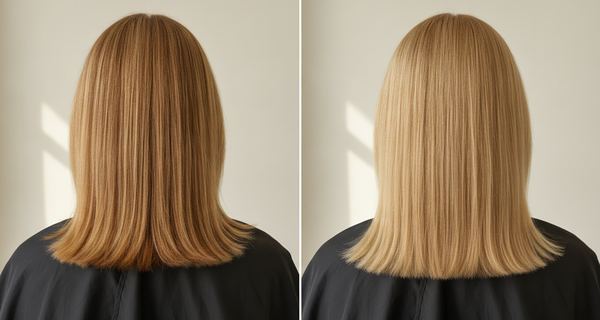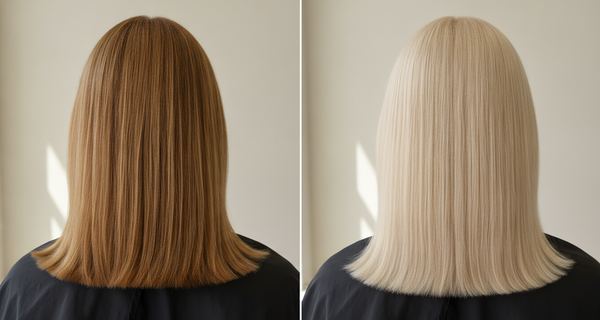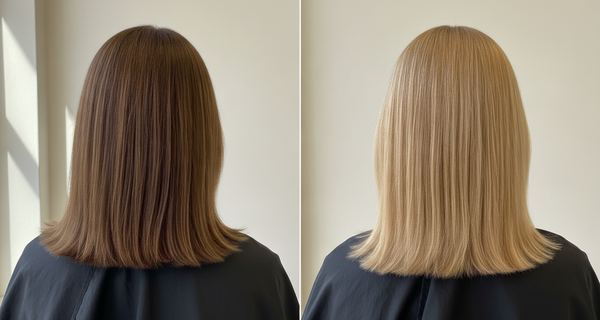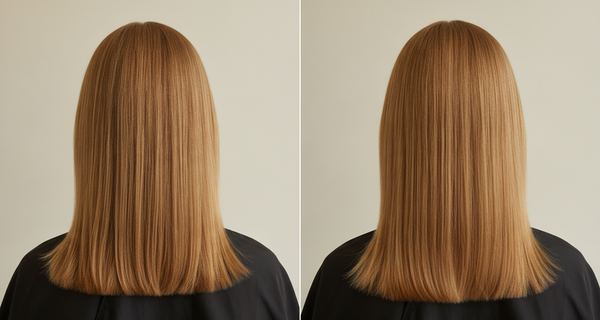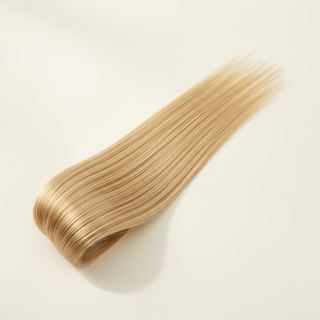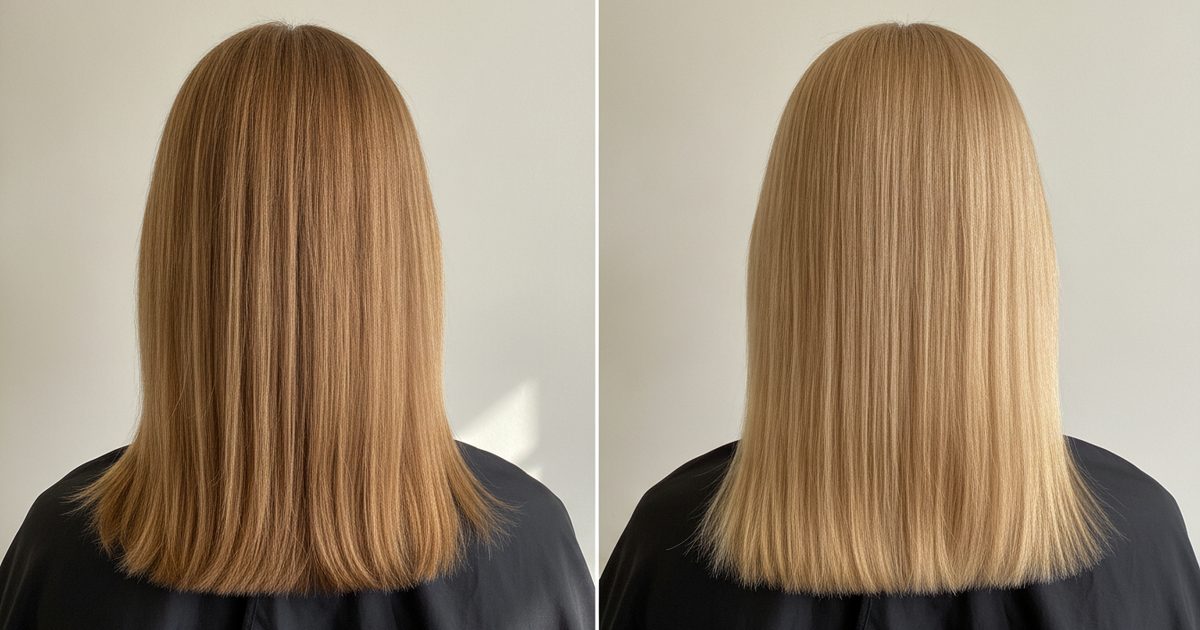
Two different heads ask for this. One is a natural 7, a medium blonde she calls dishwater, that has never seen a bowl. The other was bleached or lifted to 7 a year ago and has faded warm, and the last third of it is porous. The formula is the same 8.1 on 20 vol for both, and the difference is what happens to the ends, so the hair history gets asked before the level does.
One level, one pigment
Twenty volume lifts one to two levels on natural hair in 35 to 45 minutes, and this runs at 35 because the shade does half the work. The pigment exposed between 7 and 8 is yellow, the last rung of the red-orange-yellow ladder, with no orange left for the blue to fight. Sixty grams of 8.1 with 60 g of 20 vol, about 2 oz of each, weighed, or a spoon to a spoon if there is no scale, in a plastic bowl and used at once. Dry hair, mid-lengths and ends first, roots at minute 10, a cap over it, and one timer from the last section. The nape is the section to scrape from 20, because it went on first. This is the one full-color lift where a root band is rare on a natural head, unlike 7 to 9, where the roots need watching from minute 20.
8.1 reads clean, 8N reads yellow
An 8N is built to sit on hair that is already an 8. On a 7 with 20 vol the developer lifts a level, exposes the yellow, and the N has nothing across the wheel to cover it, so the result is a warm gold blonde. 8.1 carries blue, an 8A on US lines, and violet, with blue behind it, is what level 8 wants: it covers the yellow as it appears and the hair leaves the rinse already cool. Orange in the strand wants a third of 8.12 for the yellow-orange half. A cool shade whenever tint is lifting, and at 8 on a lifted base, keep N for gray.
(Ash looks a level darker in the bowl than it will on the hair, which is why clients flinch at the brush.)
Porous ends on a 7 that was lifted before
A 7 that was bleached to it last year is porous down its last third and drinks color. Twenty vol on it gives half a level and the ash lands hard, so the ends go gray-green while the roots are still a 7. Dilute the ends’ share 1:1 with clear, put them on last, and scrape one at 20. If the 7 came out of a box, permanent lifts the regrowth only, the lengths keep their dye, and a remover on the lengths comes before this bowl. Tint will not move tint, and a dried strand from the ends on white paper tells me which 7 is in the chair before the bowl is mixed.
Gray at 8
An 8.1 is sheer and white hair shows through it as a paler, cooler streak. Up to about 20 percent white that reads as a highlight. Past that, add 8N to the bowl, a third to a half, and the gray coverage calculator gives the split. Above 50 percent white an 8 is the wrong level for coverage and a 7N base is the answer.
After the rinse
Judge it dry and in daylight. Wet hair reads a level darker, so the basin always looks like it stalled, and the wiped strands stay on a white paper towel on the cart in the order they were scraped, 20, 25, 30, so the last one can be judged against the first. Permanent, so it does not fade out. The ash fades before the depth, and by week five the lengths read a light gold blonde under a cool root. A purple shampoo once a week is the maintenance, a ten-minute demi 8.1 on towel-dried hair is the fix when the maintenance has fallen behind, and the toner selector matches that demi to what the dry hair shows. Three summers of sun on the ends is the case where nothing can be promised from the chair, and there the ends get the diluted mix and a scrape at 20.
Why 20 and only 20
| Developer | On a natural 7 | When |
|---|---|---|
| 10 vol (3%) | Deposits only. A cool 7, no lift | The 7 to 7 toner, when the depth is fine |
| 20 vol (6%) | One level in 35 minutes, the yellow covered as it appears | This formula |
| 30 vol (9%) | Pushes a fine root past 8 while the lengths sit at 8 | Coarse, glassy hair only, and most colorists keep it off the scalp |
| 40 vol (12%) | The high-lift series, three to four levels, kept off the scalp | Not this job. See 5 to 8 |
Twenty is the standard bottle, the one to reach for when unsure, and on a 7 the processing time calculator only moves the minutes for fine or coarse hair. The developer stays.