An ounce, half a tube, thirty grams
Thirty grams of color is about an ounce (an exact ounce is 28 g) and half a standard 60 ml tube, so those are three names for the same half-inch retouch. Mix the whole tube for it at 1:1 and there is 120 g in the bowl, 60 g goes on the head, and the other 60 g gets rinsed away, half of it color. Ten retouches a year is five tubes down the sink for one client before the developer is counted.
Root touch-ups
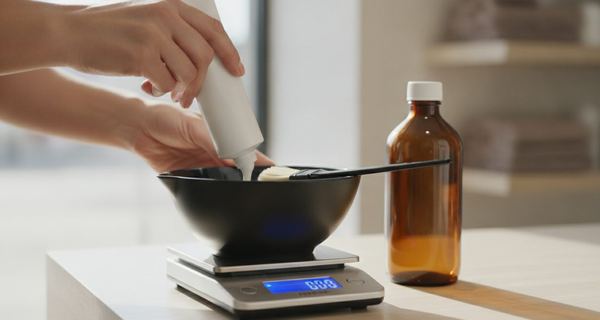
Regrowth sets the amount. The band is the same size at chin or waist, so length does not come into a touch-up. Half an inch on medium-density hair is 30 g of color, a quarter inch 20 g, an inch 40 g, past an inch and a half 50 g. Thirty grams is half a tube: squeeze onto a zeroed scale until it reads 30, or to the ounce line of the same cup you will use for the developer, then cap the rest tight and it keeps for weeks.
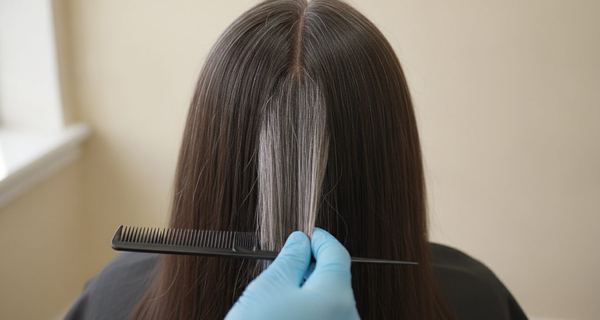
Gray does not change the number. Stubborn gray at the hairline and around the face gets thinner partings and more minutes, another five or ten past the standard time, and the grayest area goes on first so it has the longest under the color. When more time is still not covering it, the formula is the problem, and the gray coverage calculator gives the share of natural series it needs.
Full heads
On uncolored hair the color has to coat every strand, so length takes over. Chin length is 40 g of color, shoulder 60 g, mid-back 90 g and waist 120 g, all at medium density. Developer goes on top at the ratio on the back of the tube: shoulder length at 1:1.5 is 60 g of color and 90 g of developer, 150 g in the bowl. Pour it into a bowl even when a kit says shake the bottle, because a bowl and brush miss less.
The amount only works if it reaches the hair. Four quadrants first, a middle part to the nape and ear to ear, then partings thin enough to read through, each one saturated before the next comes down. Where it goes on first depends on the job: the grayest area when covering, and the mids and ends first with the roots and hairline last when lifting on virgin hair, since scalp heat makes the roots process fastest and the hairline is the most fragile hair on the head.
Roots plus a refresh is two products. The regrowth gets the full root amount of permanent, and the lengths, which are already colored, get a demi or gloss through them, mixed in its own bowl. Pulling the root permanent down over them stacks permanent on permanent and builds up. Budget about half the full-head amount for the lengths.
Long and thick hair
Past the shoulders, people under-mix far more than they over-mix. Mid-back needs 90 g of color and waist length 120 g, two full tubes before a drop of developer, or two boxes in home-kit terms.
Density hides in long hair. A head that looks medium at the crown can measure thick at the ponytail, 4 in around or more, and that is a 30 percent difference: 120 g for roots and refresh at waist length in place of 90. Thick hair is also where saturation fails first, because a section that looks covered on top can be hollow inside, so open each parting and check the underside before the next one comes down.
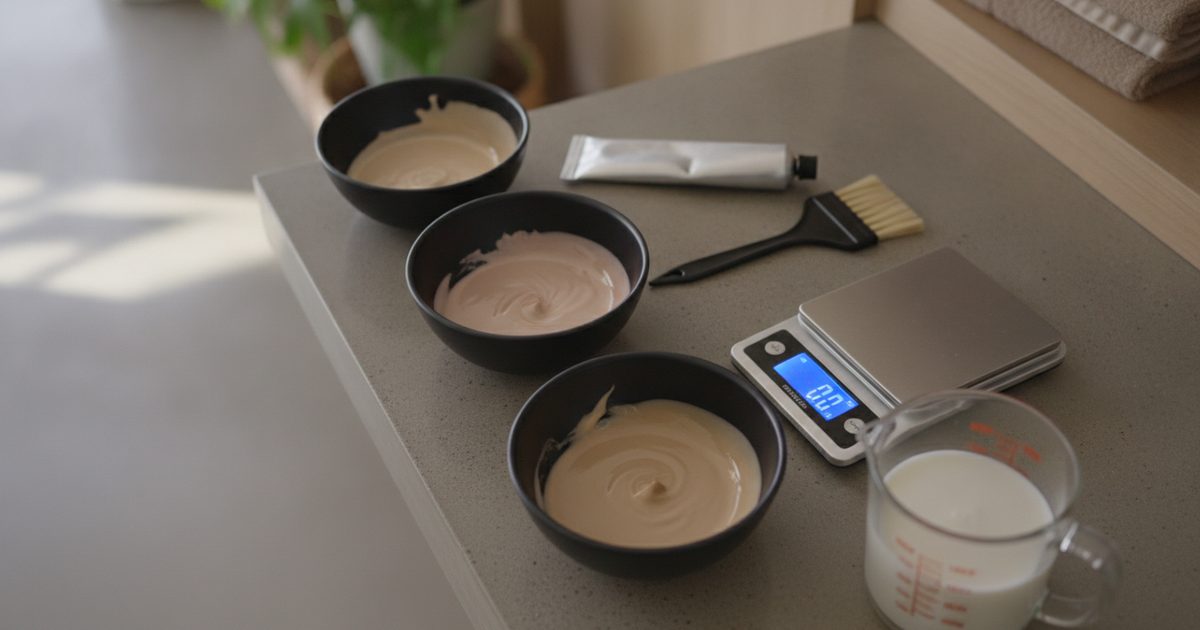
Once the total passes 200 g, mix it in two bowls and start the second when you reach it. Color and developer start working the moment they meet, so the last sections should get product that has not been sitting for twenty minutes. The processing time calculator covers the clock from there.
Toners and glosses
A toner or gloss is thinner than permanent cream and goes further per gram, so a whole-head gloss needs about 60 percent of the full-head amount: 35 g at shoulder length where a full head is 60 g. US colorists talk about it in ounces, an ounce of one shade and half an ounce of another with equal parts processing solution. The ratio depends on the product. A Shades EQ type demi gloss is equal parts, 1:1, so 35 g makes 70 g in the bowl. A liquid toner of the T18 type is 1:2, so the same 35 g makes 105 g. A demi gloss goes on 10 vol or the line's own processing solution, and a T18 type liquid toner on the 20 vol its bottle names. Both go on towel-dried hair.
Highlights, balayage and lightener
Lightener is worked out from the total in the bowl, because what covers the hair is the mixed volume, and the powder is that total split by the ratio. At the usual 1:2, a third of the bowl is powder and two thirds developer.
| Service | Ratio | Short | Chin | Shoulder | Mid-back | Waist |
|---|---|---|---|---|---|---|
| Partial highlights | 1:2 | 10 g | 15 g | 20 g | 30 g | 40 g |
| Full highlights | 1:2 | 20 g | 25 g | 40 g | 60 g | 80 g |
| Balayage | 1:1.5 | 15 g | 20 g | 30 g | 45 g | 60 g |
| Global on virgin hair | 1:2 | 25 g | 35 g | 50 g | 75 g | 100 g |
Lightener root retouch by regrowth, at 1:2: 1/4 in 15 g, 1/2 in 25 g, 1 in 35 g, 1.5 in and over 40 g. Developer on top by ratio. Fine hair times 0.8, thick hair times 1.3.
On the scalp, for a global or a root retouch, lightener stays at 20 vol or lower. Off the scalp, in foils or on painted pieces, 20 or 30 vol is usual, and 40 only where the brand allows it, on coarse, healthy, virgin hair. A global on virgin hair goes on the mids and ends first and the roots last, from a fresh bowl, because scalp heat makes them lift fastest. On a retouch, the lightener stays on the new growth: overlapping onto hair that is already lightened is how breakage lines start.
What pushes the number up
- Density. More hairs per square inch, more surface to coat. Thick hair takes about 30 percent more, fine hair 20 percent less.
- Porosity. Porous, previously lightened ends drink product. Budget an extra 10 percent.
- Curl. Curly and coily hair carries more length than it shows, and the product has to be worked into the coil, so it uses more.
- Length. It compounds with the rest. Thick, curly, waist-length hair tops every table on this page.
Two heads with the same ponytail measurement can still be 10 or 20 g apart in how they take product, which is what the second, smaller bowl is for. The calculator adjusts for density only. For porous, previously lightened ends add about 10 percent yourself, and judge curly or coily hair by its stretched length.
Running short
The amount is judged on the hair. If a section looks thinly covered, it is, and too little product does not give a lighter or gentler result, it gives spots: patchy warmth on a toner, hollow places on a lift that show once the hair is dry. To lift less, drop the developer or the time and keep the product where it needs to be. So mix a sensible bowl for the head in the chair, use it while it is fresh, and if the last two sections are running short, mix a small fresh bowl for them, so the last sections go on as saturated as the first.
Grams by service and length
Color only, at medium density: 30 g is about an ounce, 60 g about 2 oz. Fine hair times 0.8, thick hair times 1.3, rounded to the nearest 5 g, as the calculator does. Developer on top by ratio.
| Service | Short | Chin | Shoulder | Mid-back | Waist |
|---|---|---|---|---|---|
| Root touch-up, 1/2 in regrowth | 30 g | 30 g | 30 g | 30 g | 30 g |
| Full head, uncolored hair | 30 g | 40 g | 60 g | 90 g | 120 g |
| Roots (1/2 in) plus refresh | 45 g | 50 g | 60 g | 75 g | 90 g |
| Gloss or toner, whole head | 20 g | 25 g | 35 g | 55 g | 70 g |
Touch-ups by regrowth: 1/4 in 20 g, 1/2 in 30 g, 1 in 40 g, 1.5 in and over 50 g.
Roots plus refresh is two bowls in the calculator: the root amount of permanent for the regrowth, and half the full-head amount of demi or gloss for the lengths. At half an inch that is 30 g plus 20, 30, 45 or 60 g, which is where the totals in the table come from.
- Half-inch roots: 30 g of color, about an ounce, half a 60 ml tube. Full foils at shoulder length: about 40 g of lightener with 80 g of developer.
- Shoulder-length full head: 60 g of color. One tube.
- Thick hair times 1.3, fine hair times 0.8.
- Developer at the ratio on the back of the tube, weighed or measured with the same cup as the color.
- Past 200 g, two bowls, the second mixed fresh. If a section runs short, a small fresh bowl.
How much hair dye do I need?
How much dye do I need for my hair length?
On a full head at medium density: 40 g at chin, 60 g at shoulder, 90 g at mid-back, 120 g at waist. Multiply by 1.3 for thick hair and 0.8 for fine. Length does not come into a root touch-up at all, because the regrowth band is the same size whether the ends sit at the chin or the waist, so that stays at about 30 g for half an inch.
How much hair dye do I need for a root touch-up?
About 30 g of color, an ounce, for half an inch of regrowth on a medium-density head, plus developer at the ratio on the back of the tube: 30 g at 1:1 or 45 g at 1:1.5. A quarter inch needs about 20 g and a full inch about 40 g. Thick hair takes roughly 30 percent more and fine hair 20 percent less, and if the last section runs short, mix a small fresh bowl.
How much bleach do I need for my whole head?
For a global on virgin hair at medium density and 1:2, about 50 g of lightener powder with 100 g of developer at shoulder length, 75 g at mid-back and 100 g at waist. Mix about two thirds for the mids and ends first and the rest fresh for the roots, which go on last. Thick hair takes about 30 percent more, fine hair 20 percent less.
How much lightener do I need for highlights?
A full head of foils at shoulder length takes about 40 g of powder with 80 g of developer at 1:2. Partial highlights take about half that, 20 g, and balayage, mixed thicker at 1:1.5, about 30 g. On a long application mix small fresh bowls, because lightener starts working in the bowl.
Is one tube of hair dye enough for long hair?
For a full head on uncolored hair, one 60 g tube, about 2 oz, covers shoulder length at medium density and not much past it. Mid-back needs about 90 g and waist length about 120 g, so open two tubes. Roots plus a refresh through long ends takes less, because the lengths are already colored and usually get a demi or gloss through them in place of the root permanent.
How many grams are in a tube of hair color?
Most professional permanent tubes hold 60 ml, a little over 2 oz, which is why the results here count in 60 g tubes. Some lines use 50 ml tubes and others 90 ml or 100 ml, and retail box kits usually hold around 60 ml of color with a larger bottle of developer, so read the label and weigh what you squeeze out, or measure it in the same cup as the developer.
How many ounces of hair dye do I need?
One ounce is about 30 g, so a root touch-up is about 1 oz and a shoulder-length full head about 2 oz, one standard 60 ml tube. Mid-back takes about 3 oz and waist length about 4 oz. US kits and bottles are marked in ounces, so if you are pouring rather than weighing, use the same cup for the developer and read both from the same lines.
How many ml of hair dye do I need?
Close to the same number as the grams. Color cream sits near 1 g per ml, so 30 g is about 30 ml and a 60 g tube is about 60 ml. A half-inch root touch-up needs about 30 ml, a shoulder-length full head about 60 ml, and waist length about 120 ml. Weighing is still more exact, because cream clings to the sides of a cup and a few ml stay behind every time.
How much developer do I add to 30 g of color?
It follows the ratio printed on the back of the tube. At 1:1 it is 30 g of developer, at 1:1.5 it is 45 g and at 1:2 it is 60 g, and in ounces an ounce of color takes an ounce, an ounce and a half, or two. The developer mix calculator does the multiplication for any ratio and any amount, in grams or ounces.
Does thick or curly hair need more hair dye?
Yes. Dense hair has more strands to coat, so budget about 30 percent extra over a medium head. Porous, previously lightened ends soak up more as well. Curly and coily hair carries more length than it shows once it is stretched, so judge the length stretched, and if the back runs short, mix a fresh bowl for it.
Can I save leftover hair dye after mixing it?
No. The oxidation starts the moment developer meets the color, and the mix keeps working for about 30 to 45 minutes and then loses its strength, so whatever is left in the bowl is waste. Unmixed cream is a different matter: squeeze out what you need, cap the tube tightly, and the rest keeps for the next touch-up.
Then the bowl
Gloves on, a plastic or glass bowl on the scale, zero it, color in to the number, zero again, developer to its number, and mix until the bowl is smooth with nothing sitting at the bottom. The mix calculator does the developer arithmetic at the line's own ratio. Cap the half tube tight, and put the first parting in where the job says: the grayest area on a coverage, the back and the mid-lengths on a lift.