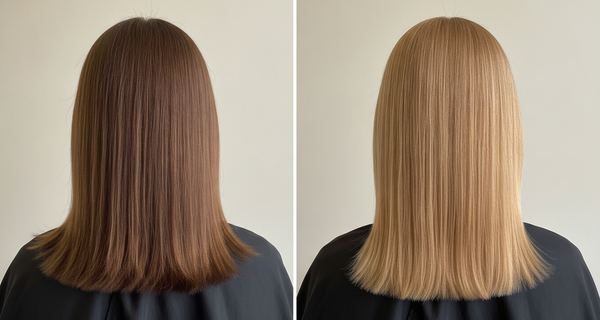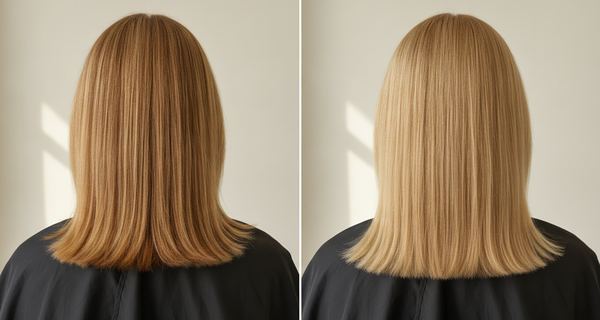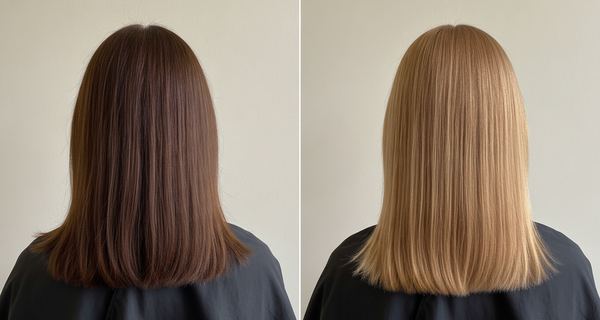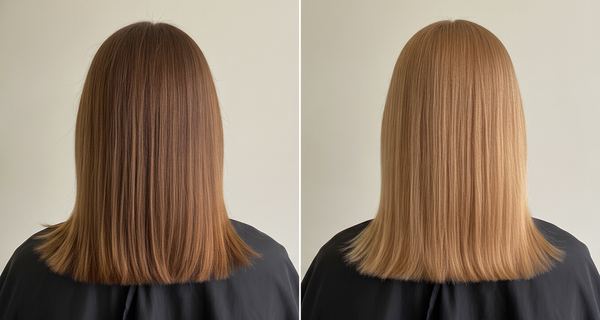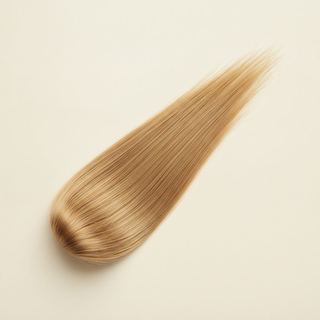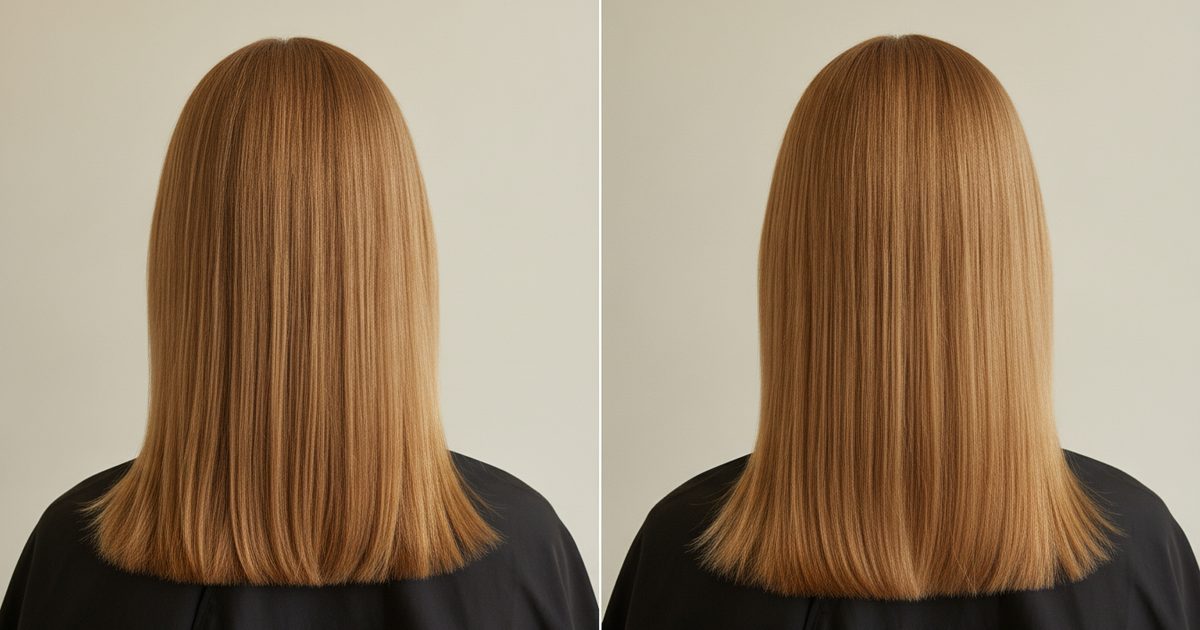
Permanent or demi is the first decision, and here it is most of the decision. A demi 7.1 on 10 vol, on towel-dried hair for 15 minutes, cools a natural dark blonde and leaves it a dark blonde. A permanent 7.1 on 20 vol, on dry hair for 35 minutes, moves the level.
A level of lift, and a lot of tone
A level 6 sits on orange and a level 7 on yellow-orange, so the trip between them is mostly about what shows once the cuticle opens. Twenty vol does the level in 30 to 35 minutes, two levels at most on virgin hair and one here. The orange is what the client sees. A 6 only looks sandy because the orange is filtered through a little brown, and take the brown away and it goes brassy. The blue in a 7.1, a 7A on US lines, sits straight across the wheel from orange, and on a natural 6 it meets the orange at about the strength the shade was built for, so no 7.12 here, since a 6 lifting one level barely reaches the yellow the violet is for. 7N reads warm. A cool shade is the rule when lifting with tint.
Same bowl as the level 6 to 7 toner page, different job: that page is a lifted, often colored 6 getting a half-level nudge, this one is natural hair with a full level expected. Tint lifts the pigment the hair grew, and a 6 with old color through the lengths keeps that color while the regrowth goes to a 7 above it, so old dye means a remover or bleach on those inches before this bowl.
The bowl
Sixty grams and 60 g, about 2 oz of each, on a scale (the markings on a mixing bowl are a guess, and a scale can read 10 g out). A spoon and a spoon keeps the ratio without one. Plastic bowl, mixed fresh and used now, because a bowl left 40 minutes is dead. Saturate. Thin sections and enough product are what make a one-level lift come out one level everywhere. The dye amount calculator scales it for long or dense hair.
Hot roots on a small lift
The problem with a one-level lift is that the roots do two. Scalp heat pushes the developer, the first inch of hair is the newest and finest, and on 20 vol for 35 minutes the root inch of a natural 6 ends up an 8 while the lengths sit at a 7. So the mids and ends go on first, a half inch off the scalp, and the roots last. On a full head the mids take 10 to 12 minutes, which leaves the roots 20 to 23 of the mids’ 35. One timer goes on when the last root section is in. But the mids are the hair to look at, from minute 15 on that timer and every 5 minutes after, because they went on first. The cap goes on between looks, since a cold room slows 20 vol.
Judge what you scrape dry. Wet hair reads a level darker, so a damp root wipe that looks even with the mids is probably a root that has gone past them. The number on the tube is the maximum, so more time on a head that already looks done is more dryness and nothing else.
Fine hair, coarse hair
Fine hair takes the developer faster and holds less pigment, so the 7.1 lands at 25 to 30 minutes on the mids and the roots are an 8 by 35. On coarse, resistant hair 30 vol goes on the lengths only, with 20 at the root, and the processing time calculator puts each texture on its own clock. The tube’s ratio is the one that counts, and a demi in the last three months only comes out by asking, so ask twice.
Between visits
The blue fades first, and by five weeks the 7 reads warm and sandy. A purple shampoo once a week is the maintenance for that. A demi 7.12 for 15 minutes on towel-dried hair is the fix when the warmth has got ahead of it, and the retouch at four to five weeks is 7.1 on the root inch only.
Gray at a 7
White hair takes a 7.1 badly. Sheer, and slightly green, because there is no orange in a white hair for the blue to cancel, and a natural in the bowl is what gives the white something to hold. Up to 30 percent gray the 7.1 alone covers it on 20 vol, which is the developer that covers, since 10 only blends. Between 30 and 50, a third of the bowl as 7N for a neutral-leaning medium blonde. Over 50, half and half, and some colorists take the ash out entirely at that point and go 7N. Better to send a 50 percent gray client home with a neutral 7 that covers than a cool 7 with silver threads through it. When the gray is heavy the order flips at the root, too: the grayest patch, usually the front and hairline, goes on first among the roots and gets scraped first, because white hair has nothing to lift and needs the longest to cover. The gray coverage calculator does the split for the percentage you count.