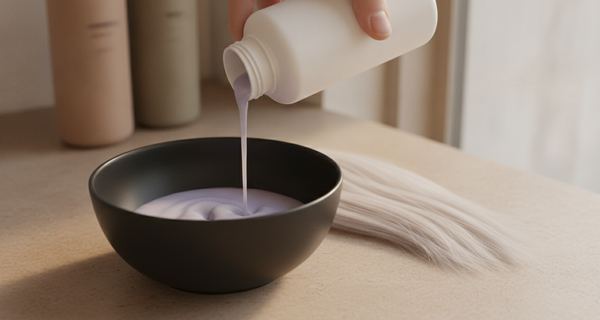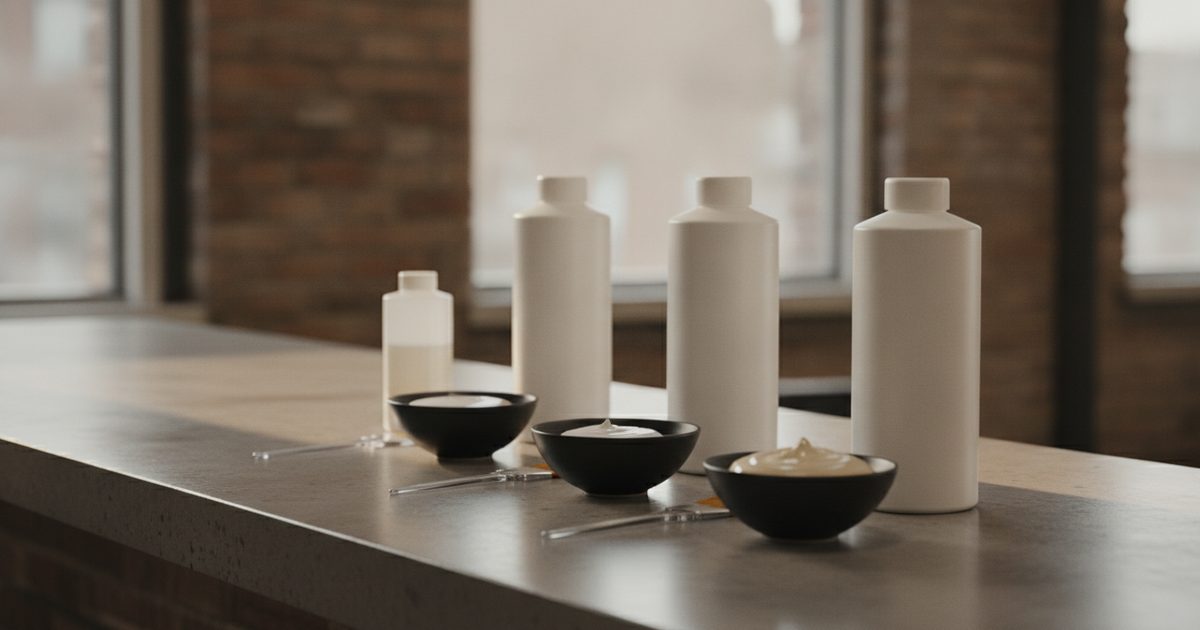
Developer does nothing on its own. It has to be mixed with color, toner or lightener, and they do nothing without it. It is hydrogen peroxide in a cream or a clear base, and it activates the color in the tube, opens the cuticle so the pigment can get in and, at higher strengths, breaks down the hair’s own melanin, which is lift. The number on the bottle is how much peroxide is in it. Ten volume is the weakest most lines sell and 40 the strongest most colorists will use, with a 5 below and a 50 above that few people need. With permanent color, more volume means more lift, more scalp heat and more damage. The tube decides tone. The developer decides how far the hair lightens on the way. Each strength has its own page (10 vol, 20 vol, 30 vol, 40 vol), and this one puts them side by side.
Two things before the table. Nothing over 20 goes on the scalp with lightener in most salons. And with lightener the developer sets the speed and the lift is in the powder, so the levels below are for permanent color and high-lift, and a 10 vol bleach mix reaches the same pale yellow as a 40, slowly.
| Volume | Peroxide | Lift with permanent color | Best for | Not for | Typical minutes | On the scalp |
|---|---|---|---|---|---|---|
| 10 vol | 3% | None to half a level | Toners and demi glosses, going darker, blending gray, a demi refresh on faded ends, fragile hair, low-and-slow lightener | Lifting natural hair with color, covering gray on its own | 10 to 25 (toner), the brand’s full time (permanent) | Fine, the gentlest on skin |
| 20 vol | 6% | 1 to 2 levels | Permanent color roots to ends, gray coverage, one or two levels of lift, lightener on the scalp | Three or more levels with color, toners unless the box says so | 30 to 45 | The standard, and the ceiling most colorists set under lightener |
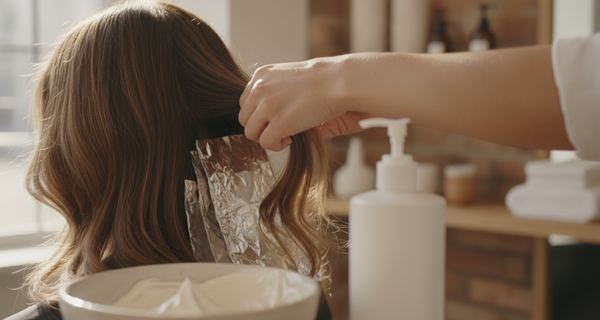
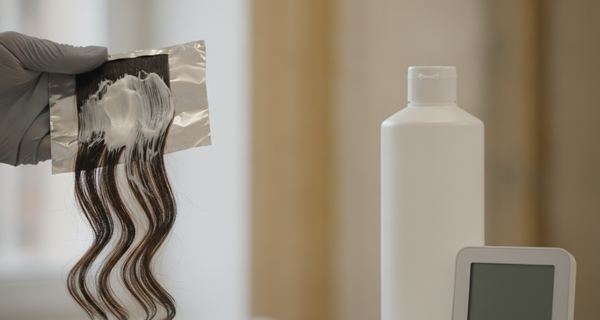
| 30 vol | 9% | 2 to 3 levels | Coarse, resistant hair that 20 will not move, three levels with color, lightener in foils, high-lift where the tube allows 30 | Gray coverage (the white goes sheer), fine or fragile hair, toners and demis | 30 to 45 | Foils. Most colorists keep it off the skin |
| 40 vol | 12% | 3 to 4 levels | The full four levels of a high-lift series on virgin hair, foils on coarse healthy hair if the brand allows it | Lightener on the scalp, fine, porous or previously colored hair, anything deposit only | 30 to 45, checked every ten | Never with lightener. Fast, then it fizzles, and it burns |
Lift figures are for natural, uncolored hair with permanent color: a level 5 on 20 vol reaches a 7, and the level chart shows which pigment surfaces at each step. Every row is a range because scalp heat, porosity and how much product went on all move the minute count, and the processing time calculator asks about texture and porosity before it gives one. Color is done at the brand’s maximum. Lightener is done inside 45 to 60 minutes by most accounts, though not every colorist agrees it ever stops.
Volume or percent
Volume is the older measure, the volumes of oxygen released per volume of solution, and it is what US bottles print and what most colorists say out loud, in the UK as much as the US. Percent is the weight of hydrogen peroxide in the solution, and it is what European bottles carry. The conversion is fixed. Percent is volume times 0.3, so 10 vol is 3 percent, 20 is 6, 30 is 9, 40 is 12 and the 50 in the beauty supply is 15.
The ratio on the back of the tube
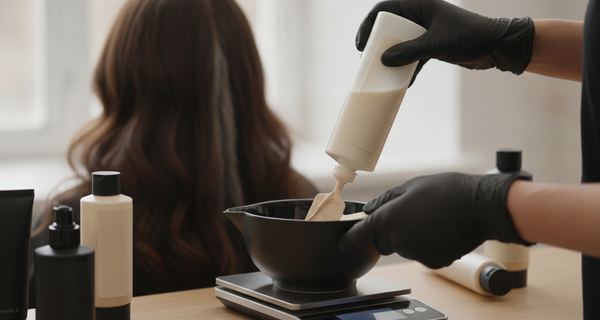
Ratio is how much developer goes in relative to color, written color first. 1:1 is equal amounts, 1:2 is twice as much developer, and the back of the tube prints it. If a lightener tub says nothing, colorists default to 1:2, one part powder to two parts developer, and 1:1 is the strongest bleach mix you can make. Ratio controls how thick the mix is and how much pigment is in it. Volume controls strength, and the two are chosen separately. A 1:1 permanent can be mixed on 10, 20 or 30 vol, a 1:2 toner is still on 10, and doubling the developer on a permanent to chase lift halves the pigment and leaves the color sheer without adding a level. Measure both parts the same way, a scale or the same scoop, a 2 oz tube of color to 2 oz of developer at 1:1, and the developer mix calculator converts grams to ounces. Eyeballing it is the one habit colorists argue about, and most of them weigh.
Cream or clear
Same strength, different consistency. Cream developer holds where it is put, so it is the one for bowl and brush, on-scalp work and foils. Clear developer, the runny one, sometimes labeled liquid or gel, pours, which suits bottle application at the basin and toners worked through damp hair. A cream in a bottle toner is too thick to spread. A clear under a permanent on the scalp runs down the neck. If unsure, pick the cream.
Mixing two bottles to a strength in between
The percent is not a salon convention either. The cosmetics regulation lists hydrogen peroxide at 12 percent, 40 volumes, and puts “wear suitable gloves” in the same entry, which is the short answer to why every colorist has a box of them on the cart.
Two developers mixed together sit at the weighted average of their strengths, because mixing two peroxide solutions is a dilution. Equal parts 20 and 40 by weight give 30 vol, 6 and 12 percent averaging to 9, and equal parts 10 and 20 give 15. For unequal parts, multiply each weight by its volume, add the two, and divide by the total weight: 40 g of 20 vol and 20 g of 40 vol is (40 × 20 + 20 × 40) / 60, which is about 27, a soft 30. Weigh both, stir them into one texture before the tube goes in, and mix in a plastic or glass bowl, since metal reacts with peroxide and gives spotty results. Water is a different thing. It lowers the percent, thins the cream until it runs and throws the color-to-developer ratio off.
Most colorists never mix strengths at all. They buy the bottle in between, since 15, 25 and 35 volume all exist.
Reading a bottle that only says a percent
Divide by 3 and multiply by 10. 3 percent is 10 vol, 6 is 20, 9 is 30, 12 is 40, 15 is 50. A 1.5 percent bottle is the 5 vol toning developer. A 4 percent bottle is about 13 vol and goes where the brand sheet names it, usually a one-level lift or resistant toning. Bottles that carry both numbers print them as “20 vol / 6%”. Box dye carries a 25 or 30 volume for everyone, and the box does not know what you are starting with. A bottle that carries neither number stays out of the bowl until someone has found the directions for it.
And the line most colorists end on: if you are unsure, 20 volume cream.