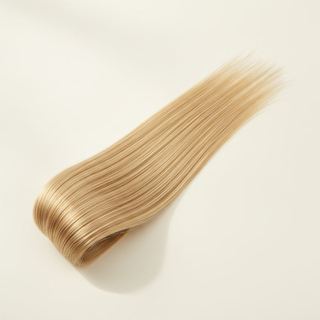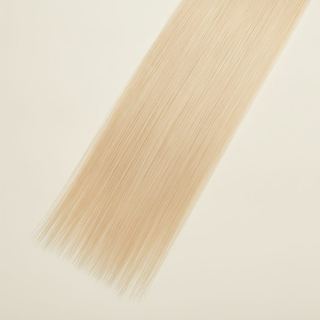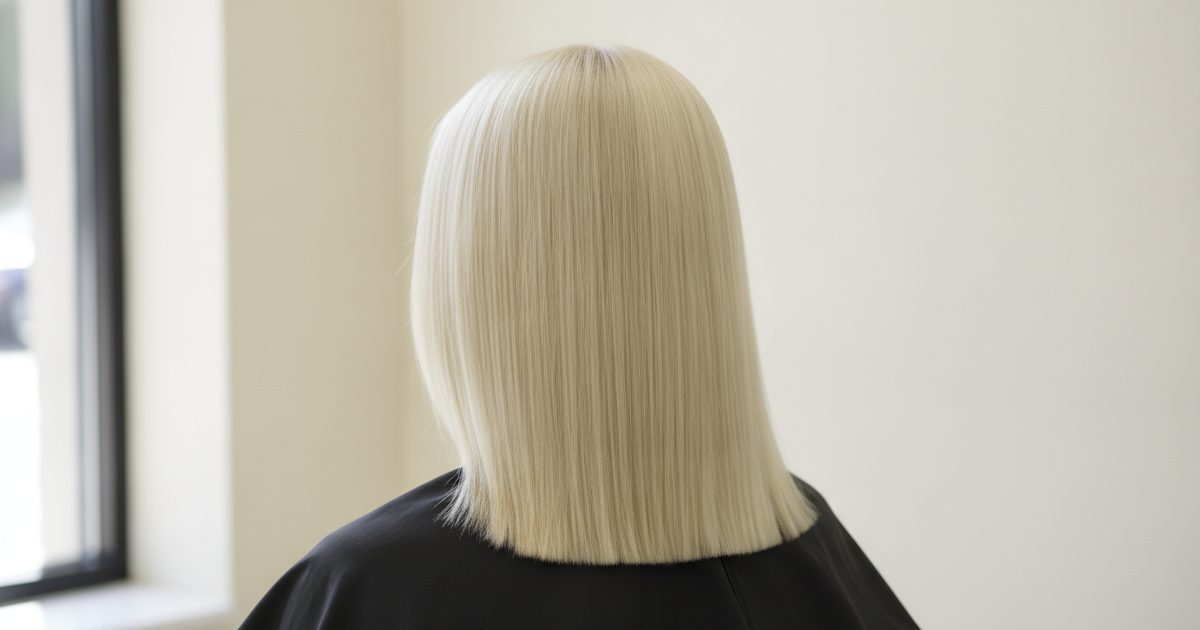
Level 10 is the palest the hair can be lifted while it is still hair. A faint yellow stays in the fiber, close to cream, and that is the level. White hair sits outside the scale altogether, with no pigment left to lift, and the white-looking 10 in every reference photo is a lifted 10 with a violet or pearl toner over it. Some lines print an 11 or a 12 above it. Those are high-lift tints, translucent rather than lighter, and the hair under them is still a 10. As a natural adult color a 10 is rare enough to be a curiosity, and every 10 you meet was made.
The last of the yellow
The underlying pigment at 10 is the palest yellow, the end of the sequence that was orange at 6 and clear yellow at 8. Lifting into 10 from a 9 removes almost all of it. Past 10 there is nothing left to remove but the fiber, and bleach left on to chase a whiter white breaks hair and lightens nothing. Under the paste a 10 looks white. At the rinse it is pale yellow, always, and the toner is what makes the photograph.
Violet cancels yellow, and at 10 the yellow is so faint that a pearl, violet with a touch of ash, or a clear demi with a few grams of violet in it is enough, on 10 vol or the 5 to 9 vol toning developer the line sells. Over-toned, a 10 goes lilac within minutes, then a flat gray-lavender, and a blue-based ash drifts green-gray. Pale hair shows every gram. T18 belongs here and nowhere darker: it is a pale-yellow product, a liquid permanent mixed with 20 vol, and on a fresh 10 that 20 vol buys a little more lift and a longer hold at the price of a scalp that stings and over-lightened ends that can go gray. On ends like that a demi on the low developer is the safer bottle. The toner selector leans light here, and the level chart lists nothing bluer than pearl for it.
Rounds and visits
From an 8, 20 vol permanent (30 vol on coarse, resistant hair). From a 7, 30 vol permanent, or a high-lift series with 40 vol on virgin hair only. From a 6, high-lift with 40 vol on virgin hair only. From a 5 or below, bleach, since permanent color cannot lift that far in one step, and old tint anywhere on the lengths makes it a bleach job whatever the root reads.
Those are single-application rules. A 10 from dark hair is bleach in rounds, and how the rounds are spaced is where colorists disagree. Some take a natural 5 to a 9 or 10 in one long day: 20 vol on the scalp and never more, a bond builder in every bowl, mids and ends first and roots last, a cap or bag to hold the hair’s own warmth and no dryer, thirty to forty-five minutes a round, then rinse, dry, look, and a fresh mix on whatever lagged. Two or three rounds like that, with a pull test between each. Others stop after a round or two, tone at the level reached, and book the rest three weeks out. Both are practiced. What they agree on is that a 4 or darker may stop at 9 and stay there, and that nobody reaches a clean 10 in the hour before an event.
What the hair has to have left
Each round of bleach opens the cuticle and takes protein out with the pigment. By 10 the lengths have been through that three or four times, the ends once more than the roots, and elasticity is the measure that matters: pull a wet strand from the back. If it stretches and comes back there is another round in it. If it pulls long and stays, or goes gummy, there is no more lift in that hair whatever the level says, and the next step is a cut, since bleaching damaged ends again is how a 10 ends up shorter than it started. Fresh bleach never overlaps onto hair that was lifted in an earlier round.
Porosity is the other cost. Hair at 10 takes toner in three or four minutes on the ends and loses it in a handful of washes, so the color it leaves with is the least stable on the scale. Roots first, ends last or diluted one to one with clear, and a strand of the ends rinsed before the timer says so.
Upkeep
Regrowth on a 10 shows at a week on a level 5 base. Most people are back at four to six weeks for roots, which is regrowth only and never overlapped, and the toner lasts two to four weeks, sooner with hard water or chlorine. A violet shampoo once a week maintains the tone between visits. It is upkeep and it is not a toner: it will not fix a 10 that has gone yellow, and used every wash it stains a 10 lilac faster than any bowl. A shadow root, a 7N or 8N demi an inch down and blurred into the 10, is the usual way to make the six weeks look deliberate.
Gray is the one place 10 gets easier. White hair is lighter than a 10, so on a 10 head it hides in plain sight, and a 10N covers nothing: on white hair it is a translucent gloss. White also grabs violet first and goes lavender first, so toner on a gray-heavy 10 runs shorter still. The gray coverage calculator calls it a blend at any percentage.
Most people who ask for a 10 are describing a well-toned 9. A 9 with a pearl over it reads as ice blonde in daylight, holds toner longer and survives a heat tool, and the client who needs the extra level is the one going somewhere with it.
What a 10 can carry
Silver, pastel pink, lavender, mint and pale peach need a 10 under them. On a 9 the yellow that is left pulls every one of them warm, a pink toward salmon, a silver toward khaki, and no toner cancels its way out of that, because a toner cannot lift.
The codes at 10, US letters beside the decimals:
| Shade | Reads as | Use it for |
|---|---|---|
| 10N | Pale natural blonde, some warmth kept | Clients who find toned blondes cold |
| 10.1 (10A) ash | Cool and matte, faintly gray | A trace of gold; muddy on a clean 10 |
| 10.2 (10V) violet | The yellow canceled, nothing added: ice | A clean lifted 10 |
| 10.21 (10P) pearl | Violet-ash: champagne with a shine | The default for “platinum” |
| 10.3 gold | Cream, honey | Warming a 10 that came out cold |
| Clear plus violet | A faint tint, mostly shine | A 10 that is almost there |
And the goals people bring, with the level the hair must reach first:
| Goal | Minimum lifted level | Toner family | Maintenance interval |
|---|---|---|---|
| Silver or gray | Clean 10 | Violet-ash (10.21 or 10.1) plus silver | 2 to 3 weeks |
| Pastel pink | 10 | Pink over a 10.2 violet base | 2 weeks |
| Icy blonde | 9 to 10 | 10.2 violet or 10.21 pearl | 3 to 4 weeks |
| Clean natural 10 | 10 | 10N or 10.21 on the toning developer | 4 to 6 weeks, toner sooner |
Coming down, one level to level 9 is a deposit on a demi at the low developer. Three or more levels darker needs a fill first, because a 10 has no warmth left to hold a brown, and lightened hair grabs pigment and dries darker than the swatch, so the shade goes in a level lighter than the target and the developer mix calculator scales the bowl.