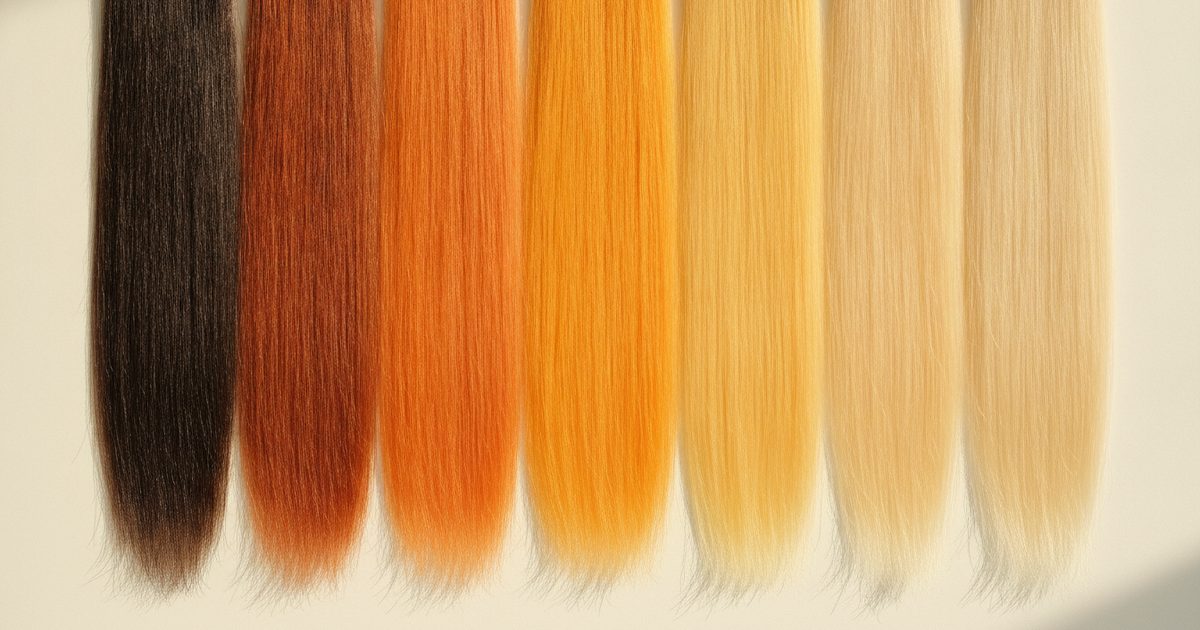
What are the levels of bleached hair?
The same ten levels everything else uses. One is black at the bottom of it, ten is the palest blonde at the top, and bleach moves hair up that scale rather than along it. What changes as the hair climbs is the pigment left in the fiber: the reds sit under the browns, the oranges under the dark blondes, and yellow under the light blondes. Hold the scraped piece against the ten levels with a picture of each and the number is whichever one it disappears into.
Two numbers matter on a head that has been bleached before. The regrowth is the natural level, read at the root, the way a level is read, and the lengths are a second number, read by the pigment showing in them. They rarely match, and the two want different bowls.
The stages of lift, in order
| Level reached | Pigment showing | How it reads on the head | What cancels it |
|---|---|---|---|
| 3, dark brown | Red | Rusty, strongest in the first twenty minutes under the powder | Green, matte or ash |
| 4, medium brown | Red-orange | Warm copper coming up through brown | Blue-green ash |
| 5, light brown | Orange-red | The stage brunettes call brassy first | Blue, with a touch of green |
| 6, dark blonde | Orange | Plain orange, the longest stage of the lift | Blue ash |
| 7, medium blonde | Yellow-orange | The strongest warmth in the sequence | Blue-violet |
| 8, light blonde | Yellow | Clear yellow, bright straight out of the bowl | Violet (a little blue for a cooler result) |
| 9, very light blonde | Pale yellow | Faint warmth, still warm against white paper | Violet |
| 10, lightest blonde | Palest yellow | Close to cream, never truly white | Violet or pearl |
The order never changes.
What changes is the speed. Orange is the stage that lasts longest, which is why so many heads stall there, and the last half level from a 9 to a 10 costs more time than the two levels before it. A head also tends to run a level more orange than the chart while the mix is still on, so the piece to formulate from is the one you scraped clean and dried.
How far does one round of lightener go?
Up to four levels in one session on healthy hair that has never been colored; five or more is usually two sessions on different days. The top of that range belongs to foils, where the packet holds the heat in, and a foil session from a light brown base is the worked example: 1:2 by the tub, 30 vol off the scalp on virgin hair, 45 to 60 minutes with the first foil opened from 25. Open air lifts more gently and lands lighter on warmth, which is the trade in a hand-painted session on dark blonde: a thicker 1:1 to 1:1.5 mix, 40 to 50 minutes, no added heat, wiped from 30 minutes on.
A natural level 4 usually lands around a 7 or an 8 and shows yellow-orange to yellow. Hair that has been colored before is the exception to every number above: the artificial pigment lifts out first, so the early minutes buy no level at all, and the hair arrives late and warmer than virgin hair from the same starting point. The honest number is the one on the wiped strand rather than the one on the chart, since a stalled lift tends to read a level more orange than the chart predicts.
A lift of five levels or more is more than one session for most hair, whatever the target, so the plan is two appointments on different days, and saying so before the bowl is mixed is what separates a stretched session from a broken one.
Why does bleached hair stall at orange?
Because orange is the widest rung on the ladder. It is the pigment under level 6, dark blonde, and the yellow-orange under level 7 is the most saturated warmth in the whole sequence. Every brown head passes through both on the way to blonde, and what to do when bleach stops at orange is that whole decision in one page. A lift that runs out of steam, or gets rinsed early because the scalp is hot, lands in the middle of them.
Stalling is not damage on its own. Plenty of heads are meant to stop at a 7 and be toned there. What makes it a problem is treating it as a color question and reaching for a violet toner, which cancels yellow and leaves the orange untouched. Orange wants blue. Blue-violet covers the two halves of a yellow-orange 7 at once, which is why a 7.12 exists. And a toner deposits, so none of it moves the hair a level lighter. If the hair stopped there and has nothing left to give, the page on correcting orange bleached hair walks the two honest routes: a controlled second pass, or a toner at the level the hair actually reached.
What developer goes under lightener at each stage?
The stage matters less than where the mix sits. On the scalp it is 20 vol or lower, always. Off the scalp, 30 vol is the working strength for virgin hair in foils, 20 vol for fine hair or where the tub names it, and 10 vol for any piece that has been lightened before. Forty vol lives in a narrow box: foils only, where the brand allows it, on coarse, healthy, virgin hair, checked every 10 minutes, with no heat under it.
Ratio comes from the tub and not from habit. Foils and a global are usually 1:2, some tubs 1:3, and hand painting wants the thicker 1:1 to 1:1.5 so the mix does not travel. For how much of it to mix for the length and density in front of you, the lightener amounts in the dye amount calculator work from the same mixed totals, and the developer to color mix calculator splits any bowl into powder and developer once the ratio is picked.
When does the lightener come off?
When the scraped strand reads the level you want, or when the hair says so first. Wipe the first section from 10 minutes on the scalp and from 25 in foils, then every 5 to 10, and dry the piece between your fingers before you judge it, because wet color lies about the level.
Elasticity is the check that overrules the color. Pull a wet strand from the back of the head: if it stretches and does not spring back, the lift is finished whatever the number says. Tone where you are, put the last level on the list for another day, and treat the ends as the fragile thing they now are.
How do you read the level of hair that is already bleached?
By the warmth it kept. Orange lengths are sitting at a 6 or a 7, clear yellow at an 8, pale yellow at a 9, and something close to cream at a 10. No swatch book is needed for that read, only daylight and a dry piece.
Old bleach complicates it in one way worth knowing. Lengths lightened months ago have usually faded warmer as the toner washed out, so they read a stage lower than they did on the day. That is a toner question and not a lift question, and reaching for the powder to fix a warm memory is how ends get thin.
Which toner matches the stage you stopped at?
The one that cancels the pigment in front of you, at the level the hair actually reached. Blue cancels orange at 6, blue-violet the yellow-orange at 7, violet the yellow at 8, with a little blue if you want it cooler, violet the pale yellow at 9, and violet or pearl cut with clear at 10. Pick from what the dried strand shows rather than from the photograph on the box, and let the toner selector narrow it once the level is settled.
Toners deposit, they do not lift. A toner cannot take a stalled 7 to a 9, and ash reads darker on the head, so a cool toner over an orange 7 can dry looking like a 6. If the goal is lighter rather than cooler, that is another round of lightener on another day, and the lift and developer between any two levels is the place to see what that round has to do.
Can bleached hair go back down a level?
Yes, by depositing instead of lifting. A demi or a permanent shade at the level you want puts pigment back, and hair that has been through the yellow stages has to have the warmth it lost put back first, which is what a filler is for. Going down more than two or three levels in one step is where the result turns muddy or green, so the shade is built at the level under the target and tested on a piece from the back of the head.