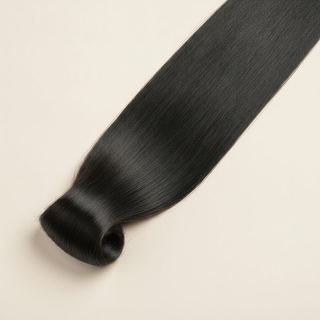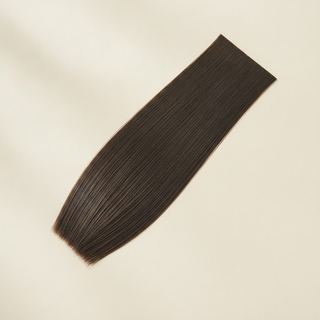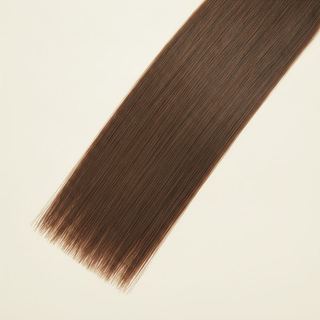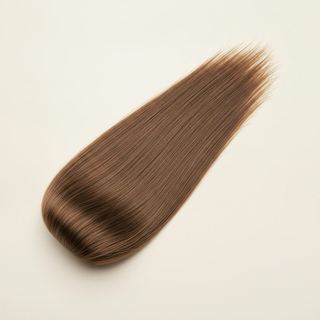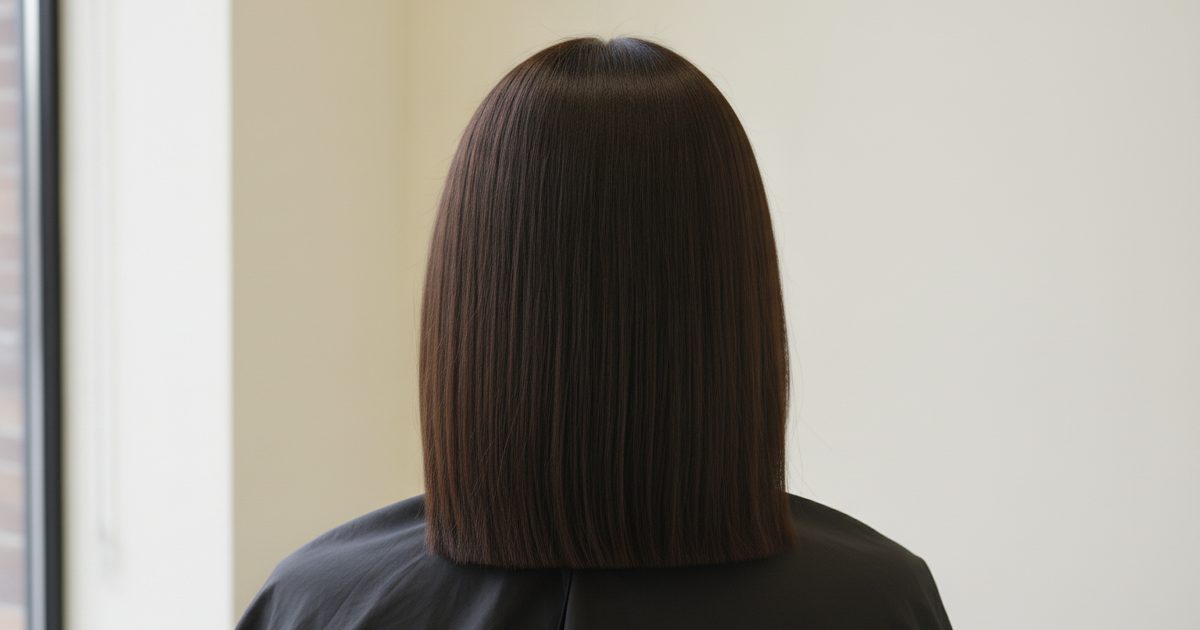
A colorist reads a 3 in three numbers before touching a tube: the natural level at the root, the level the lengths have reached if anything has been done to them, and the level the client wants. Dark brown is where that habit earns its keep, because a 3 passes for black indoors, lifts two full levels on 20 vol, and turns red on the way.
The root first
A dry section from the back of the head, held up to the window, and one question: does it still look brown? A 3 is the darkest brown that still reads as brown in daylight; indoors and in photos it passes for black. A 4 stays plainly brown in any light, and the level 4 page covers that case. Wet hair reads darker, so dry it first, and read the first inch at the scalp, since the ends may be sun-lightened or colored and belong to a different number. Some colorists photograph the section and switch it to black and white, which leaves only the lightness to compare.
Level 3 and level 2 between them are the natural color of most of the world, and a 3 sits in a color chair more often than 4, 5 and 6 put together.
Red first, then orange
At 3 the pigment underneath is a true red. From a 1 or a 2 it is one or two levels of lift on 20 vol, and this red surfaces on the way in, so a 2 taken one level lighter comes out warmer and only a little lighter. Lift a 3 up through its own level and the red starts to move: red-orange at 4, orange-red at 5, orange at 6, yellow-orange at 7, then yellow and pale yellow. That order holds on every dark head. Where each stage lands varies, and a lift that stalls tends to show its orange one level higher than the chart puts it, so the strand you press the cream off and dry is the one to formulate from. The chart, and the toner selector built on it, give you the direction across the wheel; the strand gives you the number.
Green cancels red, and the matte and ash shades at level 3 are green-based for that reason. Too much green and the result goes muddy: a flat olive-brown on lifted hair, a khaki cast on hair that was not showing much red to begin with. The green goes in a little at a time, and some colorists leave it out at 2 and 3 entirely, since nothing is exposed to cancel until the hair has been lifted to a 4 or beyond. Cooler also reads darker, so a green-based 3.1 on a natural 3 looks a step deeper than the tube.
From a 3 to lighter, by developer
| From level 3 to | Lift | What it takes on healthy, uncolored hair | Rounds | What is left to tone |
|---|---|---|---|---|
| Level 5, light brown | 2 levels | 20 vol permanent (30 vol on coarse, resistant hair) | 1 | Orange-red; blue ash with a touch of green |
| Level 6, dark blonde | 3 levels | 30 vol permanent, or high-lift with 40 vol on virgin hair | 1 | Orange; blue-based ash |
| Level 7, medium blonde | 4 levels | High-lift with 40 vol on virgin hair; otherwise lightener | 1 with high-lift, 1 to 2 rounds with lightener | Yellow-orange; blue-violet |
| Level 9, very light blonde | 6 levels | Lightener; color cannot lift this far | 2 to 3 rounds, one day or two visits | Pale yellow; violet |
The developer rule for permanent color is the one every colorist counts on a finger: 20 vol gives up to two levels, 30 up to three, 40 up to four with a high-lift series, and past that it is lightener, on which the developer only sets the speed. The level chart gives the lift for any pair. Two things the table assumes. First, natural hair: permanent color moves natural pigment only, so 30 vol on a box-dyed 3 lifts the regrowth and leaves the lengths where they were, and that head gets a color remover and a re-read, or lightener from the start, which is what most salon corrections on old box color do. Second, medium texture. Coarse, glassy level 3 hair often adds a round on the lightener rows, fine hair can shoot past the number, and a test section through the full time is how you find out which head you have.
On the lightener rows the bowl matters as much as the count: 20 vol on the scalp and up to 30 in foils or on the lengths, a bond builder in the mix, mids and ends first because the scalp is hot, a cap to hold the warmth and no outside heat, thirty minutes and then a fresh mix on whatever is lagging rather than a longer sit. Between rounds, pull a wet strand; if it stretches and does not spring back, that hair has had its day. Whether a 3 should go to a 9 in one sitting is where colorists split. In a salon with those rounds it is done routinely; the careful voices still say two visits three weeks apart leave a cleaner blonde and a client who still has ends, and at home that is the answer. Whatever the lightener leaves, the toner goes on at that level or darker, on 10 vol or the brand’s own 5 to 9 vol toning developer, and it cannot lift.
Gray at level 3
The natural series, on 20 vol. A 3N covers white hair fully, and on white hair it reads exactly the depth on the tube, since there is nothing underneath it. Ten vol only blends. Under 50 percent gray, half 3N with whatever fashion shade you want; over 50 percent, straight 3N, or 3NN if the brand has one, and stubborn white at the front gets the color first and an extra ten minutes. The catch at this depth is regrowth: white roots against a level 3 show at about three weeks, which puts most level 3 gray clients on a four-week cycle. The gray coverage calculator turns the percentage into a split.
Back down to a 3
Deposit does it, with one condition. From a 4 or 5, one or two levels darker, a 3 on 10 vol demi or 20 vol permanent goes on and stays. From a 6 or lighter on hair that has been lightened, three levels or more, the hair is missing the red a natural 3 sits on, and a 3 applied straight onto it comes out flat and muddy and fades in a week. Fill first: a warm shade at 5 or 6, gold or copper, to put the red back. Then the 3 on 10 vol. And go a touch warmer than you think, because lightened hair grabs pigment and reads cooler and darker than the swatch.
Which 3 to buy
3N (3.0) is the natural series, a neutral dark brown, for gray coverage or anyone who wants brown with nothing extra on it. 3.1 (3A) is ash, green-based at this depth, for ends throwing red or a client who wants a cool, almost black-brown; on its own over a natural 3 it reads dull and a step darker, so it goes in half with 3N. 3.5 is mahogany, red-violet on brown, which reads as a plum-tinged dark brown indoors and shows its red in sun. 3.6 is red, and at level 3 it reads as a dark cherry, since there is too little lightness for a copper to show through. The number in front is the level in every line, though some lines start at 2 and some run to 12, and the part after it is where brands part ways: the same shade is 3A, 3/1 or 3-1 depending on the box, and its green may be blue in the next line, so read the line’s own chart.