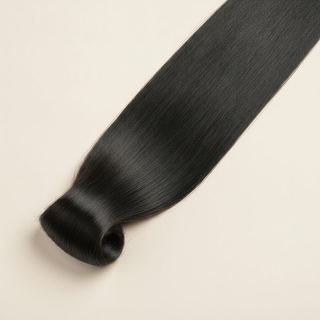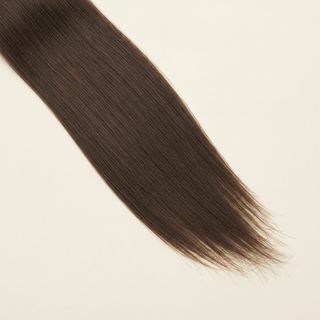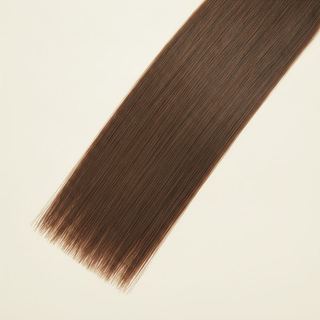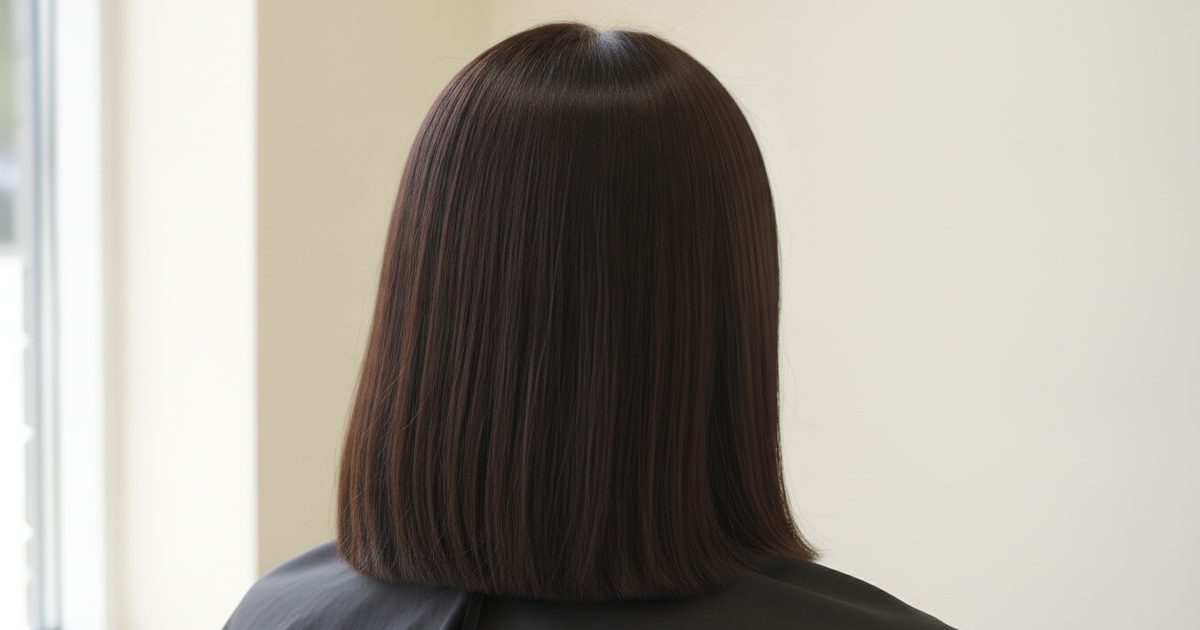
Level 2 sits between black and dark brown, and most people cannot tell it from a 1 indoors. At a window the difference is a warm cast: a 1 stays black and a 2 shows a faint burgundy glow in the lengths. The level chart is the first place a neutralizer appears, green, because 2 is the first level where the pigment underneath can show, though it takes lift to bring it up.
Reading a 2 at the root
The first number to find is the natural level, at the root, dry, in daylight. Natural level 2 is a very dark brown with a warm undertone seen most at the ends and the crown. On coarse hair the warmth is stronger; on fine hair the whole head can look like a 1 until you part it at the window. Compacted hair reads darker than it is, so some colorists take a piece out and fan it before they call the number. As a colored result, a 2N on a level 3 or 4 base is a soft black-brown with almost no grow-out line, and a 2.1 on the same base has the red taken out and reads as black in any light.
Nine times in ten the hair a client means by “natural black” is a 2. A client brought her mother’s wedding photograph to show me the family black. At the window, dry, her root sat beside the 2N swatch and matched it, and the ends had the burgundy cast a 2 picks up after a summer. A 1N over that head would have come out heavier and flatter than the color she grew up with. We did a 2N on 10 vol demi, which gives the black people remember with the warmth still in it, and 20 vol permanent only comes into it if there is gray to cover.
Dark red, and where it goes
The pigment underneath level 2 is dark red. Lift a natural 1 one level on 20 vol and the dark red is the first thing to surface, a warm cast visible at the window and invisible indoors. Lift through 2 into 3 and the red opens up, then red-orange at 4 and orange-red at 5, and on from there through orange and yellow to pale yellow. That is the chart’s version and it matches the manufacturers’ charts. On the head, a lift that stalls usually shows its orange a level higher than the chart says it should, so the number to formulate from is the one on the wiped strand, dry, and never the one the chart predicted.
Out of a natural 2, 20 vol permanent reaches a 4, 30 vol reaches a 5, a high-lift on 40 vol reaches a 6 on virgin hair only, and a 7 or above is lightener. Every one of those stops on warmth, and the toner for it is picked across the wheel from what you see: green for red, blue for orange, violet for yellow. At level 2 itself the green is the matte or ash series, 2.1, and a little is enough; some colorists skip a neutralizer altogether at 2 and 3 on the grounds that the pigment is still in the hair and there is nothing to cancel yet. Push the green too far, or put ash on a natural 2 that never went through lift, and you get a muddy green-brown at the window that the client calls dull. There is no yellow at this depth, so a violet-based shade does nothing except cost money. Past 2, the toner selector lists the green-based shades level by level.
The box-dyed 2
This is the level 2 situation salons see most. The client was a natural 5 or 6, has used a box “darkest brown” or “soft black” for a few years, and now wants to be lighter. Permanent color on 30 or 40 vol lifts natural pigment only, so the regrowth moves while the box-dyed lengths stay put and the head ends up two colors. Color does not lift color, and no lighter box changes that.
The decision is between a color remover and lightener. A remover shrinks the artificial dye so it rinses out, leaves the natural pigment alone and does not lift; afterwards the lengths sit near their pre-box level, often a warm 5 or 6, and you can read the head again. Some colorists use it whenever the target is within three levels of the natural hair. Lightener takes everything, natural and artificial, and on hair that has held years of dark dye it goes unevenly, the newest dye first and the oldest holding on at the ends as a stain over the lift. Most filmed salon corrections on old dark box color go straight to lightener at low volume with a bond builder, because when the target is blonde that is where the job ends up anyway. How much dye is on the lengths does not show at a dry root, so whichever route it is goes on a hidden strand first. The lightener leaflet also says not to use it on hair treated with henna or metallic dyes, and “darkest brown” from a box can be either, so that is a question for the consultation and not the basin.
Coming down to 2 from lighter hair
Going darker to level 2 from a 3 or 4 is deposit only, 10 vol demi or 20 vol permanent. From a 5 or lighter on lightened hair it is three or more levels down, the hair has lost the dark red a natural 2 carries, and a 2N straight onto it goes flat or green-gray at the porous ends. Fill with a warm shade first, a copper or red at level 4 or 5, then deposit the 2N on 10 vol. Skip the fill on a level 8 base and the ends come out a flat gray-green, and the repair is the filler and the 2N again, a second full application on hair that has already had one. Grams for either bowl are on the developer mix calculator.
Gray at level 2
Level 2 covers gray well: a 2N or 2.0 permanent on 20 vol covers up to 100 percent white, and on white hair it reads as a slightly warm black-brown, softer than a 1N on the same head. Ten vol only blends it. The regrowth shows in ten days to two weeks, and a 2N grows out kinder than a 1N because the line between white root and warm black-brown is softer than white against a flat 1. Start the application where the gray is, usually the front and the part line, so it gets the longest time, and give stubborn white an extra ten minutes before rinsing. The level 1 page has the ten-day version.
The codes at level 2
| Code | On a dark base, natural 1 to 3 | On a light or lightened base, 6 and up |
|---|---|---|
| 2N | Natural black-brown, warm cast at the window, soft regrowth | Flat, slightly cool black; green-gray at the ends without a warm fill |
| 2.0 | 2N in decimal notation; .00 in some brands adds coverage pigment | Same, and the extra pigment makes the flatness worse without a fill |
| 2.1 (ash) | Cool black-brown, reads as black in any light | Green-gray unless filled; ash on porous hair grabs hardest |
| 1N, for comparison | True black, no cast anywhere | Very flat black, hard to leave later |
The first number is the level and the second, or the letter, is the tone, and that much holds across brands. The rest does not: one line’s ash is green and another’s is blue, one line starts its scale at 2 and another runs it to 12, so the swatch book for the line in the bowl beats the code on a page. And on a 2 that has been lifted to blonde, the finish that matters most is at the scalp, a shadow root of darker demi smudged into the first inch so the natural 2 growing back reads as a choice and the line stays soft for weeks.