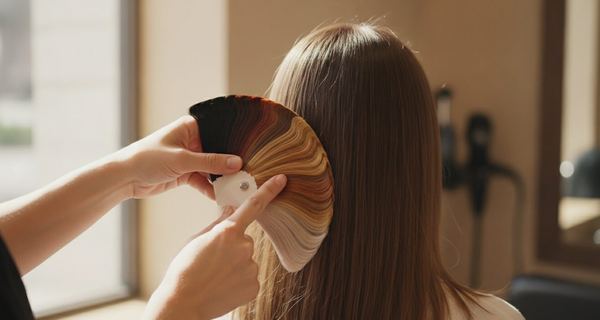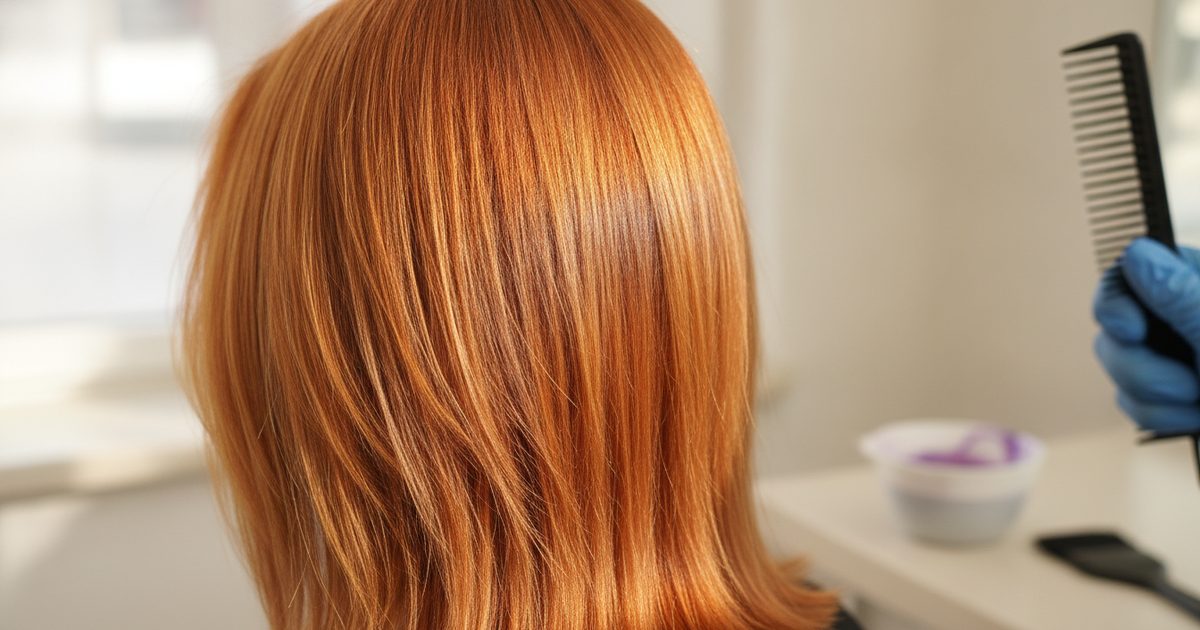
- Blue cancels orange. Violet cancels yellow. Violet shampoo will not fix true orange.
- A toner changes the tone and leaves the level where it is. It cannot turn orange into light blonde.
- Stretch-test the hair before any more lightener, and wait 4 to 6 weeks between sessions.
- Box dye or henna in the hair? Test a few snipped strands before any lightener.
What should I do in the first 24 hours after my hair turns orange?
The first day is where orange hair turns into broken hair, because panic makes people lighten twice in one evening. The order of work for the first day:
- Stop all chemical work. A second lightening on the same day belongs to someone who has tested the hair’s strength first.
- Rinse thoroughly in lukewarm water until it runs clear, so nothing is left working in the hair.
- Condition deeply. A rich mask or a bond treatment, left on for the time the pack gives.
- No heat. No iron, no wand, no hot dryer. Air-dry, or use the cool setting.
- Wait for dry hair and daylight before you judge it. Wet hair and a warm bulb both make orange look stronger and patchier than it is.
- Take photos of the front, the back and the ends in daylight. Whoever fixes it will want them.
Why did my hair turn orange after bleaching?
What underlying pigment means
Natural color is melanin: a lot of dark brown-black in dark hair, with red and orange sitting under it. Lightener breaks the dark pigment down first, and the warmth it uncovers is the underlying pigment for that level. The ladder this site uses, and the color that cancels each stage. The tone code is the number after the dot on a color tube: .1 is ash (blue-based), .2 is violet.
| Level | Name | Underlying pigment | Neutralizer | Tone code |
|---|---|---|---|---|
| 4 | Medium brown | Red-orange | Blue-green | .1 |
| 5 | Light brown | Orange-red | Blue, with a touch of green | .1 |
| 6 | Dark blonde | Orange | Blue | .1 |
| 7 | Medium blonde | Yellow-orange | Blue-violet | .1 + .2 |
| 8 | Light blonde | Yellow | Violet | .2 |
| 9 | Very light blonde | Pale yellow | Violet | .2 |
| 10 | Lightest blonde | Palest yellow | Violet | .2 |
Charts differ by about a level between brands, so read the wiped strand rather than the chart. Not sure where you are? What level is my hair reads it off the root, and the level chart has a picture of each one.
Why the lightener stopped at orange
- The time was too short for the starting level. Dark hair needs longer to get past orange. The processing time calculator gives the first look and the ceiling.
- The developer was too weak for the lift. The developer volume chart says what each volume reaches.
- The lightener dried out. Dry lightener has stopped working.
- The application was thin or uneven, so some sections got less product than others.
- There was box dye in the lengths. Artificial pigment is harder to lift than natural pigment and tends to stay warm.
- Minerals from hard water, iron especially, or pool water, built up and got in the way.
- The target was too far for one session. A level 2 or 3 to a level 9 in one sitting is not a plan, it is a hope.
Which orange do I have?
This is the step that decides everything else, and it is the reason so many people buy the wrong bottle. Orange is not one color.
| What you see, dry and in daylight | Level | Neutralize with | Where to go |
|---|---|---|---|
| Orange-red, rusty | 5 | Blue, with a touch of green (.1) | Lift again when it is safe, or go darker |
| Orange, copper | 6 | Blue (.1) | Blue toner for a neutral dark blonde, or lift again |
| Yellow-orange, brassy | 7 | Blue-violet (.1 + .2) | Blue-violet toner, or one more level of lift |
| Yellow with orange patches | 8, patches at 6 to 7 | Violet (.2), and spot work | Lift the patches only, then tone the lot |
Reading it correctly
- Dry the hair. Wet hair reads darker and warmer than it is.
- Daylight, not a warm indoor bulb.
- Read three zones separately: the root area, the mid-lengths and the ends. They rarely match.
- Fan a section out from the crown and look through it, not at the surface.
- Torn between two? Take the darker one. Toning on the darker read is the safer mistake.
The Hair Level Finder turns the level you are at and the level you want into the lift and the developer it takes.
Is my hair too damaged to fix right now?
Every fix below depends on this answer, so do it before you buy anything.
The stretch test
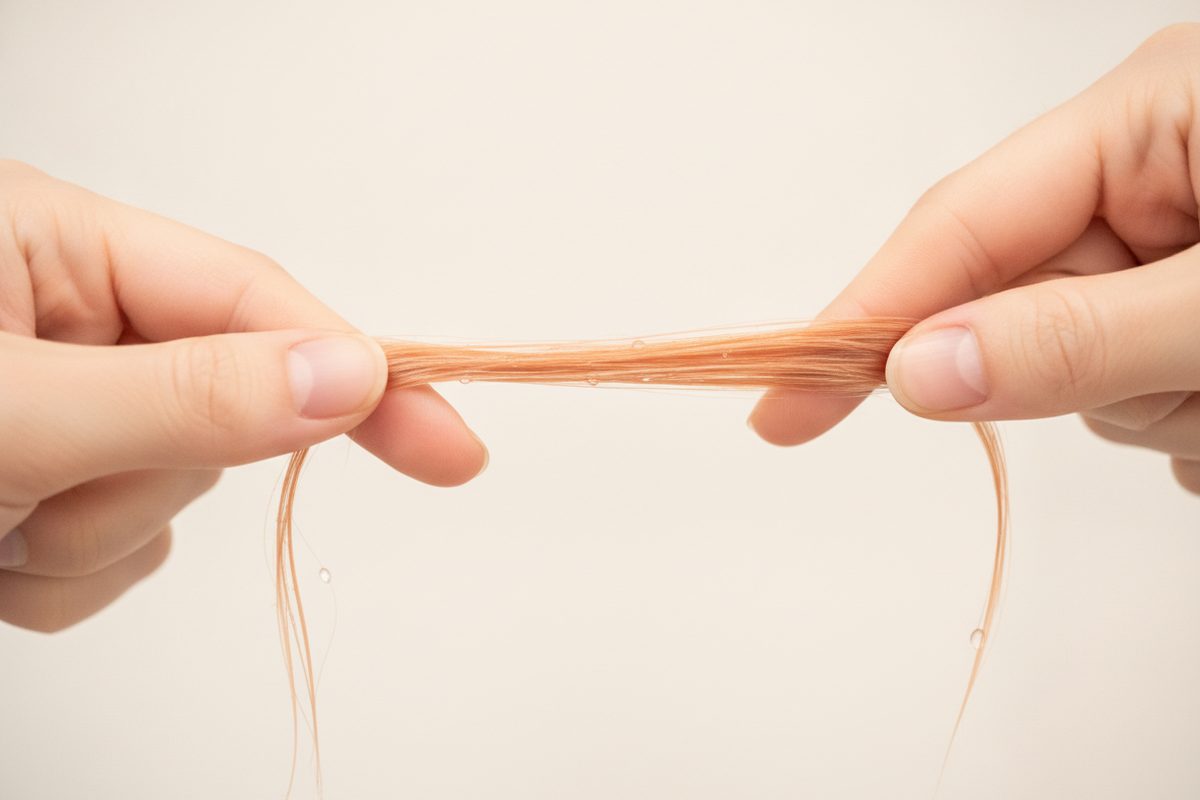
- Take five to ten hairs from behind the ear, or from the brush.
- Wet them.
- Hold both ends and pull gently.
- Read it:
| What happens | What it means | What you can do |
|---|---|---|
| Gives a little, springs back | Good strength | Tone now, lift again after a rest |
| Stretches a lot, comes back slowly | Moderate damage | Deposit only, repair, wait longer |
| Stretches like gum, does not return | Severe damage | No lightener. Deposit, trim, see a colorist |
| Snaps at once | Brittle and dry | Moisture first, no lightener, see a colorist |
Check porosity as well
Bleached hair is usually porous, which means it takes a toner fast and lets it go fast. That changes the first look and how often you will retone. The hair porosity test asks eight questions and says what it changes in the bowl.
Can a toner fix orange hair?
A toner is the most useful fix and the most misunderstood one. Most toners are demi-permanent and lift almost nothing; T18 type liquid toners are permanent and lift a little, which is why they run on 20 vol. Either way a toner lays a thin layer of cool pigment over the warmth. It cannot take pigment out.
Opposites cancel
- Orange is canceled by blue, the .1
- Yellow-orange is canceled by blue-violet, .1 with .2
- Yellow is canceled by violet, the .2
Choosing the toner
- Match the base to the warmth: blue for orange at level 6, blue-violet for yellow-orange at 7, violet for yellow at 8 and up.
- Tone on level. Pick a toner at the level the hair reached, or one darker for a little more depth. A toner lighter than the hair will not cover the orange.
- Use the developer the toner names. A demi toner runs on 10 vol. A liquid toner of the T18 type runs on the 20 vol its own bottle names; it lifts only a little, far less than a lightener.
- Do not guess the product. The Toner Selector takes the level and the warmth and gives the shade, the developer and the timing.
Applying a toner to orange hair
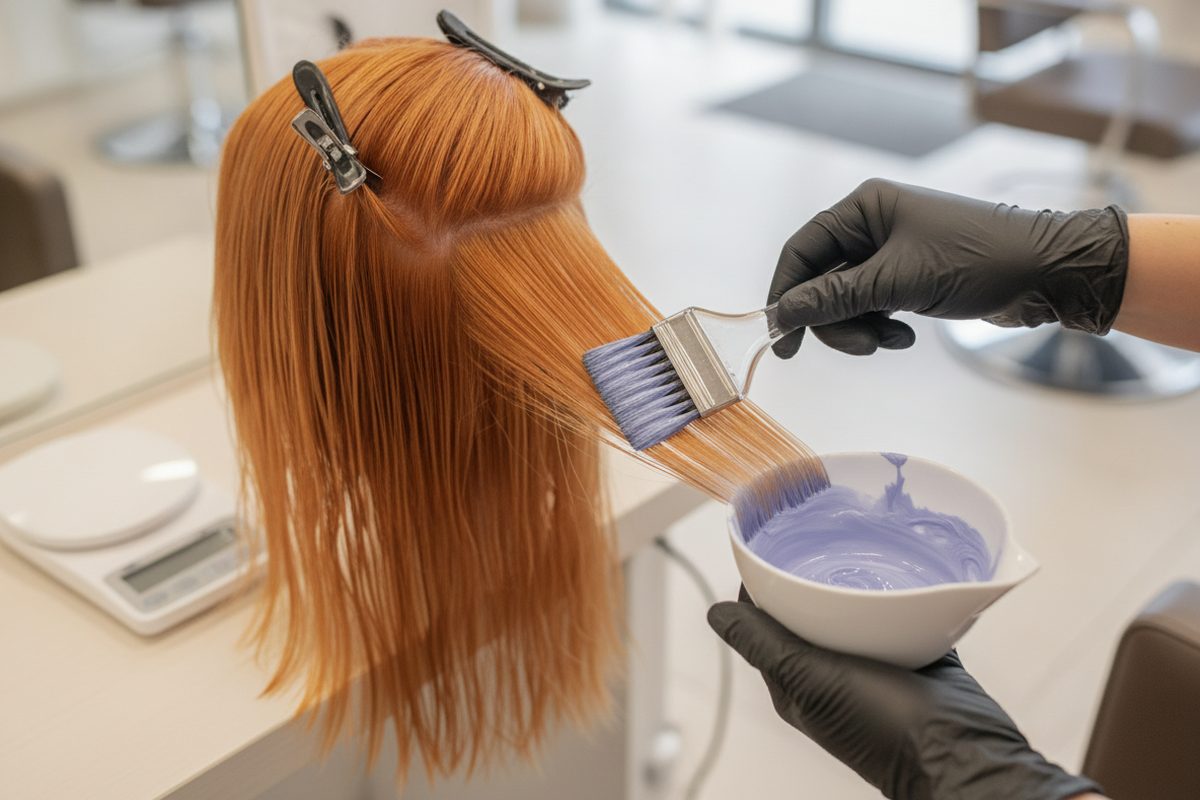
- Test a hidden section first. Tone it and time it. That is how you learn how fast porous hair takes it.
- Shampoo lightly and towel-dry so the hair is damp rather than dripping, unless the product says otherwise.
- Weigh it in a non-metal bowl, at the ratio on the tube.
- Section into four and work fast and evenly, starting where the orange is strongest.
- Porous ends last. They take pigment fastest and are the first to go gray.
- Watch it as well as time it. Wipe a strand clean every few minutes and read it.
- Rinse cool once the orange has gone neutral, and condition.
Why a toner fades
A toner sits near the surface, and porous bleached hair lets it go within a few weeks, which is when the orange appears to come back. That is maintenance rather than failure, and it is the next section.
Blue shampoo or violet shampoo: which one fixes orange?
| Product | What it does | Best for | What it will not do |
|---|---|---|---|
| Violet shampoo | Lays down a little violet | Yellow, levels 8 to 10 | Remove orange |
| Blue shampoo or mask | Lays down a little blue | Orange, levels 5 to 7, and upkeep | Correct a strong orange |
| Toner | Lays down controlled cool pigment | Fixing tone in one sitting | Lighten |
| Demi | Lays down tone and shine | Refreshing tone, softening warmth | Lighten |
| Lightener | Takes pigment out | Getting lighter | Neutralize tone by itself |
Using a blue shampoo
- On wet hair, lather, and leave it the time the bottle gives before rinsing.
- Start at once a week and adjust by what you see.
- If the ends start reading slate or gray, use it less often, or keep it to the mid-lengths.
- Condition after. Toning shampoos are drying.
Should I bleach again to get past the orange?
A toner cannot take orange to blonde. Only lightening can. The second session is where most breakage happens, so it is the one to slow down.
Who should, and who should wait
- Go ahead: hair that passed the stretch test, a scalp with no complaints, no box dye or henna in the lengths, and a target within reach.
- Wait, or hand it over: hair that stretched like gum, visible breakage, very fine hair, or a head that is already lighter in places.
How long to wait
The common professional answer is 4 to 6 weeks between lightening sessions, and 8 weeks or more on hair that is already damaged. The wait is not wasted: tone the orange so you can live with it, treat it weekly, and keep the heat down.
The second lift, safely
- Lower developer rather than more lightener. A slow controlled lift is kinder than a fast one: 30 vol lifts more slowly than 40, with less damage, and gives you time to watch the hair.
- Add a bond builder to the lightener if you have one.
- Only on the orange. Do not overlap onto hair that is already yellow. Overlap is the classic cause of breakage.
- Keep it wet. Dry lightener has stopped lifting.
- Time it and look at it. Foils and open air run on different clocks, and 20 vol on the scalp is as strong as lightener gets there.
- Tone straight after, because freshly lifted hair is yellow and wants neutralizing.
- The worked version. The exact formula for correcting orange bleached hair takes a home lift that stalled at 6 or 7 through the second lift and the toner, in grams.
Can I color over orange hair to hide it?
- Base: neutral (N) or a natural-ash. A straight ash on very porous orange can go muddy or greenish at the ends, so a neutral with some ash in it is the safer bowl. The hair color mixing calculator shows what a pair of tones lands on.
- Level: the same, or one to two darker. Much darker on lightened hair goes flat and fades unevenly.
- Type: a demi is gentler on bleached hair than a permanent, and it fades more softly.
- Test a hidden section. Bleached ends drink color and can finish darker than the roots.
Can I turn orange hair into a color I actually like?
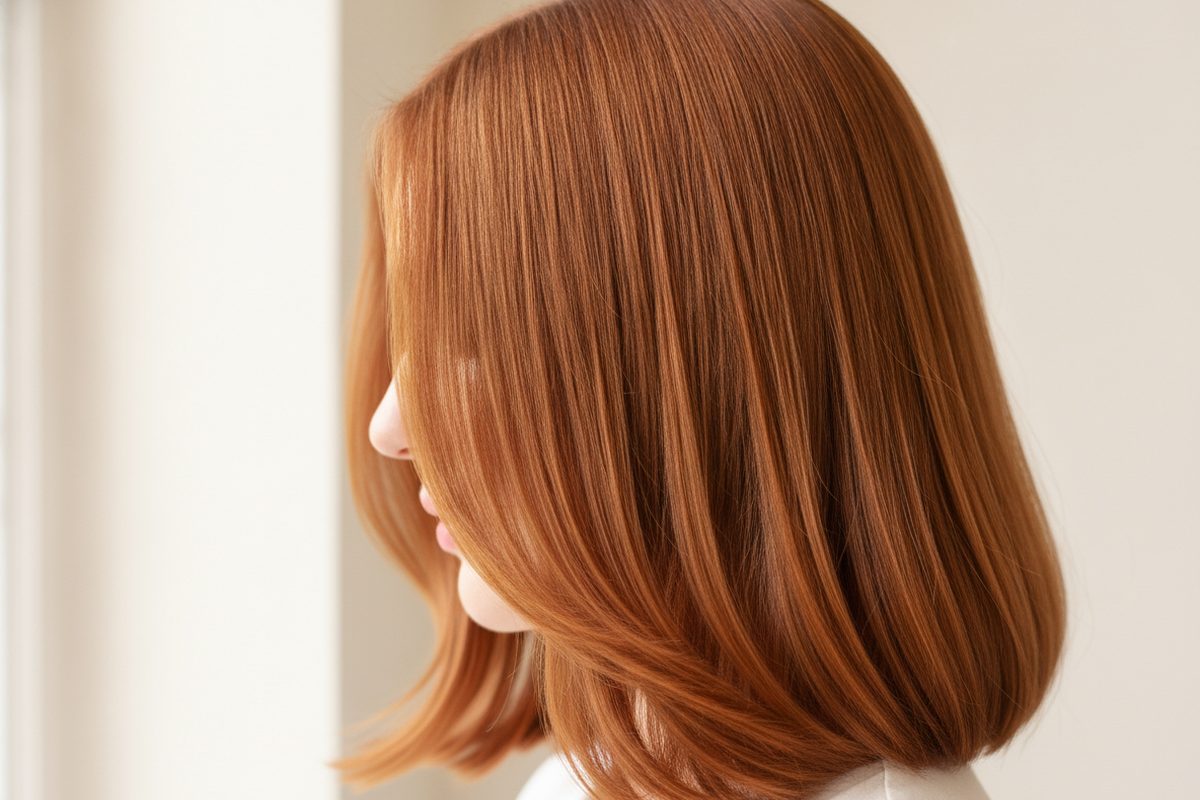
Orange looks wrong mostly because it is uneven and unplanned. The same warmth, evened out and given shine, reads as a choice.
- Copper: a copper or copper-gold demi pulls patchy orange into one shade.
- Caramel or honey brown: a gold-neutral demi one level darker turns orange into a warm brown.
- Warm balayage finish: a few deeper lowlights turn the orange into dimension.
- Why it is kinder: no more lift, only deposit and shine.
When should I see a colorist instead?
What a colorist usually does
- A demi to neutralize and add shine, if the level already suits you.
- Targeted lightening on the orange sections only, usually with a bond builder.
- Lowlights or balayage to turn the orange into dimension.
- A plan across visits if the goal is light blonde from dark hair.
Worth asking before you book
- “What level is this now, and what level can you reach today?”
- “Will you lighten the whole head or only the orange?”
- “Do you use a bond builder?”
- “How many sessions do you expect?”
Bring the daylight photos from day one. They say more than any description.
The problems nobody warns you about
Why did my hair turn green or gray after toning?
- Why: blue over yellow pulls green, and very porous ends take a toner in seconds.
- Next time: ends last, a shorter time, or clear in the portion that goes on the ends.
- Not dish soap or baking soda. They take the moisture out with the pigment.
Why are my roots lighter than the rest of my hair?
- Next time: mid-lengths and ends first, the root area last, because it processes fastest.
- A visible band of orange through the middle wants lightener on the band alone and nowhere else.
Why is my hair patchy, orange in places and yellow in others?
- Work in small sections and saturate properly.
- Keep the lightener off anything that has already reached the target.
Can I lighten over box dye or henna?
- Test first. A few snipped strands, away from the head, before any lightener or color goes on.
- A remover before a lightener. A dedicated color remover targets artificial pigment with less damage than lightening does.
- If the product was sold as black henna, or you do not know what it was, see a professional.
Why does the orange keep coming back?
- The more porous the hair, the more often it wants retoning, and the porosity reading above says which band it is in.
- Chlorine and sun shift the tone too. A hat, and a rinse after swimming.
Can very dark hair reach blonde?
Which fix fits which head?
The hair turned orange after bleaching
Did it pass the stretch test?
No. Repair first. Deposit only, or go one to two shades darker. See a colorist.
Yes. Does the depth suit you, and it is only the orange you dislike?
Yes. Tone with blue for orange, blue-violet for yellow-orange. Hold it with a blue shampoo.
Or keep it warm. Take it to copper, caramel or honey brown with a warm demi.
No, lighter is the goal. Is there box dye or henna in it?
Yes. Strand test, and see a colorist.
No. Wait 4 to 6 weeks, lift the orange only, with a bond builder, then tone.
The myths that make orange worse
- “Vinegar, lemon or baking soda will take the orange out.” None of them neutralize orange pigment. Baking soda is alkaline and dries fragile hair further, and lemon in the sun adds warmth.
- “A stronger developer will fix it faster.” A higher volume lifts faster and harsher, with more breakage and more hot roots. Slower and lower is safer.
- “Leave the toner on longer for a cooler result.” On porous hair that is the road to gray or green ends.
- “A toner will lighten it.” A toner deposits. It cannot lift orange to blonde.
- “Bleach again tonight and it is done.” Same-day re-lightening at home is the quickest route to breakage.
How do I stop the orange coming back?
- Blue shampoo or mask once a week, and violet once the hair reaches yellow.
- Lukewarm or cool water when you wash.
- A sulfate-free, color-safe shampoo for everyday washes.
- A clarifying or chelating wash about once a month on hard water, with a mask after.
- A shower filter where the water is hard.
- Heat protectant every time, at a lower temperature.
- A hat in strong sun, and a rinse after swimming.
- A demi refresh every four to eight weeks to keep the tone even.
How do I avoid orange next time?
Three things prevent most orange: know your starting level and your target before you mix, and the pigment ladder above says what you will pass through on the way; mix enough lightener to saturate every section and keep it wet, which the hair dye amount calculator works out in grams; and apply to the lengths first and the roots last, so the scalp heat does not run ahead of you. If you start at level 1 to 3 and want light blonde, plan for more than one session.
The bottom line
Orange after bleaching is a checkpoint rather than a disaster: name your orange, test the strength, then tone it, hold it, lift again after a rest, go darker, or make it copper on purpose. Go slowly; the hair you keep today is the blonde you can reach next month.
Sources
- Hair Colour for Hairstylists: Level 2, section 4.6 “Formulating the Toner” (BCcampus open textbook): toning on level, and underlying pigment by level.