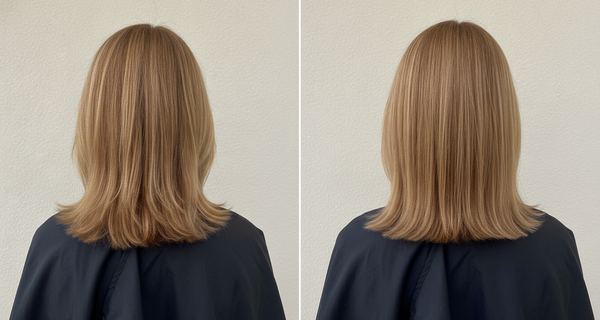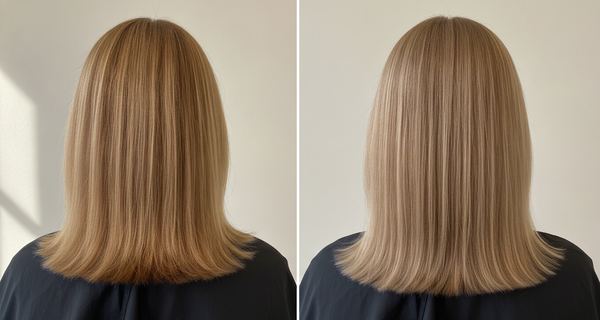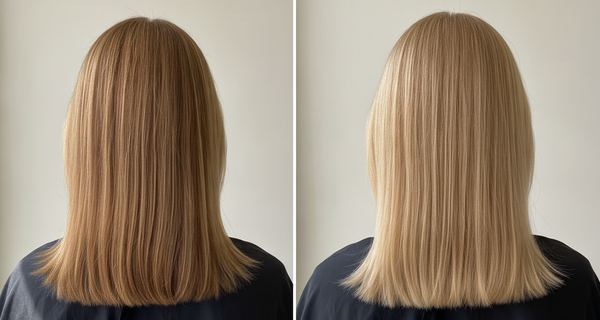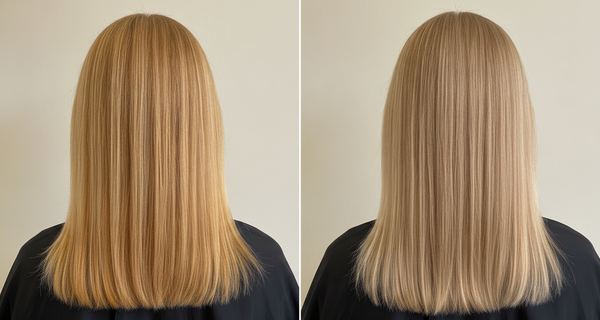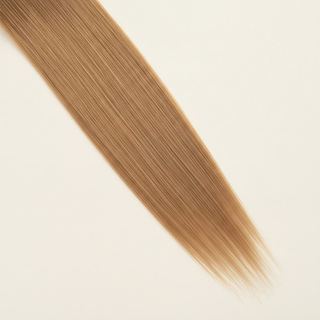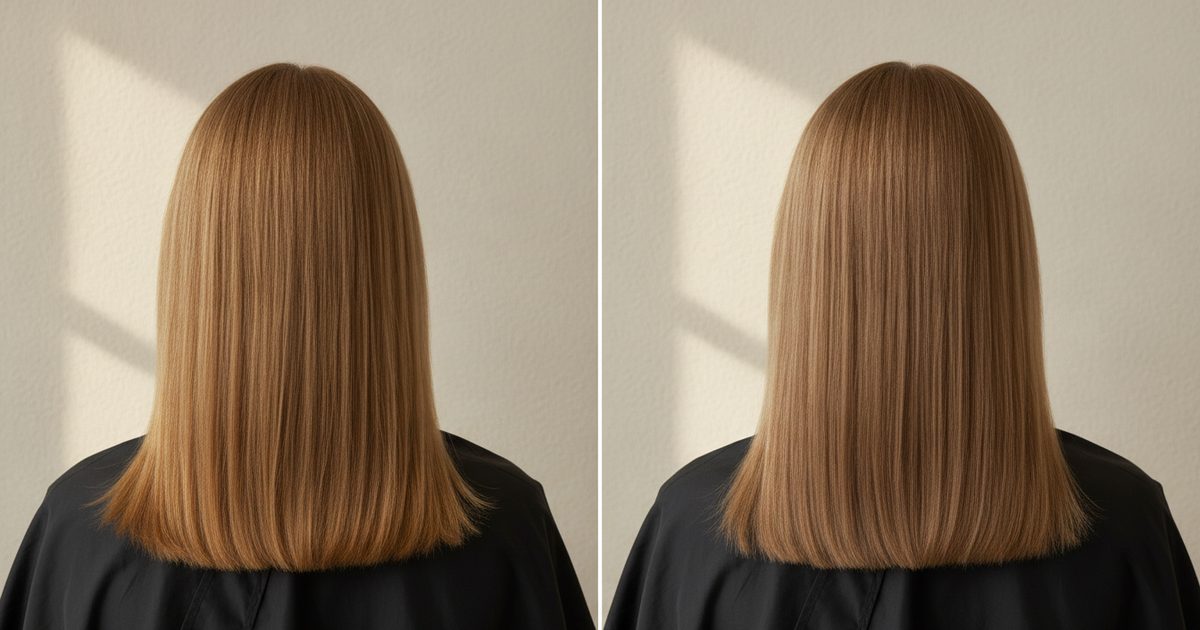
She came in as a 4, a medium brown, and 30 vol took it as far as it would go: a 6, orange root to tip, the color of a terracotta pot. The consultation sheet said 8. She looked at it in the mirror, still wet, and said she liked the depth and could I take the orange out and leave it there. This is the formula for that.
Orange at 6 is the pigment underneath
Every level exposes a pigment when it lifts, and at 6 that pigment is orange; the level 6 page walks through the lift from a 4 minute by minute. What matters for the toner is that the orange is even. Red still in it at the root means that root stalled at a 5, and a 6 toner will cool the lengths and leave it warm; that root wants a 5.1 of its own.
Blue cancels it, and 10 vol leaves the level alone
Blue sits across from orange on the wheel, so the shade is a .1, blue-based ash. 6.1 cancels fully and gives a cool dark blonde, which in most indoor light reads as a light brown (salon lighting lies, and the bathroom mirror at home lies the other way). 6.13 carries gold with the ash and leaves a sandy dark blonde. In my chair 6.13 is the one I reach for, and a colleague thinks that is timid and puts 6.1 on everyone.
The level stays at 6 whichever one you pick.
Ten volume because a toner deposits. Twenty would lift more orange up under the blue, and the volume chart has the rest of the ladder. The ratio is 1:2 for a liquid toner and whatever the tube says for a demi cream; the developer mix calculator turns either into grams. I write the grams on masking tape on the side of the bowl because I have lost count halfway through a mix more than once.
6.1 alone can go khaki on white hair
Blue ash on a white hair has no orange under it to cancel, so it shows as itself, a green-gray that dries khaki. On anything over 30 percent white, mix 6.1 two parts to one part 6N; the natural gives the white something to sit on.
What the strand shows at 5, 10, 15 and 20
At 5 minutes the cream on the hair looks muddy brown, the orange showing through the blue, and tells you nothing. At 10, wipe a strand clean with a damp towel and take it to the window: it should have gone dull, a wet sand. At 15 a normal-porosity head is done. Coarse hair, 20 minutes. I left a 6.1 on for 25 once on a fine-haired client because the phone rang, and the lengths came out a gray-green that took two clarifying washes and a 6.3 gloss to put right, 45 minutes and a tube I did not bill for. Ends like that are done at 10 whatever the roots are doing; I rinse them on their own now.
| What the wiped strand looks like | Minute | What to do |
|---|---|---|
| Muddy brown, orange under blue | 5 | Leave it; check porous ends |
| Orange gone dull, wet sand | 10 | Rinse ends if flat |
| Cool or sandy dark blonde, wet | 15 | Rinse on normal hair |
| Still a shade warm | 20 | Rinse; longer only adds gray |
| Gray-green cast on the ends | Any | Rinse now |
Where this formula fails
If the hair was really a 5, the blue cancels the orange half of orange-red and leaves a muddy auburn. Ends lightened on an earlier visit take the blue in five minutes; dilute their portion 1:1 with clear and put them on last. And if she decides she wants one more step without bleach, the level 6 to 7 formula tones and nudges half a level. What I cannot tell from a photo is whether a given orange 6 has the strength for a second lift; that is a strand test.
What fades and when
Four to six weeks. The blue goes first, so the hair drifts back toward warm over the weeks. Cool rinses and a color-safe shampoo slow it; a pool speeds it. At week five the same formula for 10 minutes puts it back, and the toner selector tells you whether the returning warmth is still orange or has faded to yellow.