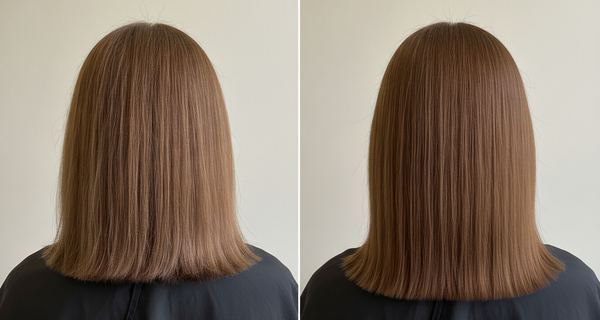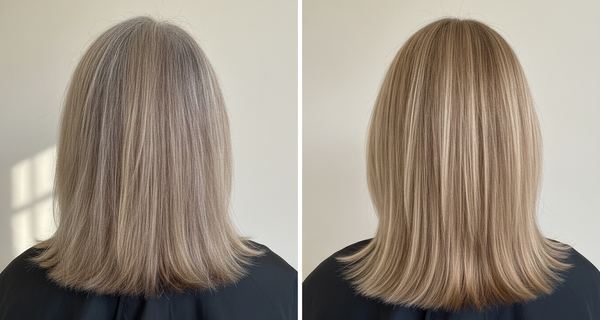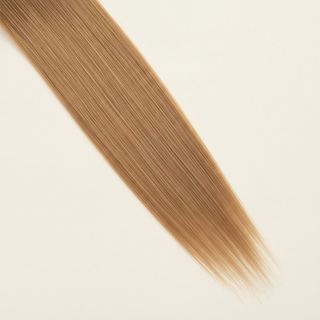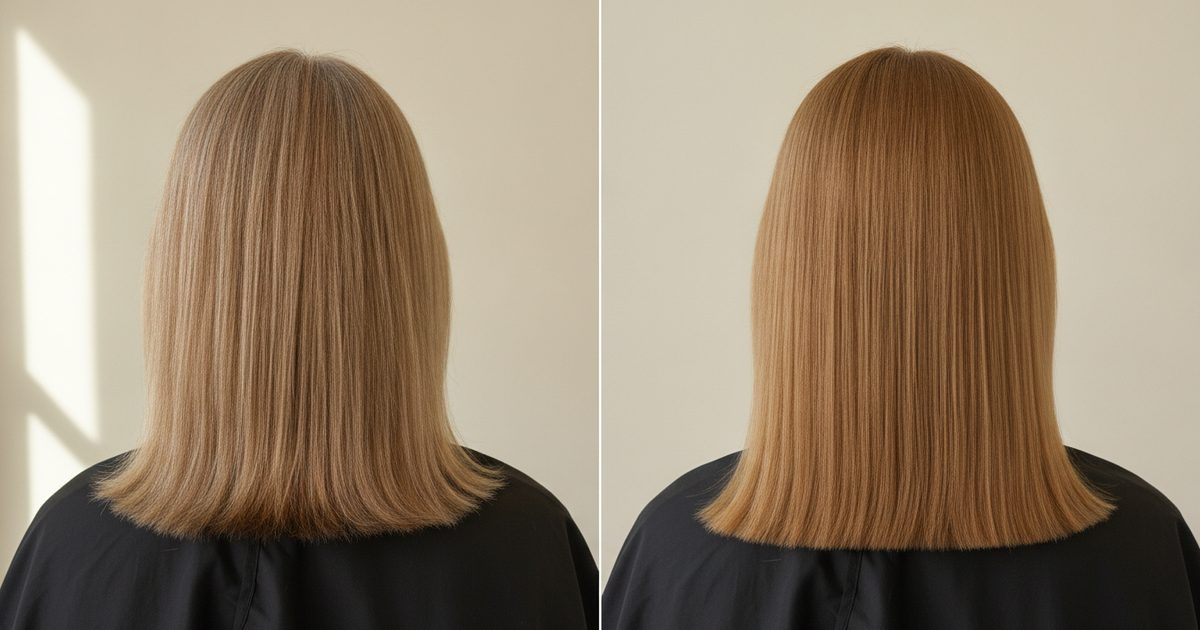
A natural dark blonde, never colored, the white in at the hairline and along the part, about a third of what shows there and far less behind. She wants her own color with the white gone, and to know whether that means a salon chair every three weeks.
Two routes fit this head, and she asked for the covering one.
Half 6N in the bowl, half beige
A white hair has no pigment to lift and none to lean on, so covering it means building a dark blonde from nothing. The dark blonde she is staying at has 6N as its most used coverage shade, and the other half of the bowl is 6.13, the beige, a 6NB on letter lines. At 30 percent white the share table in grams puts half the bowl as natural, and one big professional line would use the beige alone at that share. Start at half because a see-through front at the second shampoo is the complaint that brings people back, and ash alone on white goes dingy and greenish. Twenty vol, six percent, the strength that gets into a white hair, equal parts, about an ounce of each shade and two of developer. Some colorists read 20 vol as a level of lift and drop to a 5N; most read it as deposit at her own level.
Start at the hairline, where the white lives
Dry hair, four sections, the brush to the front first, the hairline and the part, because the mirror shows her that hair first and it is the slowest on the head to take color. Half-inch sections, cream on top of each strand and underneath it, since a thin swipe leaves a white hair white. This first time the white strands are white their whole length, so the bowl goes root to end on them, then back, nape last.
Why does the white at the hairline still show after coloring?
Usually because it got the least time or the least product. The hairline holds the thickest white and the most stubborn hair, so it needs the bowl first, half-inch sections, and cream on both sides of the strand. Barrier cream too close blocks the baby hairs, big sections miss strands, and the box time is written for pigmented hair, so the front needs 35 to 45 minutes and a look before the rinse.
How long do you leave permanent color on gray roots?
Thirty-five minutes, and up to 45 if the front still shows white when the cream is pushed back. Boxes often print 20, the lines that cover well say 30 to 40 and add ten for stubborn white, and the tube sets the ceiling. The timer starts once the whole head is on and is only a reminder to look, with the same minutes adjusted for her texture on the tool.
| Minute | The front, pushed back | What to do |
|---|---|---|
| 0 | Whole head on, leftover on the hairline | Timer, cap, no heat |
| 20 | Box number, white not taken yet | Leave it |
| 30 | Covered, or translucent and warmer than its neighbors | Covered rinses, translucent waits five |
| 35 | Fine and medium hair usually covered | Rinse, judge the tone dry |
| 40 | Coarse white can still read sheer | Five more, leftover on it |
| 45 | The ceiling on most lines | Rinse, 6NN next time |
Does 10 volume developer cover gray hair?
No, it blends it. The color sits nearer the surface of a white hair and softens it into the rest, so she still has white hair, quieter. At 30 percent that is a real route, taken for the lower upkeep. A demi 6N or 6NB type on 10 vol, dry hair, 20 minutes, no heat, grows out with no line over 8 to 10 weeks, as do fine foils and babylights at the hairline that copy the white coming in. The demi blend written out at a level 7 and fine foils on a dark blonde are those pages.
Three weeks to the line, then roots only
The white is back at the front two to three weeks after a solid permanent, and that line is the price of this route. Book monthly. The retouch goes on the regrowth alone, hairline first again, nothing overlapped onto the lengths, which build up under permanent over permanent. The lengths take a demi at the same level on 10 vol for the last few minutes, or the leftover thinned with water two to one and combed through for five.