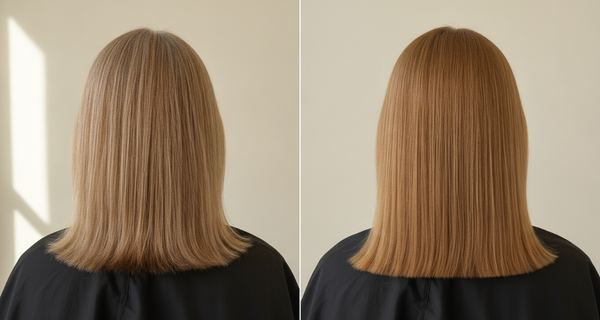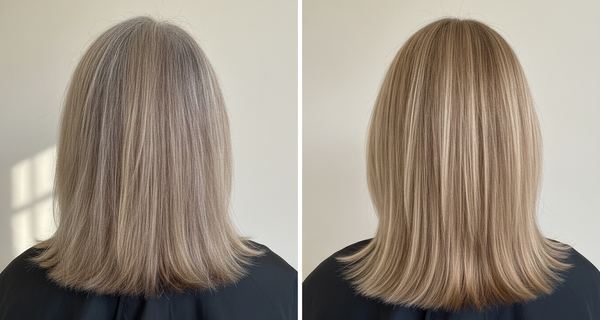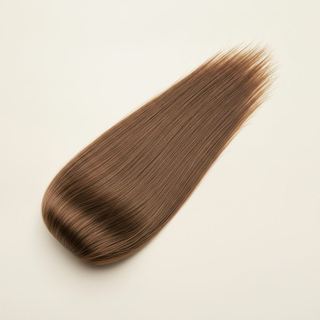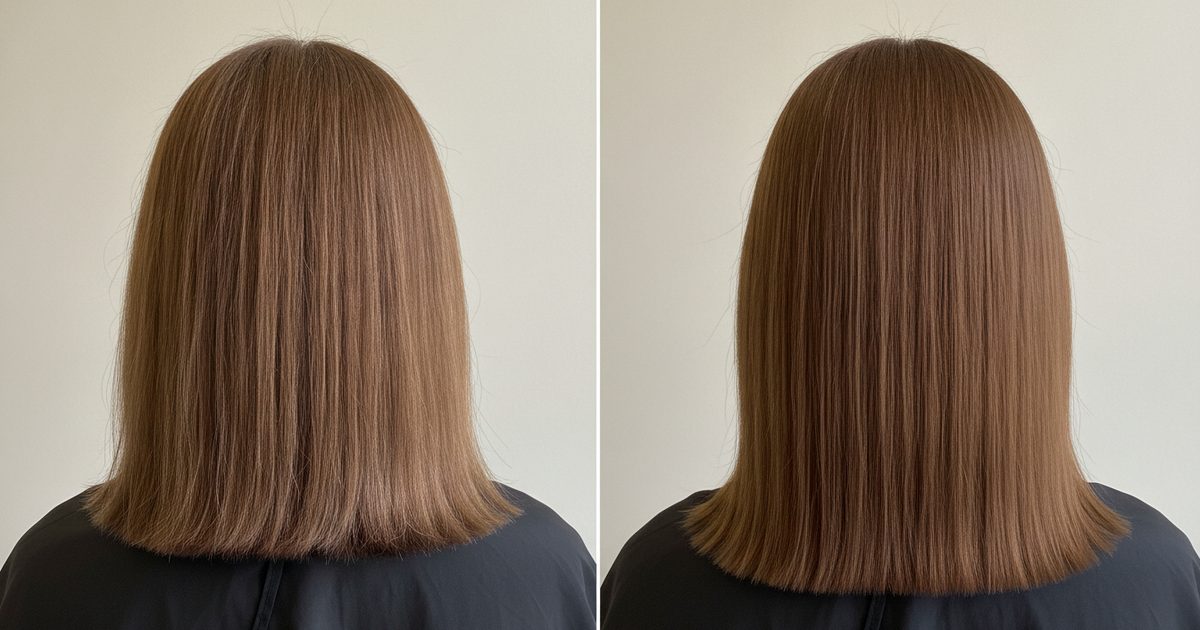
One thin section behind the front hairline, where the white runs thickest, went on first with the planned bowl, 5N and 5.3 in equal parts on 20 vol. At 30 the tail comb pushed the cream back on warm, see-through white beside pigmented hair already a full light brown. At 45 the same strands came up opaque, a touch warmer than their neighbors, and dried to one even 5.
That settles it: half natural in the bowl, 20 vol, 45 minutes, front first.
Does 10 volume cover half-gray hair?
No. Ten vol blends it: the white is tinted, softened and still there. A white hair has no pigment and a tighter cuticle, coarse and often wiry, and 10 vol does not open it far enough for permanent pigment to lodge. Six percent opens white hair at the natural level, and the lower bottle waits for the ends at the retouch.
Why half the bowl is 5N
A 5.3 alone over white gives shine and no depth, and a 5.1 alone goes dull with a green edge, since ash cancels warmth and a white strand has none. The natural series builds that depth, and it is warm. At half white the site’s share table puts half the bowl as 5N and half as the target, 30 g and 30 g; one professional line runs lighter, a third natural from 30 to 50 percent and half above. The light brown level page lists the codes, and the natural share calculator does the grams.
Should the shade go lighter or darker than a natural 5?
Neither, and one or two levels either way is the honest range. Past that the colorists split: one school goes a level darker, since 20 vol nudges the natural hair up a step anyway, and another goes a shade lighter with the years, since a 4 can read drained. Two limits hold: lifting and covering in one bowl leaves the white sheer, and coverage turns unreliable above level 8. Lighter and covered is two visits, the second a foil job like the 5 to 8 highlights formula.
Twenty vol everywhere, and what shifts around it
| Start condition | Developer | Ratio | What changes |
|---|---|---|---|
| Virgin natural 5, half white | 20 vol (6%) | 1:1 | Half 5N, 45 minutes, front first, ends last |
| Lengths colored or lightened before | 20 vol at the root, 10 vol demi on the lengths | 1:1, the demi at its own ratio | No overlap; lifted hair grabs darker, demi a shade lighter |
| Coarse, wiry white at the front | 20 vol, still | 1:1 | 5NN for the 5N, the full 45, no barrier cream |
| Fine or porous hair | 20 vol | 1:1 | Read at 25, off five early, porous ends demi only |
| Under 30 or over 75 percent white | 20 vol | 1:1 | A quarter 5N under 30, all 5N over 75, 5NN if stubborn |
The front goes on first and comes off last
Dry, unwashed hair in four quadrants. The front hairline and part line are brushed first, then the crown, then the back. Sections thin enough to see through, every white strand saturated on top and underneath, because a thin coat on white rinses white. Equal parts by weight in anything but a metal bowl, and barrier cream, if any, well back from the baby hairs. The timer starts as the last section goes on, under a cap for the scalp’s own warmth and nothing hotter. The minutes by texture shift five either way.
Regrowth on a permanent 5, and the blend that avoids it
Dry a piece before she looks, since wet hair reads a level darker. Less white a level up is the 30 percent head at level 6, and the soft road here is the level 5 blend with fine highlights.
How soon does the white show again at the front?
Two to three weeks on a solid permanent, at the front and the part line first. The retouch goes in the book at four weeks, before the regrowth passes half an inch, because fresh white beside covered white looks patchy. Each retouch is regrowth only, with the demi through the ends.
Would a demi blend suit half white better?
Sometimes, and it is a different result. A demi 5N or 5NB on 10 vol, up to 20 minutes with checks, tints the white translucent, so at half white a good deal of gray still shows in daylight, softened rather than gone. The trade is the grow-out: no line, and a visit every 6 to 10 weeks against every 4 on permanent.