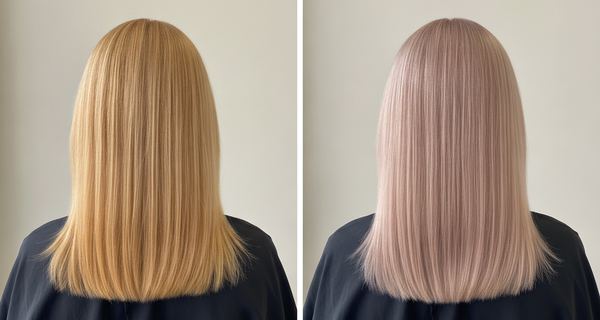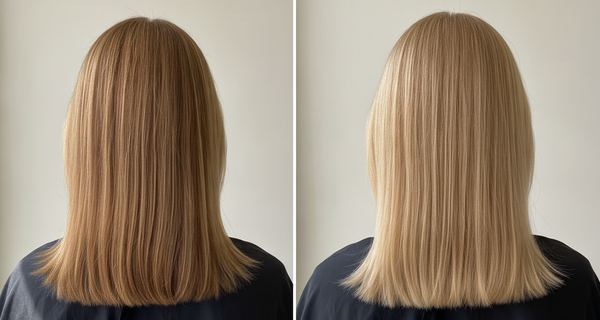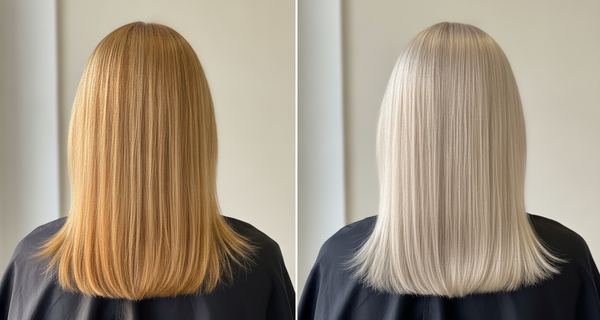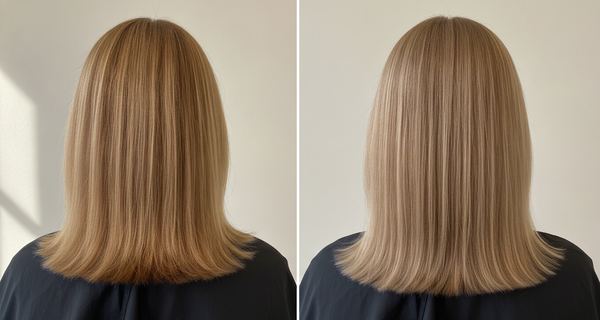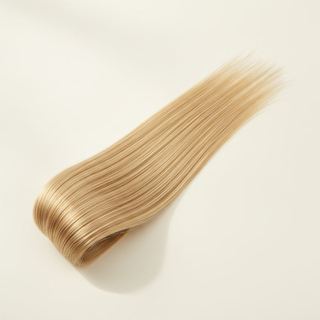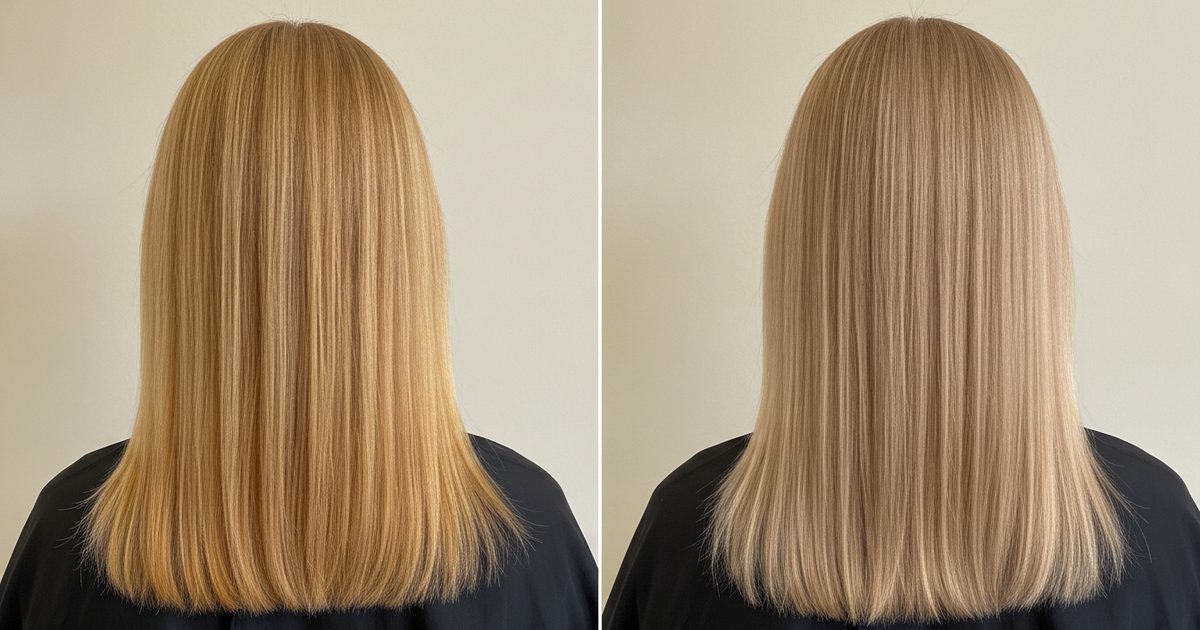
This is the toner I mix most weeks. An 8 is the first level where a blonde toner does what people expect, and a demi 8.1 or 8.13 on 10 vol turns its yellow into a light blonde in one pass.
Is my hair really an 8?
Dry a section on cool air and hold it on white paper at the window. An 8 is a clear yellow, the yellow of dry spaghetti, with no orange left in it. Orange at the root means a 7, and this formula cancels only the yellow half of it, leaving khaki. Pale, banana-skin ends are a 9, and on them it lands a level darker than you meant. Between two numbers, call it the darker one; the level 8 page has the full check.
8.1, 8.13 or 8.2?
The pigment at 8 is yellow with a trace of orange, so the neutralizer is violet with a little blue behind it. 8.1 is blue-based ash: it cools the yellow and handles the orange trace, and alone it can sit green-gray at the ends, so the working ash at 8 is 8.1 with a quarter of 8.2. 8.13 is ash with gold and leaves a soft sand that forgives an uneven lift. 8.2 alone cancels fast and keeps going on porous ends.
I think 8.13 is the better toner for most heads that walk in, a minority view among people who like their blondes cold. The toner selector picks between them from the warmth you see.
Damp or dry?
Damp. Towel-dried until it stops dripping, and even from root to end. On dry hair the cream grabs wherever the brush lands first and the first section comes out a shade cooler than the last. On soaking hair the 10 vol is watered down and it runs patchy. (Half the toners I have redone went onto hair left under a towel for ten minutes, dry at the crown and wet at the nape.) Ten volume, and no more than that, at 1:2 for a liquid toner or the tube’s ratio for a demi cream; the developer mix calculator does the grams. Twenty volume lifts warmth up under the toner while it deposits.
How long?
Ten to 20 minutes, and a look every 5. At 5 the cream looks purple-gray and tells you little, but ends bleached more than once can already be done, so I wipe one end at 5 every time. At 10, wipe a strand and take it to the window: it should read a pale sand with no lemon in it. Coarse hair runs to 20. I set a kitchen timer with a cracked face for 5 minutes and reset it at each check, because I have no faith in my own sense of time when the phone is going. On a fine-haired client I let a 15-minute check slip to 22 and the whole head came out a pale lilac-gray that took two clarifying washes and a 40-minute redo I did not charge for.
| What you see at the check | Minute | Read as | Do |
|---|---|---|---|
| Purple-gray, yellow through it | 5 | Early | Wipe one end |
| Pale sand, no lemon | 10 | Done | Rinse |
| Warm yellow under the cream | 10 | Early | Go to 15 |
| Sand at root, gray at ends | 15 | Ends past it | Rinse ends, finish root |
| Lilac or gray once dry | Any | Over-toned | Clarifying wash, twice |
Why did it go lilac?
Because the toner deposited more violet than there was yellow to cancel.
That happens when the ends were really a 9, when they are porous from an earlier bleach, or when a 15-minute check became 22. On anything bleached twice, dilute the ends portion 1:1 with clear, apply it last, and check at 5. Two clarifying washes pull most of it out and a 5-minute 8.13 gloss warms what is left. And if the whole head went gray, the hair was lighter than an 8 and wanted the level 9 to 9 formula.
How long will it last?
Four to six weeks. The violet fades first, so the ends turn faintly yellow by week three and the root follows. Where I stop being sure is hair with three porosities down its length; on those I can promise the mid-lengths and nothing about the ends, and the processing time calculator is only a starting point.