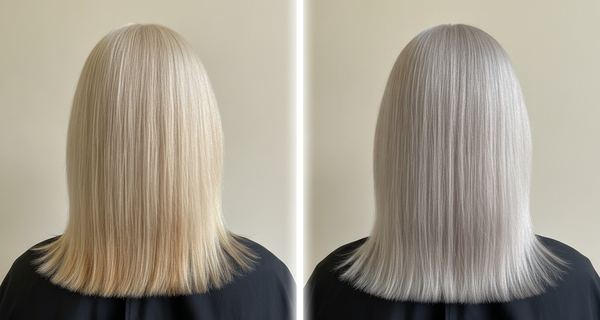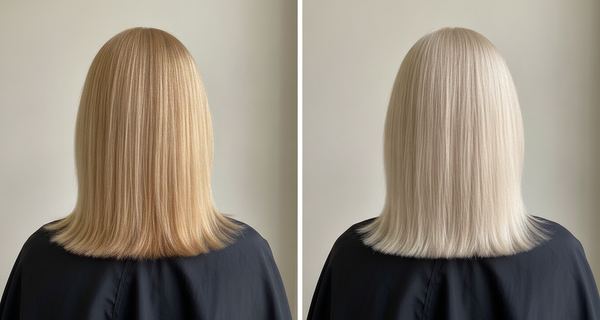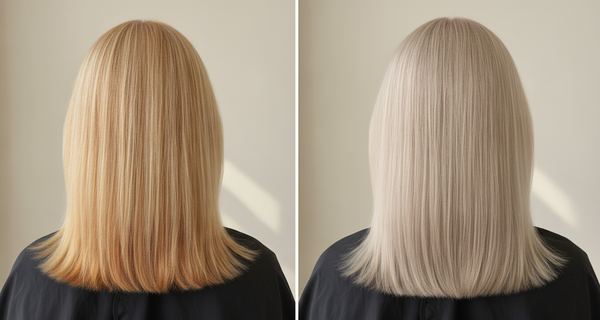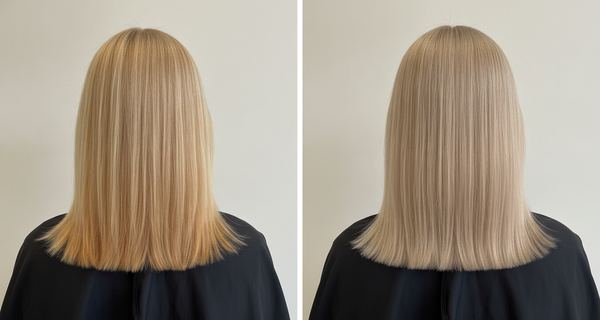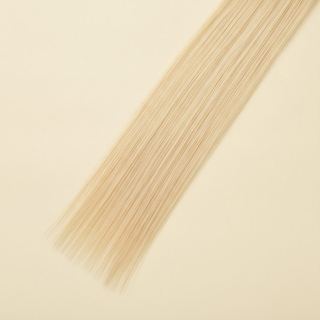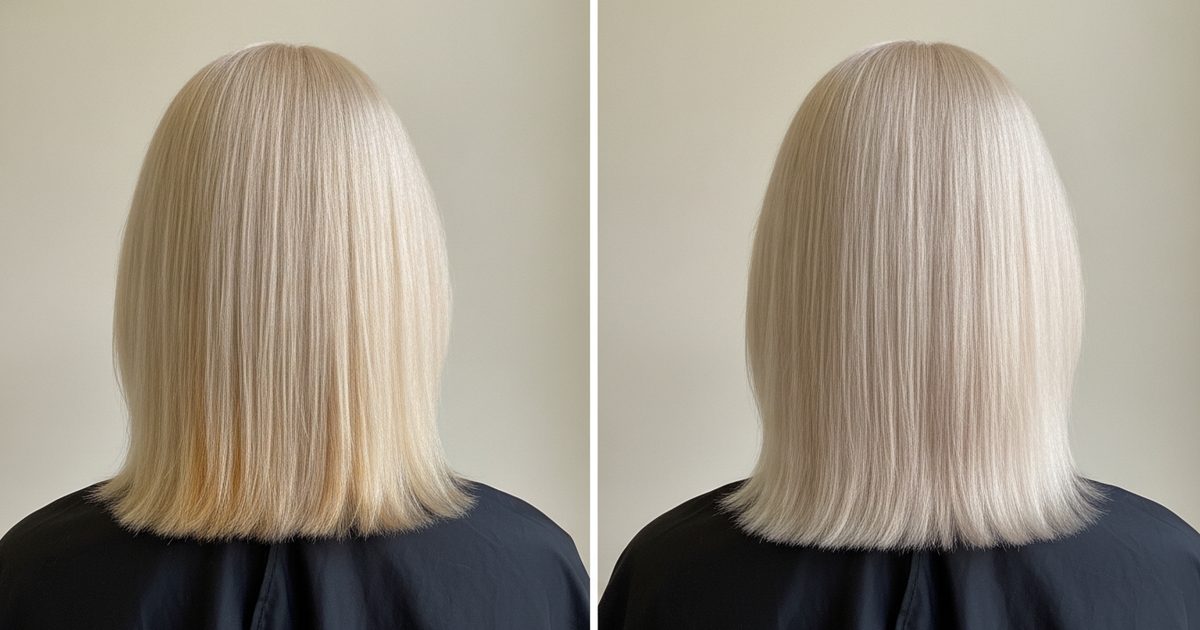
Minute four. The roots have not moved. The mid-lengths are just beginning to lose their cream. And the last two inches, the part that has been through the bleach five times since spring, are lilac. Properly lilac, and deepening while you watch. That is full-strength violet on a porous 10, and it is how most people learn what this page is about.
The formula card is the version that does not do it. Half toner, half clear, 10 vol, five to ten minutes, ends on last and off first. A toner deposits and cannot lift, so the hair stays a 10 either way; only the tone changes.
Why a 10 takes toner in minutes
Level 10 is palest yellow over hair that has nearly always been through bleach more than once. The cuticle is open and the pigment left to cancel is a faint cream. Which is why a violet that would take twelve minutes on a 9 is done on a 10 in four, and why the ends, lifted more often than the roots, are done in two. The level 10 page lists violet or pearl as the neutralizer, diluted. The diluted part is the formula.
Half clear
Clear demi is the toner’s base with no pigment in it. Mixing the 10.2 or 10.21 1:1 with clear halves the violet in every gram, so the hair reaches five minutes still blonde. I keep the clear in a squeeze bottle with masking tape that says CLEAR, because in the bowl it looks exactly like developer, and I once mixed 30 g of developer into 30 g of developer and stood there for four minutes waiting for the roots to do something.
On a fresh 10 from a single lift, two parts toner to one of clear is fine. On anything bleached three or more times, 1:1, and on the ends I have gone to 1:2.
Between the two tubes I think the 10.21 is the better one; the touch of ash keeps the violet from leaning pink as it fades, and the flatter finish is a fair trade. The toner selector offers both.
Towel-dried, always
Damp hair spreads the toner in seconds and thins it a little on the way in. Bone-dry porous ends pull the violet straight in and stripe. Mix only once the hair is sectioned, because five minutes of toner sitting on the cart is five minutes closer to the ends drying out.
I had a bride’s trial on a Thursday where the lilac showed under her ring light before I had finished the nape (a ring light is the worst light in the building for judging tone, and every bride brings one). I had toned wet from the sink, and the water sitting in the ends had turned my 1:1 into a puddle at the tips.
Minute by minute
| Minute | Roots | Mid-lengths | Porous ends |
|---|---|---|---|
| 2 | Cream, unchanged | Cream, a little cooler | Already pale and cooling |
| 4 | Slightly cooler | Clean pale blonde | Done; rinse them if you can reach the basin |
| 6 | Clean pale blonde | Done | Lilac if they went on at the start |
| 8 | Done | Cool, close to the edge | Deep lilac |
| 10 | Rinse; past here the roots go gray-lavender | Gray-lavender | Gray-violet and flat |
The processing time calculator shortens these numbers for fine hair. What it cannot tell you is how porous your ends are; a five-minute strand test on the worst piece at the nape is the only thing that does.
Getting lilac out
Over-toned, a 10 goes lilac at the ends, then a flat cool gray that reads dirty. Fresh, it comes out. Rinse at once and shampoo twice with a clarifying shampoo, a full minute of lather each time. Most of it leaves on the second wash; what stays fades over about two weeks.
If it will not budge, a pale gold gloss, 10.3 cut 1:1 with clear, two minutes on damp hair, pulls it to neutral. It is a fix I dislike because it puts warmth back into hair that has just been cleaned of it. But it beats sending someone home purple.
What it keeps
Two to four weeks. The violet leaves first and the cream comes back from the ends inward. Cool water, and a violet shampoo once a week from week two. Twice a week and you are back to lilac by another route. Chlorine and hard water take it fastest of all.