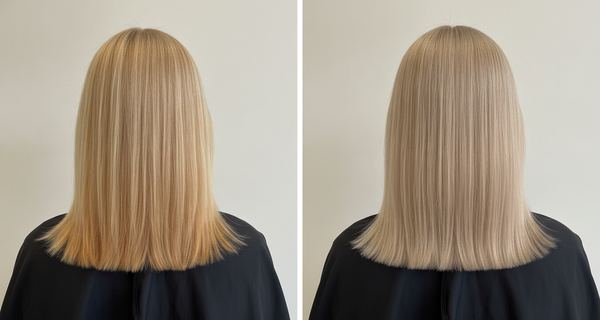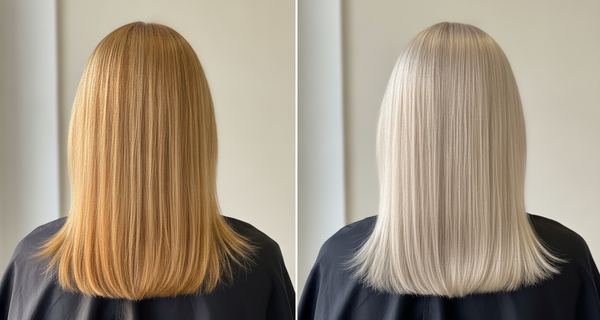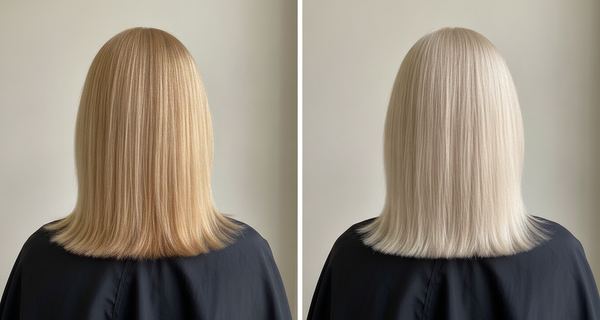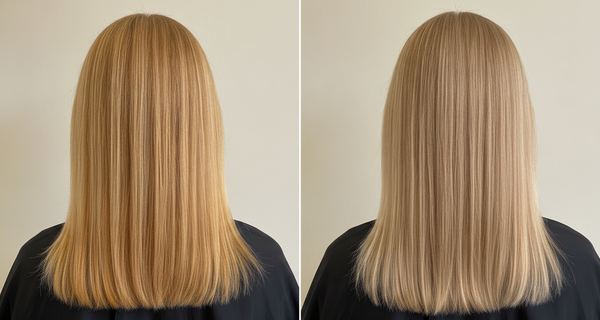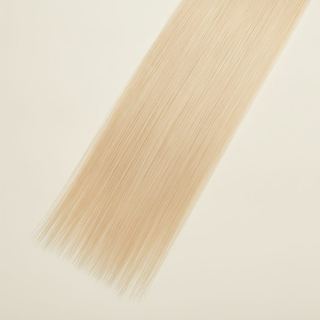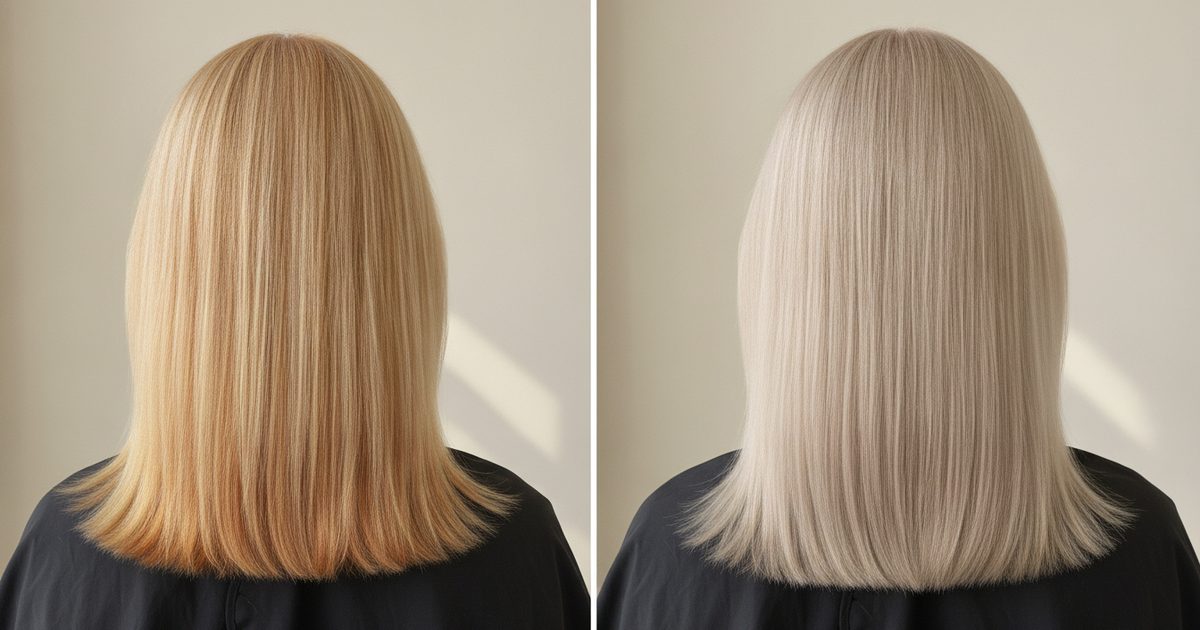
Three swatches on the counter, in a row, on a white paper towel because the counter is beige and lies. Left, 9.21 pearl. Middle, 9.1 ash. Right, 9.3 gold. Above them, a dried section of the client’s even pale-yellow 9. Every one of those tubes leaves her at a 9. What changes is which blonde she walks out with.
A toner deposits and cannot lift. The level stays; the tone is what moves, and on a 9 it can move three ways.
The pale yellow under all three
Level 9 sits over pale yellow, the last of the warmth that was orange at 6 and clear yellow at 8. Violet cancels yellow, and at 9 there is no orange left, so violet alone does the job and anything with much blue behind it is more than the hair needs. That is why the card says 9.21: violet first, with just enough ash to keep it from leaning pink, on 10 vol so it deposits and stops.
One head, three results
| Toner | What it does to the pale yellow | What she sees at the window | Fades toward |
|---|---|---|---|
| 9.21 pearl | Cancels it, ash behind the violet | Cool, clean blonde with a faint shimmer | Soft yellow, evenly |
| 9.1 ash | Cancels it and keeps going | Flatter, cooler, gray-beige indoors | Yellow at the roots first |
| 9.2 violet | Cancels it, no ash | Cool, mauve past 15 | Yellow, fast at the ends |
| 9.3 gold | Leaves it and adds warmth | Honey blonde | Brassier than it started |
| 9N natural | Softens it without canceling it | Neutral, slightly warm, the safest | Warm, evenly |
Why blue at level 9 goes green-gray
Blue cancels orange. At 9 there is no orange, so a blue-based ash has nothing to cancel and sits on pale yellow, and blue over yellow makes green. Faintly. Over a cool base that reads gray, and more of it shows as the violet half of the shade fades first. I watched a 9.1 with extra blue stirred in (someone wanted it “really ash”) go the color of a dirty nickel by day five, and it cost a clarifying wash and a 9N gloss. For ash at 9, the 9.1 alone is as far as I go.
The clock
At five minutes the yellow is still there, but the ends, the most porous part of the head, have already moved. At ten the mid-lengths are a clean pearl and the roots are close behind. At fifteen it is done, and past fifteen a pearl on a 9 goes lilac at the ends first, then a flat gray-mauve through the rest.
Roots and mid-lengths first, ends last, and on hair bleached more than twice the ends portion gets cut 1:1 with clear. I write the minute the ends went on in pen on the back of my hand, because the timer on the cart is running for the roots and I have forgotten the ends more than once. The processing time calculator shortens these numbers for fine hair.
When the hair was not a 9
The commonest failure here has nothing to do with the toner. The hair was an 8, or a 7 at the scalp and a 9 on the ends, and the 9.21 went on anyway. On an 8 a pearl goes muddy beige. On a 7 it does nearly nothing, and she leaves yellow-orange with a bill. Check the level dry, against white paper, at a window; the level 9 page has the swatch. Between two numbers, choose the darker one, and if the darker one is an 8, the level 8 to 9 page uses a permanent shade to nudge as it tones. Salon lighting is warm and forgiving and will call an 8 a 9; the window by the back door is the only honest light in most buildings, and I walk every head to it, even in January.
Damp application spreads the toner faster and more evenly. Bone dry takes it harder and patchier. I have never liked toning hair that has sat wrapped in a towel for twenty minutes while I mix, because by then the ends are drier than the roots and grab.
Keeping it pearl
The violet leaves first. By week three the shimmer thins and the yellow comes back. Four to six weeks is the usual run. A weekly violet shampoo from week two pushes that out; twice a week pushes it into lilac. Hard water and chlorine take it faster than anything, and no toner I know of fixes that ahead of time.
The developer mix calculator turns 1:2 into grams for any bowl.