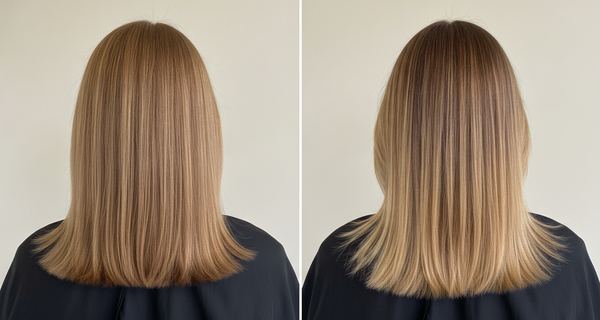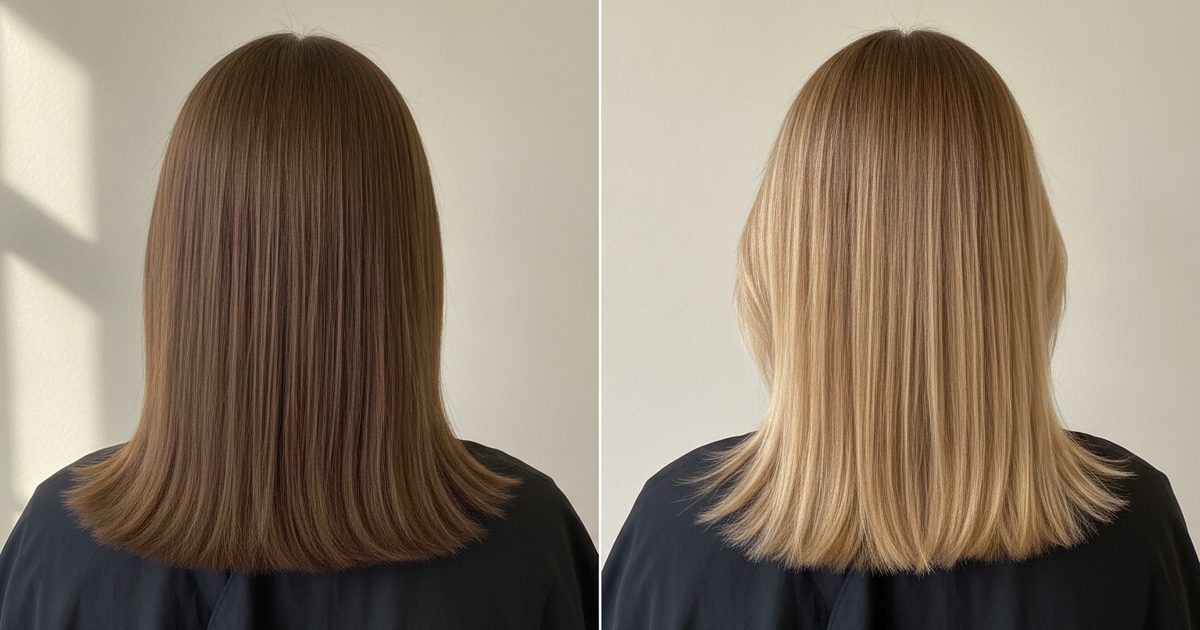
Ten minutes in, the nape piece wiped back to orange-red, the pigment under a level 5, light brown. At 20 it was plain orange, the last inch going yellow-orange. Two stages in twenty minutes inside a foil is a virgin 5 lifting on schedule, and it settled the day: foils, 30 vol (9%), 30 to 45 minutes, a toner picked after the rinse.
Still orange-red at 20 would have meant old color the history missed, or a coarse head whose day ends at a warm 7, a 7.12, and a second visit for the 8.
How many levels can balayage lift a light brown?
Three, in foils: a virgin 5 on 30 vol comes out a warm 7 to 8, sometimes 8 to 9. Open air on the same powder gives a couple of levels, maybe a few, so an 8 through the ends in one visit is a foil job. Thirty vol is the everyday balayage developer because the paste never touches the scalp.
Is foilyage the same thing as balayage?
It is the same painting with a foil folded over each piece. The foil holds the warmth of the head and keeps the paste moist, so the piece lifts faster and lighter than in open air, which is why a light brown that wants a real level 8 in one visit goes into foils. Painted pieces often go into foils and are still called balayage. The root is teased first so the top has no hard line.
Thick mix, teased root, foil on top
A bowl of 30 g powder, roughly an ounce, with 30 to 45 g of 30 vol and a bond builder at its own dose, whisked thick enough to hold its edge, since a runny mix bleeds. Sections run diagonal-back so each painted piece falls over an unpainted one, nape first. Every section is teased from mid-shaft up before any paste goes on. Paint starts at the mids: opaque icing through the ends, feathered up into the tease with less product and less pressure, never pressed through. Hairline and baby hairs go last, finest sections, least product, since they lift fastest and snap first. Then the foil, folded over.
From the first look to the rinse
One timer, set when the last foil is in, and the foil you open is the first one you painted.
| Minute | The wiped piece | What to do |
|---|---|---|
| 10 | Orange-red, the pigment beneath a 5 | Fold it back |
| 20 | Orange, ends turning yellow-orange | Some step the front bowl to 35 if the nape leads |
| 30 | Yellow-orange mids, yellow ends | Earliest rinse for the first foils. Wipe, dry, read |
| 40 | Yellow, orange still near the top of each piece | Rinse in painting order |
| 45 | Whatever it reads | The ceiling. Longer only damages |
Under the paste a piece reads whiter than it rinses, and wet it reads a level darker, so read a wiped piece dried between two fingers, then check how many foil minutes this texture wants.
Why does balayage on light brown hair go orange?
Because orange-red sits under a level 5, and any piece rinsed before it reaches yellow is rinsed on orange. Open air stops a level or two short of an 8, and a foil rinsed early comes out more orange than it looked under the paste. A toner cancels warmth at the level the hair reached and does nothing for orange at a 6, so orange at the rinse means a 7.12 today or the foils again another day.
Toned where it landed, and the months after
Shampoo, condition, towel-dry, then two formulas at the bowl: a 6N or a 7N tapped where each lifted piece begins, an inch down, and an 8.2 (8V) with a little 8.1 (8A) through the lengths, violet-blue for the yellow and trace of orange an 8 shows. Ten vol or the line’s toning developer, 5 to 10 minutes, ends last because they grab. The demi that finishes a lifted 8 is that bowl. Most tap a root shadow so the grow-out has no line, and a few leave it out because the next lightener has to lift through that deposit and bands there. Better to send a first visit home a clean warm 8 than chase a 9, which is usually a second round and the 5 to 9 version. The next lightener is 3 to 8 months out, on the regrowth and the dark pieces only.