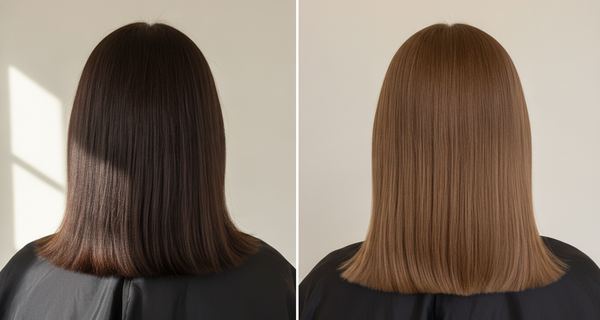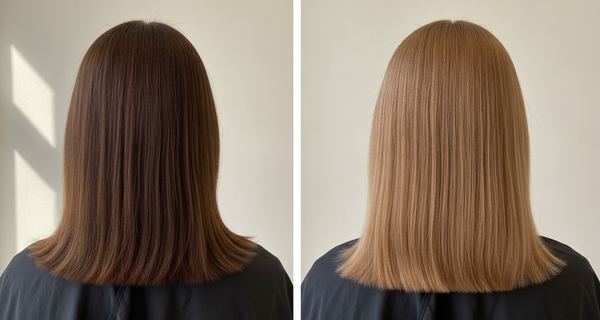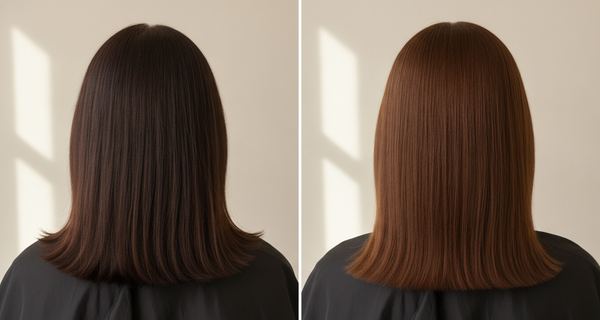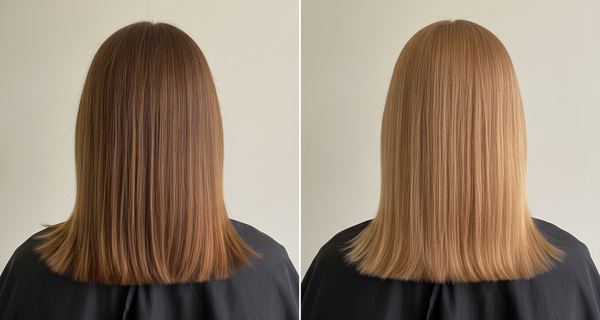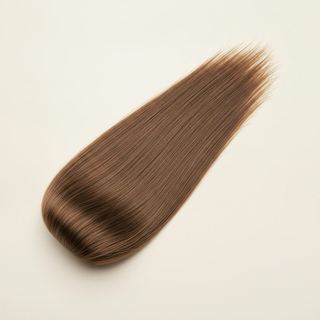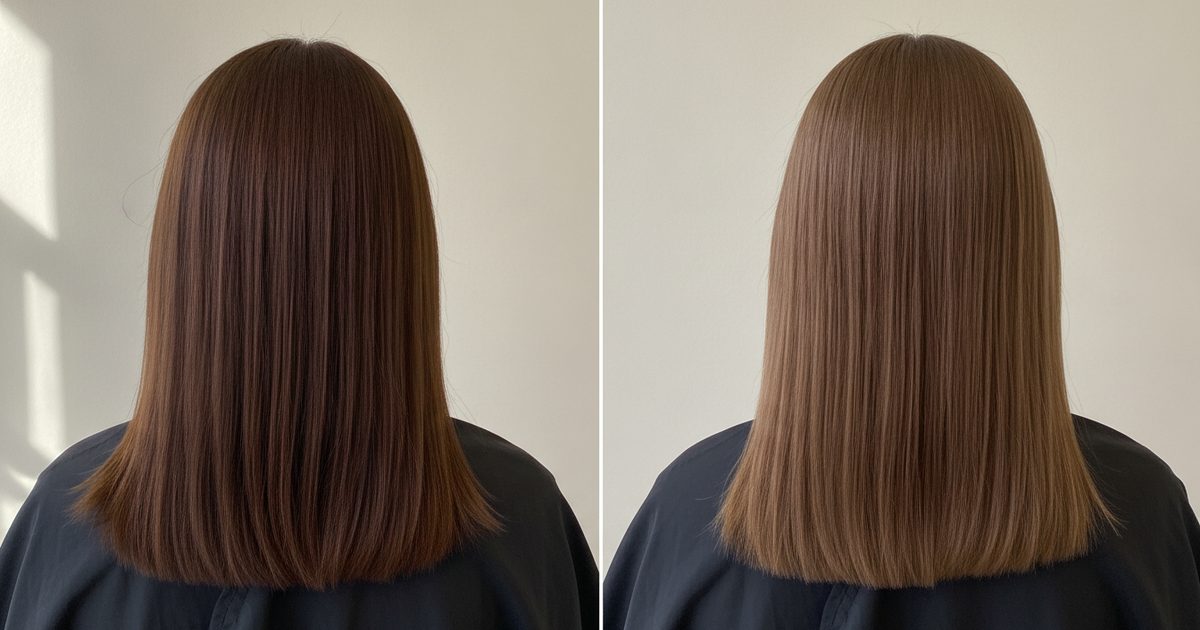
Start at the front. On a head with white at the hairline, the front is what she sees in the mirror, and it is the hair that takes the longest to cover, so it gets the color first and the last look before the rinse. The pigmented hair through the back will lift on schedule whatever order you paint it in, and the white will not lift at all, so the only thing the order can cost you is coverage at the front.
What a natural 4 with white does under 20 vol
Two different hairs are on this head. The pigmented hair is a natural level 4, medium brown, and one level of lift from it brings up the red-orange underneath, which the natural and gold families sit on comfortably. The white has no pigment to lift and a cuticle that does not want to open, so the 20 vol (6 percent) only opens it for the deposit and the 5 goes on at full depth. Ten vol would blend that white, and 20 covers it, which is why 20 vol is the gray developer on every line. On a level 5 both hairs end up close together.
How much natural, and the ash question
Coverage is built from the natural series. A fashion shade alone on white gives shine with nothing under it, so a 5.3 by itself holds to about 25 percent white and goes see-through past that. The share of 5N follows the percentage, and our ladder is a safe starting point that leans heavy on purpose, because a see-through hairline at the second shampoo brings her back.
| White at the front | Natural share (ours) | In 60 g at level 5 | Wella’s guidance |
|---|---|---|---|
| Up to 25 percent | 1/4 N | 15 g 5N + 45 g 5.3 | Target shade alone under 30 |
| 30 to 50 percent | 1/2 N | 30 g 5N + 30 g 5.3 | A third natural |
| 55 to 75 percent | 3/4 N | 45 g 5N + 15 g 5.3 | Half natural |
| 80 to 100 percent | All N, 5NN if resistant | 60 g 5N, gold as a demi toner after | Half natural and half target |
A 35 percent hairline gets three quarters 5N in my bowl, above both columns. The gray coverage calculator does the grams from whichever column you trust.
If she wants it cooler, a little 5.1 (a 5A on letter lines) can go in with the 5N. The pro lines mix ash into their naturals on purpose, and an ash shade with a natural base under it covers fine. The thing that goes green and dull at the hairline is ash on its own over white, with no natural in the bowl to hold it. Ash also reads darker, so tell her the cool version will look a touch deeper than the warm one.
The order, and 35 minutes
Sixty grams of color to sixty of 20 vol, equal parts, an ounce and an ounce if you measure that way, mixed fresh in a plastic bowl and used now. Dry hair, thin sections, saturation on every white strand top and underneath, because a white hair that got a thin coat stays white. Front hairline and part line first, roots only. Then mid-lengths and ends. Then the roots through the back last, since the scalp is warm and pigmented roots lift fastest. If you use barrier cream, keep it off the white baby hairs at the hairline, or the color will not get through.
One timer when the last section is on, and a cap over it to hold the scalp warmth. From 30 wipe a hairline strand clean and look at it. Translucent means the white needs more time, five minutes at a stretch to 45. Opaque means rinse at 35. Read the directions on your line too, since every line sets its own time for gray, and more is not more once the white is covered.
The retouch, and the other road
The white shows first, at the front, at about four weeks. The level line, a 4 under a 5, is soft enough that most people see the white before it. Book her at five. The retouch is the same bowl on the regrowth only, 20 vol, 35 minutes, hairline first again, with a demi 5N and a little 5.3 on 10 vol through the lengths for the last five minutes. Do not run the permanent through the lengths every visit. They are colored now, and if she ever asks for lighter than a 5 they will need a remover or a lightener while the regrowth alone takes the 4 to 6 formula.
And if the line at four weeks bothers her more than the white did, the other road is a blend: a demi at her level on 10 vol, or lowlights through the white, which takes the edge off the gray without covering it and grows out soft over eight to ten weeks. Solid permanent coverage is the right service for a client who wants the white gone. It is the wrong one for a client who only wanted it quieter.